Q11Written answer
In algebra, letters may stand for
(A) known quantities (B) unknown quantities
(C) fixed numbers (D) none of these
Show solutionHide solution
Worked solution
Solution:-
(B) Unknown quantities
Your cart is empty.
Practice each question, then open the answer or worked solution.
In algebra, letters may stand for
(A) known quantities (B) unknown quantities
(C) fixed numbers (D) none of these
Solution:-
(B) Unknown quantities
“Variable” means that it
(A) can take different values (B) has a fixed value
(C) can take only 2 values (D) can take only three values
Solution:-
(A) Can take different values
The word ‘variable’ means something that can vary, i.e., change. The value of a variable is not fixed. We use a variable to represent a number and denote it by any letter such as l, m, n, p, x, y, z etc.
10 – x means
(A) 10 is subtracted x times (B) x is subtracted 10 times
(C) x is subtracted from 10 (D) 10 is subtracted from x
Solution:-
(C) x is subtracted from 10
Savitri has a sum of Rs x. She spent Rs 1000 on groceries, Rs 500 on clothes and Rs 400 on education, and received Rs 200 as a gift. How much money (in Rs) is left with her?
(A) x – 1700 (B) x – 1900 (C) x + 200 (D) x – 2100
Solution:-
(A) x – 1700
From the question it is given that,
Savitri has a sum of Rs x
She spent money on groceries = ₹ 1000
She spent money on clothes = ₹ 500
She spent money on education = ₹ 400
She received gift = ₹ 200
Total money spent by Savitri = 1000 + 500 + 400 = ₹ 1900
Then,
Total money left with her after deducting = ₹ (x – 1900)
Therefore, money left with her after adding gift money = (x – 1900) + 200
= x – 1700
The perimeter of the triangle shown in Fig. 7.1 is
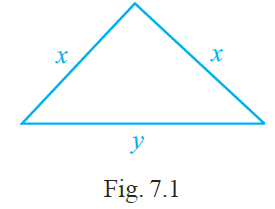
(A) 2x + y (B) x + 2y (C) x + y (D) 2x – y
Solution:-
(A) 2x + y
Given triangle is an isosceles triangle,
So, perimeter of an isosceles triangle = 2 × x + y
= 2x + y
The area of a square having each side x is
(A) x × x (B) 4x (C) x + x (D) 4 + x
Solution:-
(A) x × x
We know that, area of square = side × side
Given, square having a side x.
So, area of a square = x × x
= x2
The expression obtained when x is multiplied by 2 and then subtracted from 3 is
(A) 2x – 3 (B) 2x + 3 (C) 3 – 2x (D) 3x – 2
Solution:-
(C) 3 – 2x
From the question it is given that,
X is multiplied by 2 = x × 2 = 2x
Then, x is multiplied by 2 and then subtracted from 3 = 3 – 2x
q/2 = 3 has a solution
(A) 6 (B) 8 (C) 3 (D) 2
Solution:-
(A) 6
Consider the given equation q/2 = 3
By cross multiplication we get, q = 6
x – 4 = – 2 has a solution
(A) 6 (B) 2 (C) – 6 (D) – 2
Solution:-
(B) 2
Consider the given equation x – 4 = -2
Transform – 4 from left hand side to right hand side it becomes 4.
x = – 2 + 4
x = 2
4/2 = 2 denotes a
(A) numerical equation (B) algebraic expression
(C) equation with a variable (D) false statement
Solution:-
(A) numerical equation
4/2 = 2
By cross multiplication we get,
4 = 4