If the sum of two angles is greater than 180°, then which of the following is not possible for the two angles?
Show solutionHide solution
Solution: –
(D) Two right angles.
Because the sum of all angles of right angles must be equal to 180o.
Your cart is empty.
Practice each question, then open the answer or worked solution.
If the sum of two angles is greater than 180°, then which of the following is not possible for the two angles?
Solution: –
(D) Two right angles.
Because the sum of all angles of right angles must be equal to 180o.
If the sum of two angles is equal to an obtuse angle, then which of the following is not possible?
Solution:-
(D) Two right angles.
Because, the sum of all angles of right angles must be equal to 180o.
The right-angle triangle does not contain an obtuse angle.
An obtuse angle is defined as an angle formed greater than 90o and less than 180o.
A polygon has prime number of sides. Its number of sides is equal to the sum of the two least consecutive primes. The number of diagonals of the polygon is
(A) 4 (B) 5 (C) 7 (D) 10
Solution:-
(B) 5
The two least consecutive prime numbers are 2 and 3
Sum of two numbers = 2 + 3 = 5
By using formula = n(n – 3)/2
= 5(5 – 3)/2
= (5 × 2)/2
= 10/2
= 5
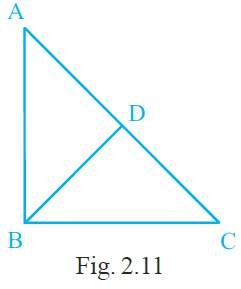
In Fig. 2.11, AB = BC and AD = BD = DC. The number of isosceles triangles in the figure is
(A) 1 (B) 2 (C) 3 (D) 4

Solution:-
(C) 3
From the figure, ΔABC, ΔABD and ΔCBD are isosceles triangles.
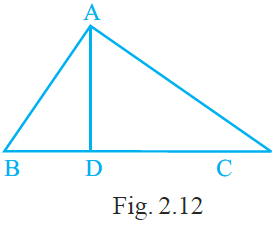
In Fig. 2.12, ∠BAC = 90° and AD ⊥ BC. The number of right triangles in the figure is
(A) 1 (B) 2 (C) 3 (D) 4

Solution:-
(C) 3
From the figure, ΔABC, ΔABD and ΔADC are right triangles.
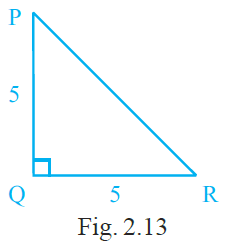
In Fig. 2.13, PQ ⊥ RQ, PQ = 5 cm and QR = 5 cm. Then ∆ PQR is
(A) a right triangle but not isosceles
(B) an isosceles right triangle
(C) isosceles but not a right triangle
(D) neither isosceles nor right triangle

Solution:-
(B) an isosceles right triangle
From the question, it is given that, PQ ⊥ RQ, PQ = 5 cm and QR = 5 cm.
We know that, an isosceles triangle has two equal sides.
Therefore, the given ΔPQR is an isosceles right triangle.
In questions 17 to 31, fill in the blanks to make the statements true:
An angle greater than 180° and less than a complete angle is called _______.
Solution:-
An angle greater than 180° and less than a complete angle is called a reflex angle.
The number of diagonals in a hexagon is ________.
Solution:-
The number of diagonals in a hexagon is 9.
We know that a hexagon has 6 sides.
By using the formula, number of diagonals = n(n – 3)/2
= 6(6 – 3)/2
= 6(3)/2
= 18/2
= 9
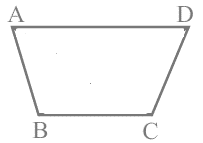
A pair of opposite sides of a trapezium are ________.
Solution:-
A pair of opposite sides of a trapezium are parallel.

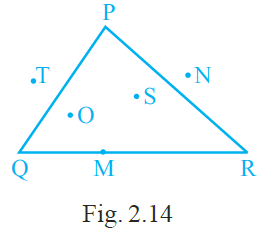
In Fig. 2.14, points lying in the interior of the triangle PQR are ______, that in the exterior are ______, and that on the triangle itself are ______.

Solution:-
In Fig. 2.14, points lying in the interior of the triangle PQR are O and S, that in the exterior are N and T and that on the triangle itself are M, P, Q and R.