Which of the following numbers in Roman numerals is incorrect?
(A) LXXX (B) LXX (C) LX (D) LLX
Show solutionHide solution
Solution:-
(D) LLX
As we know that, the symbol L can never be repeated.
Therefore, LLX is incorrect.
Your cart is empty.
Practice each question, then open the answer or worked solution.
Which of the following numbers in Roman numerals is incorrect?
(A) LXXX (B) LXX (C) LX (D) LLX
Solution:-
(D) LLX
As we know that, the symbol L can never be repeated.
Therefore, LLX is incorrect.
The largest 5-digit number having three different digits is
(A) 98978 (B) 99897 (C) 99987 (D) 98799
Solution:-
(C) 99987
In the given, options there are three numbers used 9, 8 and 7
To get the largest of 5- digit we have to arrange the numbers in descending order.
Then, from the given options 99987 is the largest of 5 – digit number.
The smallest 4-digit number having three different digits is
(A) 1102 (B) 1012 (C) 1020 (D) 1002
Solution:-
In the given, options there are three numbers used 0, 1 and 2
To get the largest of 4- digit we have to arrange the numbers in ascending order.
Then, from the given options 1002 is the smallest of 4 – digit number.
Number of whole numbers between 38 and 68 is
(A) 31 (B) 30 (C) 29 (D) 28
Solution:-
(c) 29
Number of whole numbers between 38 and 68 is 29.
The product of successor and predecessor of 999 is
(A) 999000 (B) 998000 (C) 989000 (D) 1998
Solution:-
(B) 998000
The number which comes immediately before a particular number is called its predecessor.
The successor of a whole number is the number obtained by adding 1 to it.
So, Successor of 999 = 999 + 1 = 1000
Predecessor = 999 – 1 = 998
Then, product of successor and predecessor of 999 is = 1000 × 998
= 998000
The product of a non-zero whole number and its successor is always
(A) an even number (B) an odd number
(C) a prime number (D) divisible by 3
Solution:-
(A) an even number
The product of a non-zero whole number and its successor is always an even number.
For example: – 4 × 5 = 20, 7 × 8 = 56
A whole number is added to 25 and the same number is subtracted from 25. The sum of the resulting numbers is
(A) 0 (B) 25 (C) 50 (D) 75
Solution:-
(C) 50
Let us assume the number be x.
From the question it is given that, number is added to 25 = x + 25
The same number is subtracted to from 25 = 25 – x
Then, the sum of the resulting numbers is = (x + 25) + (25 – x)
= x + 25 + 25 – x
= 50 + x – x
= 50 + 0
= 50
Which of the following is not true?
Solution:-
(C) 7 + 8 × 9 = (7 + 8) × (7 + 9)
Consider the left hand side = 7 + 8 × 9
= 7 + (8 × 9)
= 7 + 72
= 79
Now, consider the right hand side = (7 + 8) × (7 + 9)
= 15 × 16
= 240
By comparing LHS and RHS
LHS ≠ RHS
79 ≠ 240
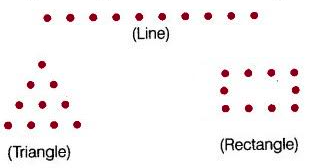
By using dot (.) patterns, which of the following numbers can be arranged in all the three ways namely a line, a triangle and a rectangle?
(A) 9 (B) 10 (C) 11 (D) 12
Solution:-
(B) 10

Which of the following statements is not true?
Solution:-
(B) Zero is the identity for multiplication of whole numbers.
Example:- 1 × 0 = 0