Q11Written answer
Show solutionHide solution
Worked solution
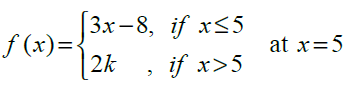
Finding the left hand and right hand limits for the given function, we have
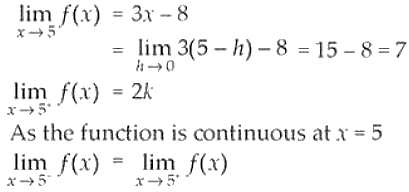
So,
7 = 2k
k = 7/2 = 3.5
Therefore, the value of k is 3.5
Your cart is empty.
Practice each question, then open the answer or worked solution.
Finding the left hand and right hand limits for the given function, we have
So,
7 = 2k
k = 7/2 = 3.5
Therefore, the value of k is 3.5
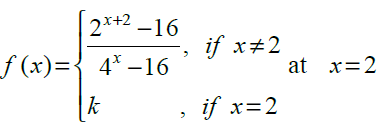
The given function f(x) can be rewritten as,
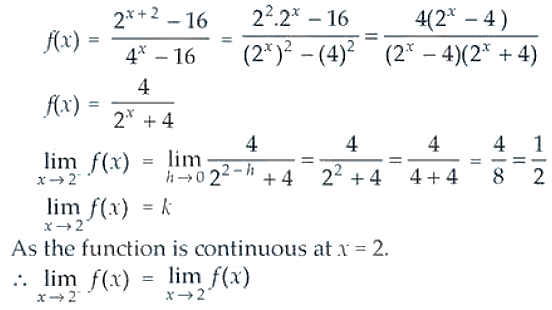
So, k = ½
Therefore, the value of k is ½
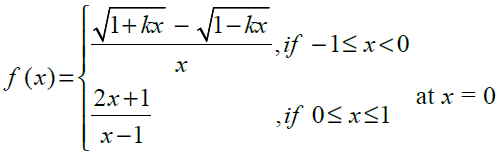
Finding the left hand and right hand limits for the given function, we have
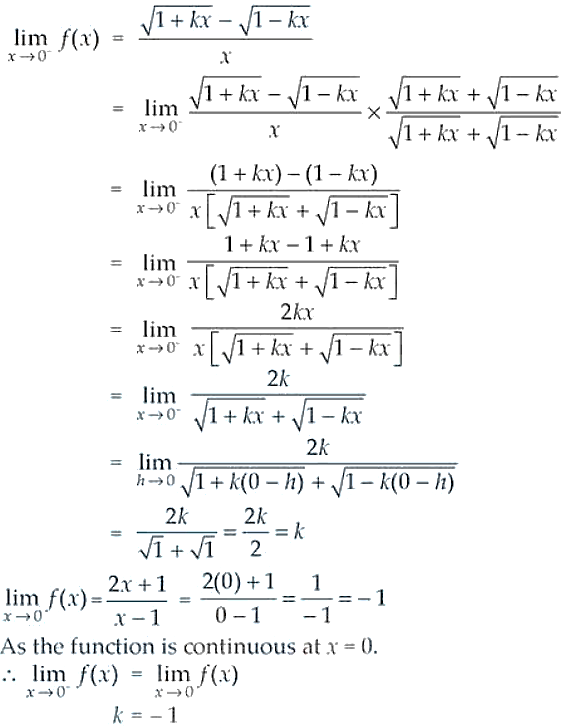
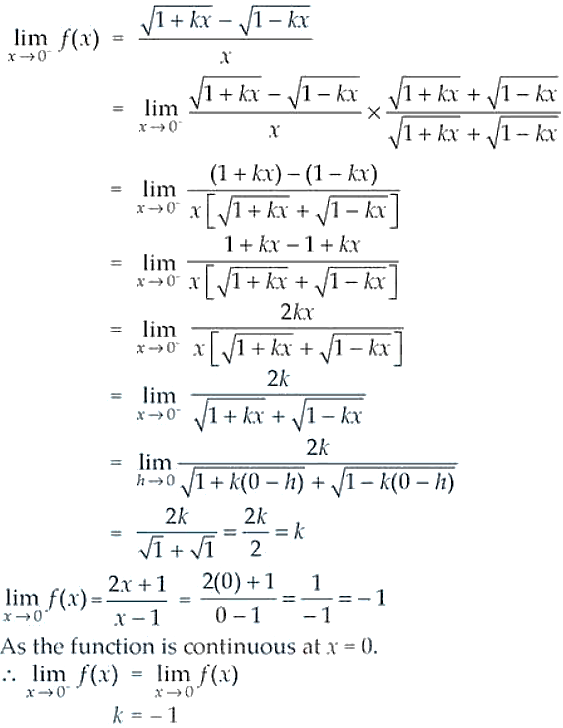
Therefore, the value of k is -1
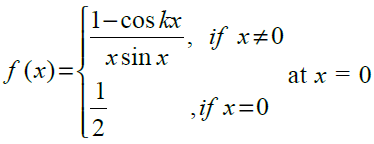
Finding the left hand and right hand limits for the given function, we have
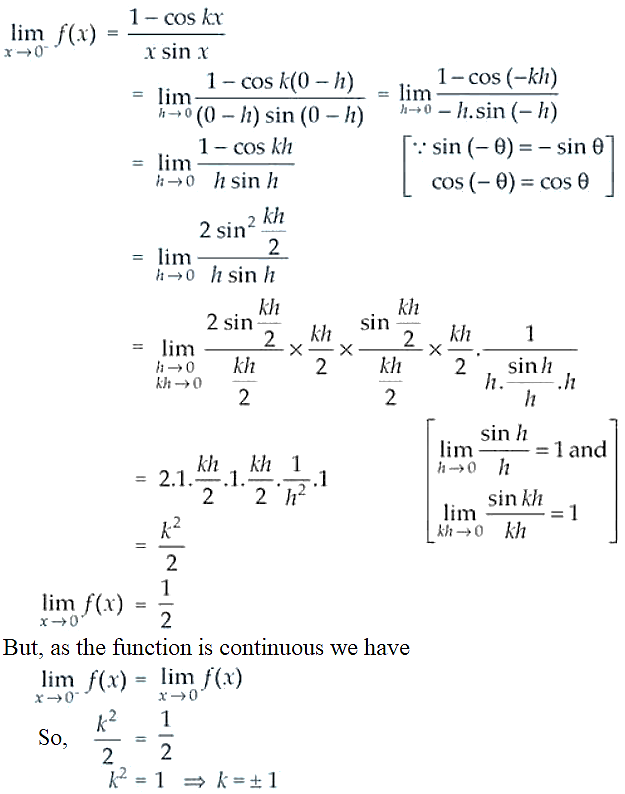
Therefore, the value of k is ± 1
Prove that the function f defined by
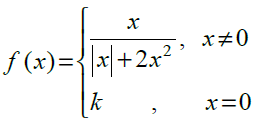
remains discontinuous at x = 0, regardless the choice of k.
Finding the left hand and right hand limit for the given function, we have
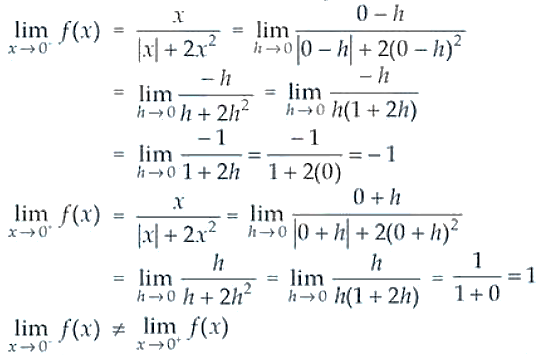
Now, as the left hand limit and the right hand limit are not equal and the value of both the limits are constant.
Hence, regardless the choice of k, the given function remains discontinuous at x = 0.
Find the values of a and b such that the function f defined by
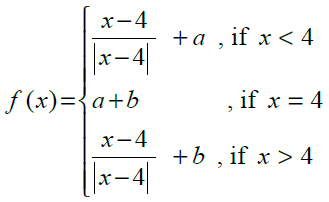
is a continuous function at x = 4.
Finding the left hand and right hand limit for the given function, we have
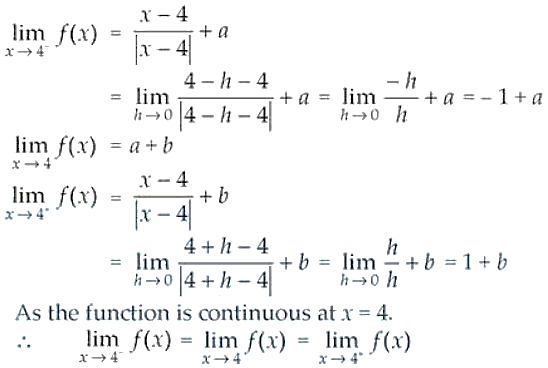
So, -1 + a = a + b = 1 + b
-1 + a = a + b and 1 + b = a + b
We get, b = -1 and 1 + -1 = a + -1 ⇒ a = 1
Therefore, the value of a = 1 and b = -1
Given the function f (x) = 1/(x + 2) . Find the points of discontinuity of the composite function
y = f (f (x)).
Given,
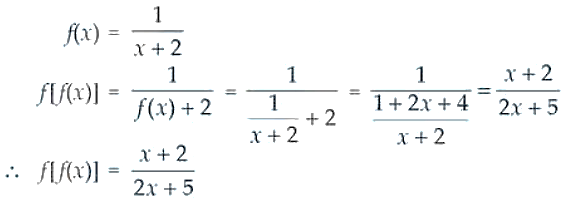
Now, the function will not be defined and continuous where
2x + 5 = 0 ⇒ x = -5/2
Therefore, x = -5/2 is the point of discontinuity.
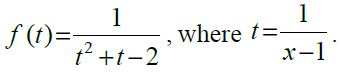
Find all points of discontinuity of the function
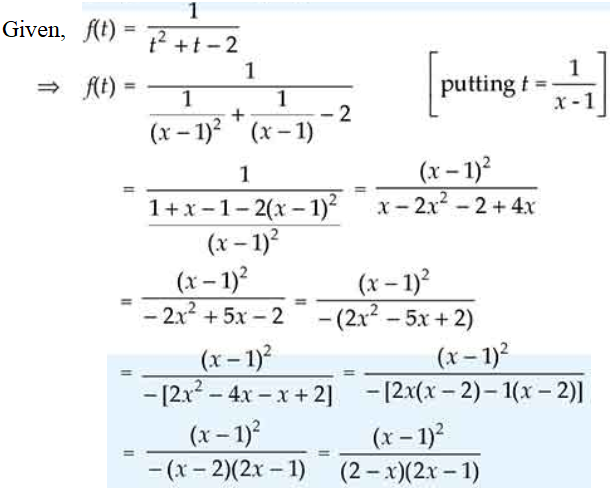
Now,
if f(t) is discontinuous, then 2 – x = 0 ⇒ x = 2
And, 2x – 1 = 0 ⇒ x = ½
Therefore, the required points of discontinuity for the given function are 2 and ½.
Show that the function f (x) = |sin x + cos x| is continuous at x = p. Examine the differentiability of f, where f is defined by
Given,
f(x) = |sin x + cos x| at x = π
Now, put g(x) = sin x + cos x and h(x) = |x|
Hence, h[g(x)] = h(sin x + cos x) = |sin x + cos x|
Now,
g(x) = sin x + cos x is a continuous function since sin x and cos x are two continuous functions at x = π.
We know that, every modulus function is a common function is a continuous function everywhere.
Therefore, f(x) = |sin x + cos x| is continuous function at x = π.
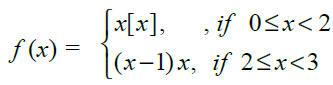 at x = 2.
We know that, a function f is differentiable at a point ‘a’ in its domain if
Lf’(c) = Rf’(c)
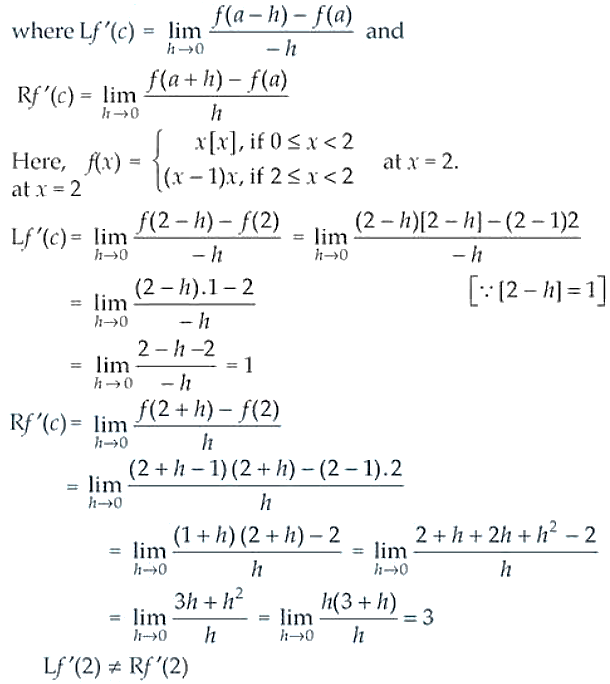
Therefore, f(x) is not differentiable at x = 2.