Q20Written answer
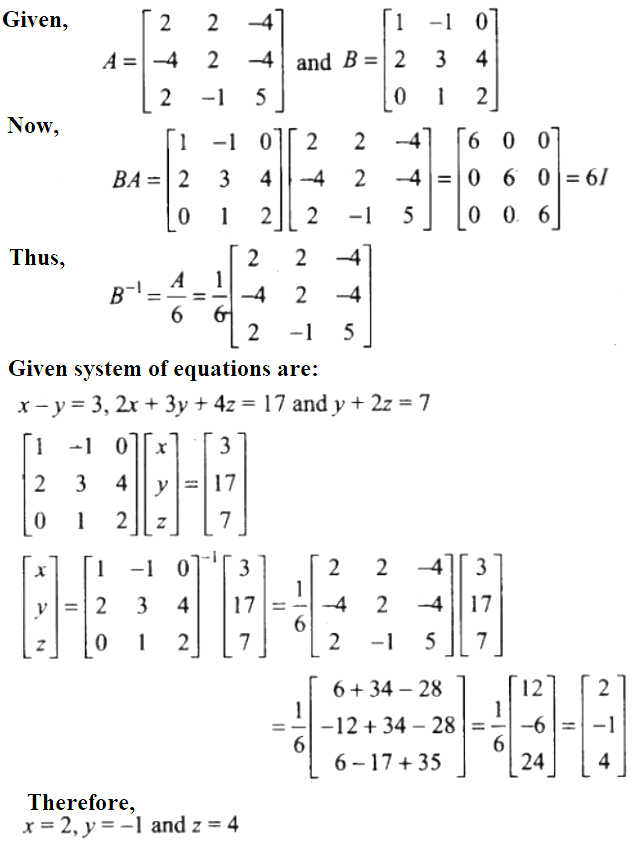
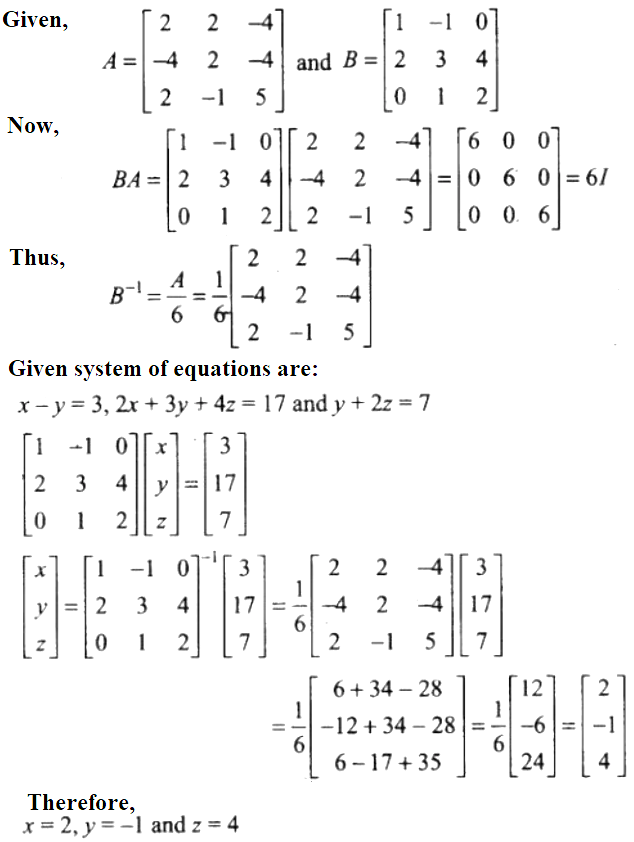
Given find BA and use this to solve the system of
equations y + 2z = 7, x – y = 3, 2x + 3y + 4z = 17.
Show solutionHide solution
Worked solution
Your cart is empty.
Practice each question, then open the answer or worked solution.
Given find BA and use this to solve the system of
equations y + 2z = 7, x – y = 3, 2x + 3y + 4z = 17.
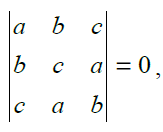
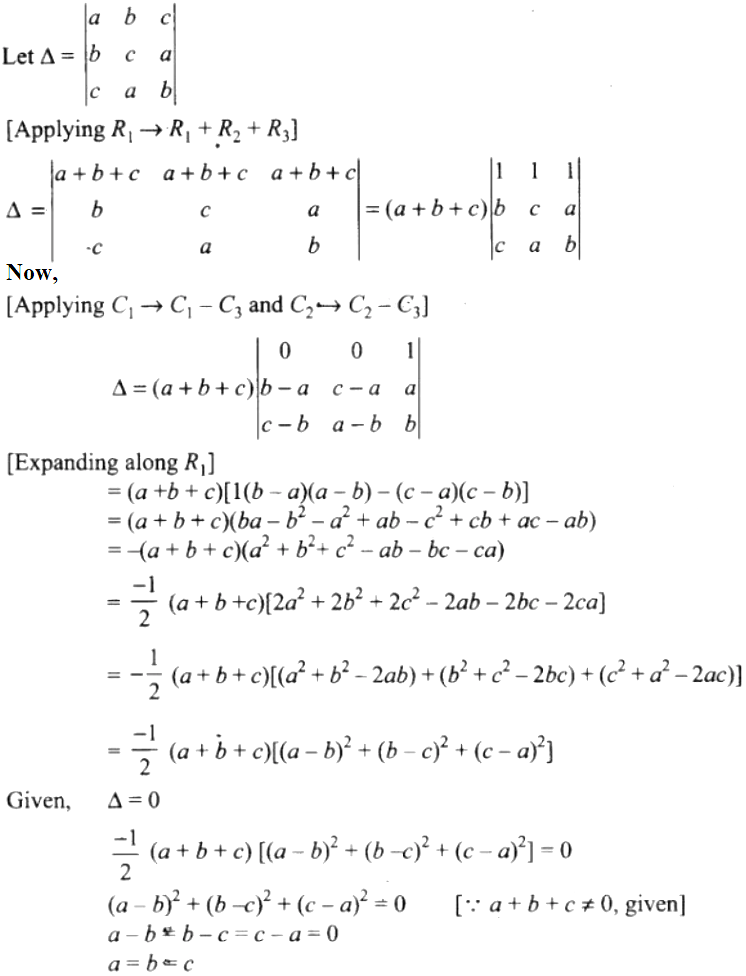
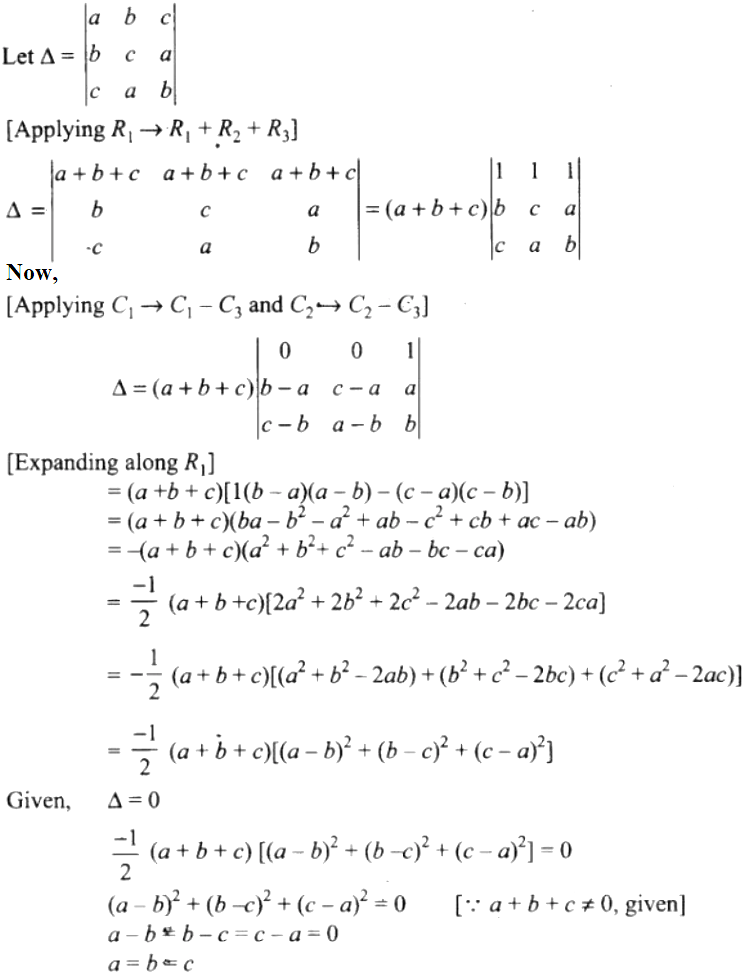
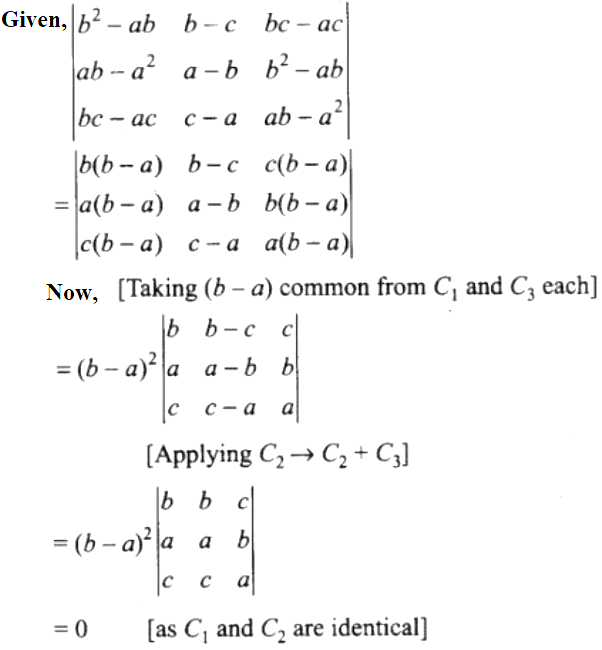
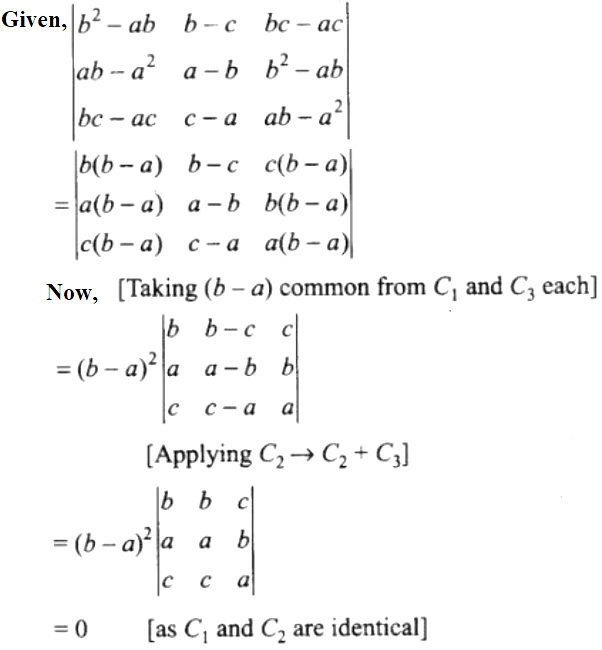
If a + b + c ¹ 0 and then prove that a = b = c.
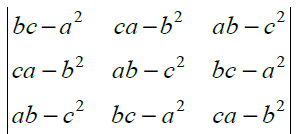
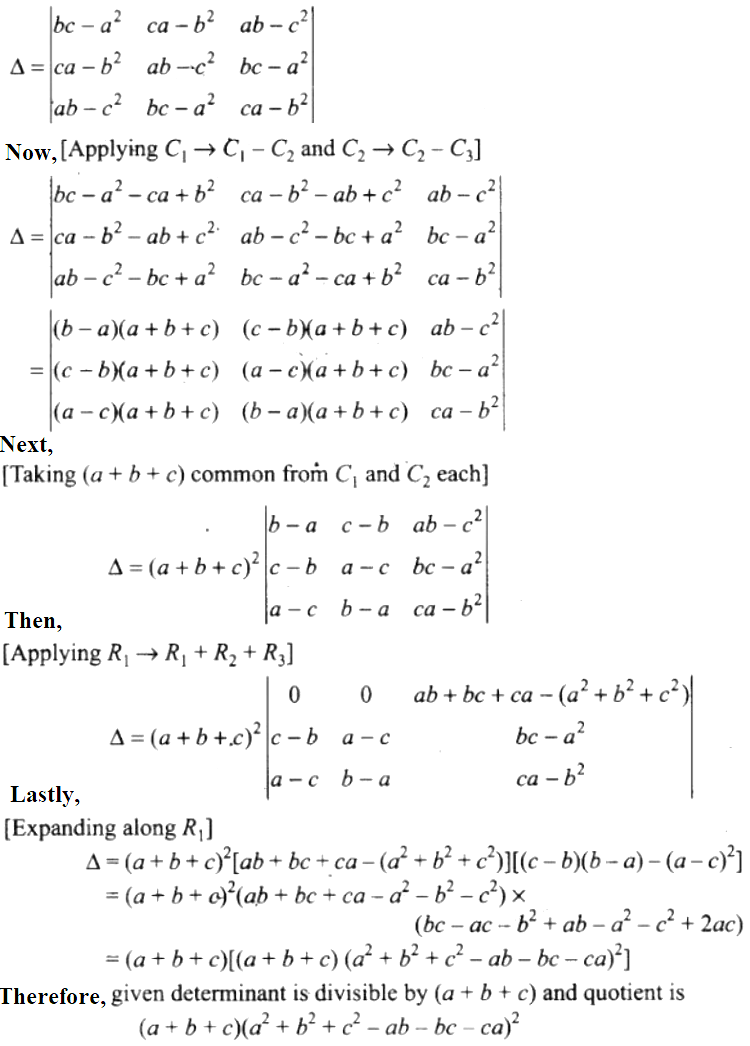
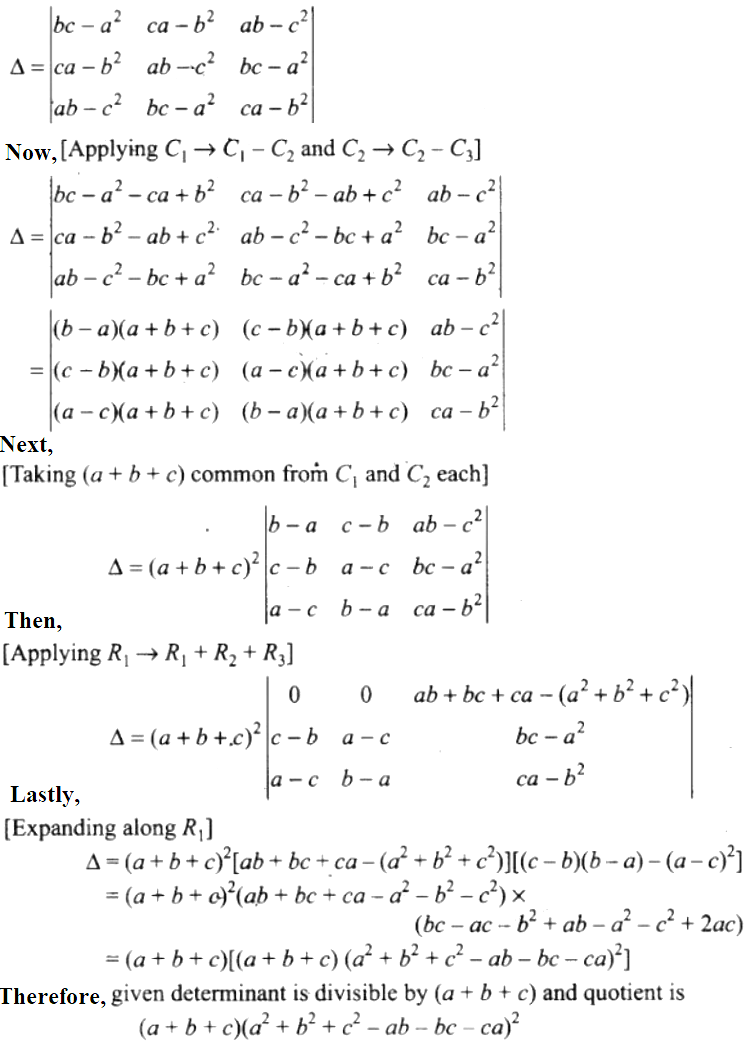
Prove that is divisible by a + b + c and find the quotient.
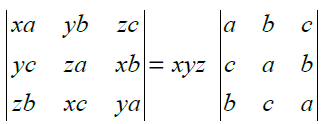
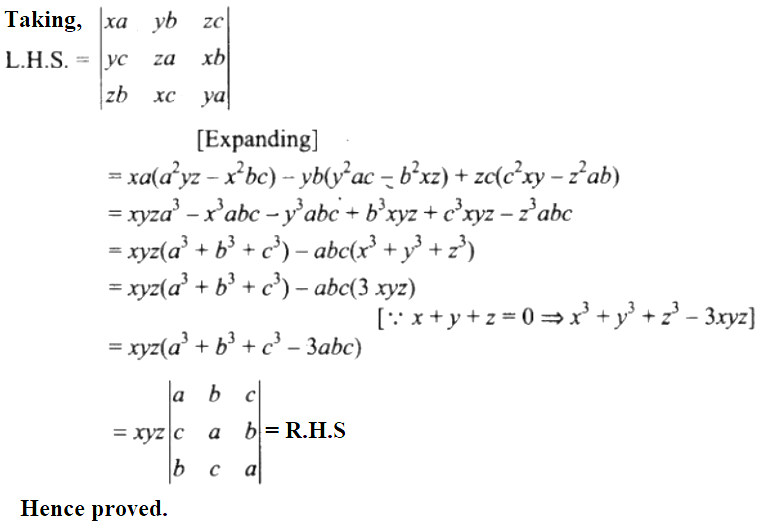
If x + y + z = 0, prove that
Objective Type Questions (M.C.Q.)
Choose the correct answer from given four options in each of the Exercises from 24 to 37.
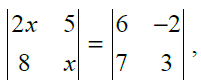
If then, value of x is
(A) 3 (B) ± 3 (C) ± 6 (D) 6
Option (C) ± 6
From the given,
On equating the determinants, we have
2x2 – 40 = 18 + 14
2x2 = 72
x2 = 36
Thus, x = ± 6
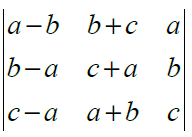
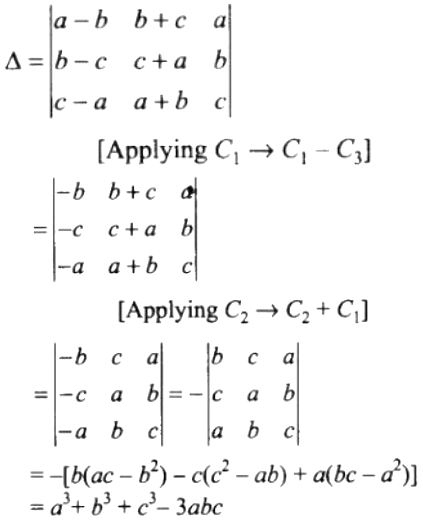
The value of determinant
(A) a3 + b3 + c3 (B) 3 bc (C) a3 + b3 + c3 – 3abc (D) none of these
Option (C) a3 + b3 + c3 – 3abc
Given,
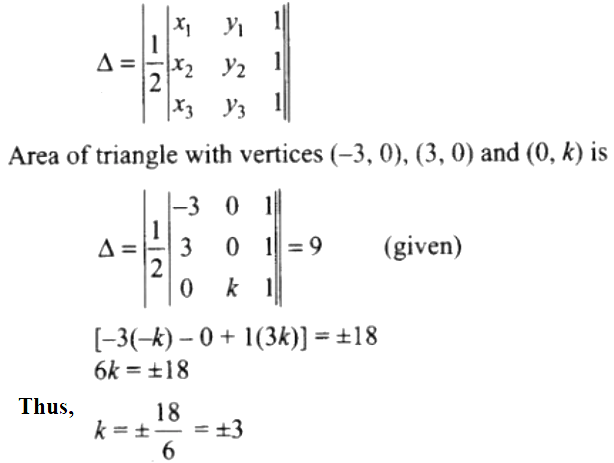
The area of a triangle with vertices (–3, 0), (3, 0) and (0, k) is 9 sq. units. The value of k will be
(A) 9 (B) 3 (C) – 9 (D) 6
Option (B) 3
We know that, the area of a triangle with vertices (x1, y1), (x2, y2) and (x3, y3) is given by
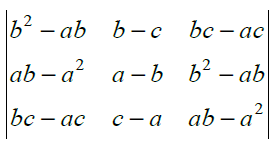
The determinant equals
(A) abc (b–c) (c – a) (a – b) (B) (b–c) (c – a) (a – b)
(C) (a + b + c) (b – c) (c – a) (a – b) (D) None of these
Option (D)
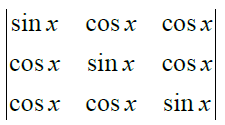
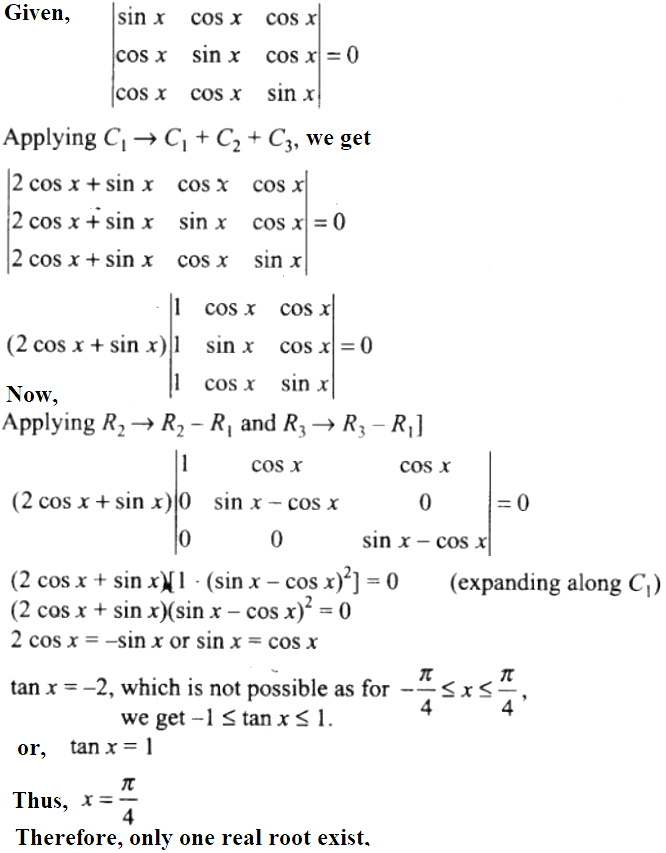
The number of distinct real roots of = 0 in the interval -π/4 ≤ x ≤ π/4 is
(A) 0 (B) 2 (C) 1 (D) 3
Option (C) 1
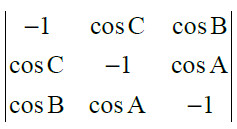
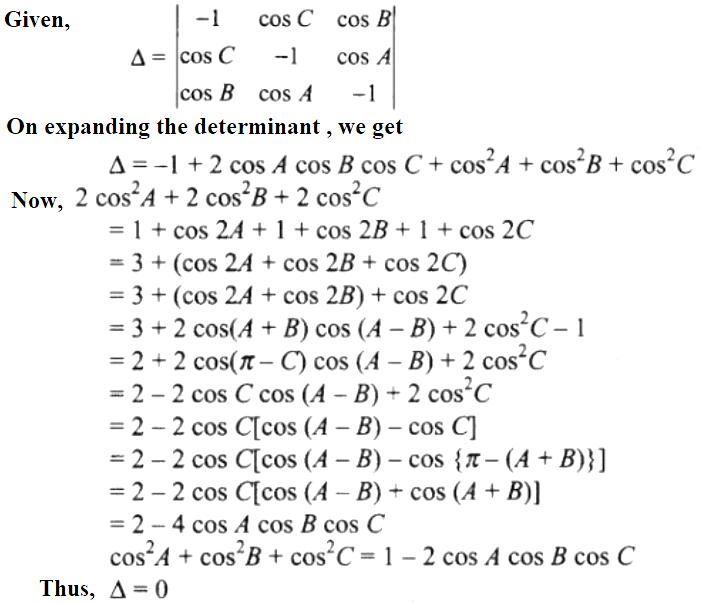
If A, B and C are angles of a triangle, then the determinant is equal to
(A) 0 (B) -1 (C) 1 (D) None of these
Option (A) 0