My Cart
Your Cart 0

    Your cart is empty.

  • Total (Amount) ₹0.00
NCERT Exemplar · Class 12 · Maths

Chapter 1: Relations and Functions

Practice each question, then open the answer or worked solution.

Questions

31 questions
Q11Written answer

Let the function f: R → R be defined by f (x) = cos x, ∀ x ∈ R. Show that f is neither one-one nor onto.

Show solutionHide solution
Worked solution

We have,

f: R → R, f(x) = cos x

Now,

f (x1) = f (x2)

cos x1 = cos x2

x1 = 2nπ ± x2, n ∈ Z

It’s seen that the above equation has infinite solutions for x1 and x2

Hence, f(x) is many one function.

Also the range of cos x is [-1, 1], which is subset of given co-domain R.

Therefore, the given function is not onto.
Q12Written answer

Let X = {1, 2, 3} and Y = {4, 5}. Find whether the following subsets of X × Y are functions from X to Y or not.

(i) f = {(1, 4), (1, 5), (2, 4), (3, 5)} (ii) g = {(1, 4), (2, 4), (3, 4)}

(iii) h = {(1,4), (2, 5), (3, 5)} (iv) k = {(1,4), (2, 5)}.

Show solutionHide solution
Worked solution

Given, X = {1, 2, 3} and Y = {4, 5}

So, X × Y = {(1, 4), (1, 5), (2, 4), (2, 5), (3, 4), (3, 5)}

(i) f = {(1, 4), (1, 5), (2, 4), (3, 5)}

f is not a function as f(1) = 4 and f(1) = 5

Hence, pre-image ‘1’ has not unique image.

(ii) g = {(1, 4), (2, 4), (3, 4)}

It’s seen clearly that g is a function in which each element of the domain has unique image.

(iii) h = {(1,4), (2, 5), (3, 5)}

It’s seen clearly that h is a function as each pre-image with a unique image.

And, function h is many-one as h(2) = h(3) = 5

(iv) k = {(1, 4),(2, 5)}

Function k is not a function as ‘3’ has not any image under the mapping.

Q13Written answer

If functions f: A → B and g: B → A satisfy g o f = IA, then show that f is one-one and g is onto.

Show solutionHide solution
Worked solution

Given,

f: A → B and g: B → A satisfy g o f = IA

It’s clearly seen that function ‘g’ is inverse of ‘f’.

So, ‘f’ has to be one-one and onto.

Hence, ‘g’ is also one-one and onto.

Q14Written answer

Let f: R → R be the function defined by f(x) = 1/(2 – cos x) ∀ x ∈ R. Then, find the range of f.

Show solutionHide solution
Worked solution

Given,

f(x) = 1/(2 – cos x) ∀ x ∈ R

Let y = 1/(2 – cos x)

2y – ycos x = 1

cos x = (2y – 1)/ y

cos x = 2 – 1/y

Now, we know that -1 ≤ cos x ≤ 1

So,

-1 ≤ 2 – 1/y ≤ 1

-3 ≤ – 1/y ≤ -1

1 ≤ – 1/y ≤ 3

1/3 ≤ y ≤ 1

Thus, the range of the given function is [1/3, 1].

Q15Written answer

Let n be a fixed positive integer. Define a relation R in Z as follows: ∀ a, b ∈ Z, aRb if and only if a – b is divisible by n. Show that R is an equivalance relation.

Show solutionHide solution
Worked solution

Given ∀ a, b ∈ Z, aRb if and only if a – b is divisible by n.

Now, for

aRa ⇒ (a – a) is divisible by n, which is true for any integer a as ‘0’ is divisible by n.

Thus, R is reflective.

Now, aRb

So, (a – b) is divisible by n.

⇒ – (b – a) is divisible by n.

⇒ (b – a) is divisible by n

⇒ bRa

Thus, R is symmetric.

Let aRb and bRc

Then, (a – b) is divisible by n and (b – c) is divisible by n.

So, (a – b) + (b – c) is divisible by n.

⇒ (a – c) is divisible by n.

⇒ aRc

Thus, R is transitive.

So, R is an equivalence relation.

Long Answer (L.A.)

Q16Written answer

If A = {1, 2, 3, 4 }, define relations on A which have properties of being:

(a) reflexive, transitive but not symmetric

(b) symmetric but neither reflexive nor transitive

(c) reflexive, symmetric and transitive.

Show solutionHide solution
Worked solution

Given that, A = {1, 2, 3}.

(i) Let R1 = {(1, 1), (1, 2), (1, 3), (2, 3), (2, 2), (1, 3), (3, 3)}

R1 is reflexive as (1, 1), (2, 2) and (3, 3) lie is R1.

R1 is transitive as (1, 2) ∈ R1, (2, 3) ∈ R1 ⇒ (1, 3) ∈ R1

Now, (1, 2) ∈ R1 ⇒ (2, 1) ∉ R1.

(ii) Let R2 = {(1, 2), (2, 1)}

Now, (1, 2) ∈ R2, (2, 1) ∈ R2

So, it is symmetric,

And, clearly R2 is not reflexive as (1, 1) ∉ R2

Also, R2 is not transitive as (1, 2) ∈ R2, (2, 1) ∈ R2 but (1, 1) ∉ R2

(iii) Let R3 = {(1, 1), (1, 2), (1, 3), (2, 1), (2, 2), (2, 3), (3, 1), (3, 2), (3, 3)}

R3 is reflexive as (1, 1) (2, 2) and (3, 3) ∈ R1

R3 is symmetric as (1, 2), (1, 3), (2, 3) ∈ R1 ⇒ (2, 1), (3, 1), (3, 2) ∈ R1

Therefore, R3 is reflexive, symmetric and transitive.

Q17Written answer

Let R be relation defined on the set of natural number N as follows:

R = {(x, y): x ∈ N, y ∈ N, 2x + y = 41}. Find the domain and range of the relation R. Also verify whether R is reflexive, symmetric and transitive.

Show solutionHide solution
Worked solution

Given function: R = {(x, y): x ∈ N, y ∈ N, 2x + y = 41}.

So, the domain = {1, 2, 3, ….., 20} [Since, y ∈ N ]

Finding the range, we have

R = {(1, 39), (2, 37), (3, 35), …., (19, 3), (20, 1)}

Thus, Range of the function = {1, 3, 5, ….., 39}

R is not reflexive as (2, 2) ∉ R as 2 x 2 + 2 ≠ 41

Also, R is not symmetric as (1, 39) ∈ R but (39, 1) ∉ R

Further R is not transitive as (11, 19) ∉ R, (19, 3) ∉ R; but (11, 3) ∉ R.

Thus, R is neither reflexive nor symmetric and nor transitive.

Q18Written answer

Given A = {2, 3, 4}, B = {2, 5, 6, 7}. Construct an example of each of the following:

(a) an injective mapping from A to B

(b) a mapping from A to B which is not injective

(c) a mapping from B to A.

Show solutionHide solution
Worked solution

Given, A = {2, 3, 4}, B = {2, 5, 6, 7}

(i) Let f: A → B denote a mapping

f = {(x, y): y = x + 3} or

f = {(2, 5), (3, 6), (4, 7)}, which is an injective mapping.

(ii) Let g: A → B denote a mapping such that g = {(2, 2), (3, 2), (4, 5)}, which is not an injective mapping.

(iii) Let h: B → A denote a mapping such that h = {(2, 2), (5, 3), (6, 4), (7, 4)}, which is one of the mapping from B to A.

Q19Written answer

Give an example of a map

(i) which is one-one but not onto

(ii) which is not one-one but onto

(iii) which is neither one-one nor onto.

Show solutionHide solution
Worked solution

(i) Let f: N → N, be a mapping defined by f (x) = x2

For f (x1) = f (x2)

Then, x12 = x22

x1 = x2 (Since x1 + x2 = 0 is not possible)

Further ‘f’ is not onto, as for 1 ∈ N, there does not exist any x in N such that f (x) = 2x + 1.

(ii) Let f: R → [0, ∞), be a mapping defined by f(x) = |x|

Then, it’s clearly seen that f (x) is not one-one as f (2) = f (-2).

But |x| ≥ 0, so range is [0, ∞].

Therefore, f (x) is onto.

(iii) Let f: R → R, be a mapping defined by f (x) = x2

Then clearly f (x) is not one-one as f (1) = f (-1). Also range of f (x) is [0, ∞).

Therefore, f (x) is neither one-one nor onto.

Q20Written answer

Let A = R – {3}, B = R – {1}. Let f : A → B be defined by f (x) = x – 2/ x – 3 ∀ x ∈ A . Then show that f is bijective.

Show solutionHide solution
Worked solution

Given,

A = R – {3}, B = R – {1}

And,

f : A → B be defined by f (x) = x – 2/ x – 3 ∀ x ∈ A

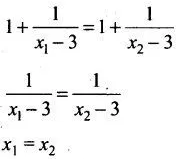
Hence, f (x) = (x – 3 + 1)/ (x – 3) = 1 + 1/ (x – 3)

Let f(x1) = f (x2)

NCERT Exemplar Solutions Class 12 Mathematics Chapter 1 - 1

So, f (x) is an injective function.

Now let y = (x – 2)/ (x -3)

x – 2 = xy – 3y

x(1 – y) = 2 – 3y

x = (3y – 2)/ (y – 1)

y ∈ R – {1} = B

Thus, f (x) is onto or subjective.

Therefore, f(x) is a bijective function.