My Cart
Your Cart 0

    Your cart is empty.

  • Total (Amount) ₹0.00
NCERT Exemplar · Class 12 · Chemistry

Chapter 7: The P-Block Elements

Practice each question, then open the answer or worked solution.

II. Multiple Choice Questions (Type-II)

31 questions
Q38Written answer

In the preparation of H2SO4 by Contact Process, why is SO3 not absorbed directly in water to form H2SO4?

Show solutionHide solution
Worked solution

Dissolution of SO3 in water is highly exothermic. This leads to the formation of a mist of tiny droplets which are highly corrosive and they can even attack the lead pipelines (lead pipelines are used to cover the tower in contact process).
Q39Written answer

Write a balanced chemical equation for the reaction showing catalytic oxidation of NH3 by atmospheric oxygen.

Show solutionHide solution
Worked solution

NH3 + O2 →(Pt gauze) 4NO + 6H2O

Pt gauze reacts as a catalyst, which is added to increase the rate of reaction.

Q40Written answer

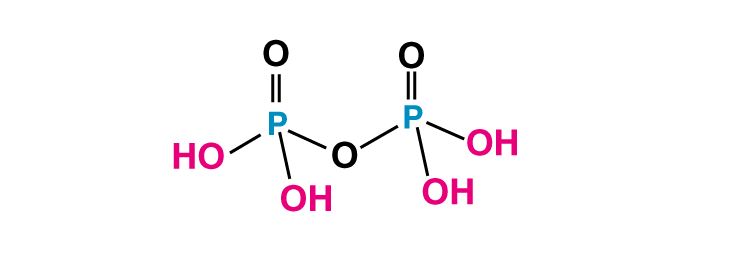
Write the structure of pyrophosphoric acid.

Show solutionHide solution
Worked solution

NCERT Exemplar Solutions of Class 12 Chemistry Chapter 7 The p-Block Elements-1

Q41Written answer

PH3 forms bubbles when passed slowly in water but NH3 dissolves. Explain why?

Show solutionHide solution
Worked solution

PH3 does not form hydrogen bonding with water. Therefore it is not soluble in water and it escapes as a gas and forms bubbles whereas ammonia forms hydrogen bonding and soluble in water.

Q42Written answer

In PCl5, phosphorus is in sp3d hybridised state but all its five bonds are not equivalent. Justify your answer with reason.

Show solutionHide solution
Worked solution

The size of axial bonds is greater than the size of equatorial bonds to overcome repulsion because the three equatorial bonds cause more repulsion. Therefore two axial P-Cl bonds are longer and different from equatorial bonds.

Q43Written answer

Why is nitric oxide paramagnetic in gaseous state but the solid obtained on cooling it is diamagnetic?

Show solutionHide solution
Worked solution

Nitric acid in the gaseous state exists in monomer form. It consists of only one unpaired electron therefore it is paramagnetic. In solid-state, it exists as a dimer (N2O2). There is no unpaired electron in its dimer form, therefore it is diamagnetic.

Q44Written answer

Give the reason to explain why ClF3 exists but FCl3 does not exist.

Show solutionHide solution
Worked solution

Chlorine has vacant d orbitals hence it can show an oxidation state of +3. Fluorine has no d orbitals, it cannot show a positive oxidation state. Fluorine shows only -1 oxidation state. Therefore FCl3 does not exists.

Q45Written answer

Out of H2O and H2S, which one has a higher bond angle and why?

Show solutionHide solution
Worked solution

H2O has higher bond angle than H2S because as we move from oxygen to sulphur the size of the central atom increases and electronegativity decreases due to which bond pair goes away from the central atom which results in a decrease in bond pair repulsion and hence bond angle decreases.

Q46Written answer

SF6 is known but SCl6 is not. Why?

Show solutionHide solution
Worked solution

Fluorine is the strongest oxidizing agent and it can oxidize sulphur to its maximum oxidation state +6 to form SF6. Chlorine is not a good oxidizing agent, it cannot oxidize sulphur to its maximum oxidation state. Chlorine can oxidize sulphur to only +4 oxidation state. Hence it can form SCl4 but not SCl6.

Q47Written answer

On reaction with Cl2, phosphorus forms two types of halides ‘A’ and ‘B’. Halide A is a yellowish-white powder but halide ‘B’ is a colourless oily liquid. Identify A and B and write the formulas of their hydrolysis products.

Show solutionHide solution
Worked solution

Halide A is PCl5 because it is a yellowish-white powder

Halide B is PCl3 because it is a colourless oily liquid.

PCl3 + 3H2O H3PO3 + 3HCl

PCl5 undergoes a violent hydrolysis

PCl5 + H2O POCl3 + 2HCl

PCl5 + 4H2O H3PO4 + 5HCl