My Cart
Your Cart 0

    Your cart is empty.

  • Total (Amount) ₹0.00
NCERT Exemplar · Class 12 · Chemistry

Chapter 2: Solutions

Practice each question, then open the answer or worked solution.

Questions

47 questions
Q22Written answer

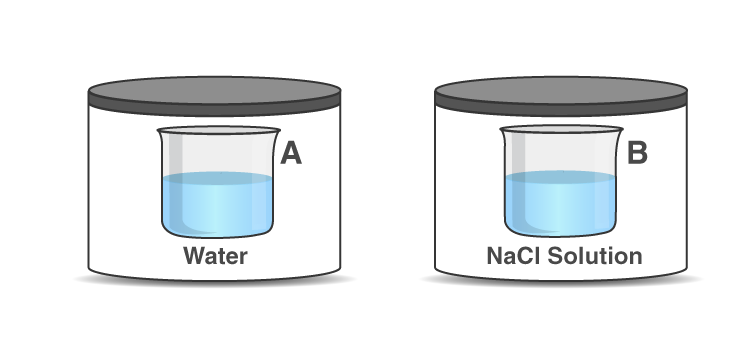
Two beakers of capacity 500 mL were taken. One of these beakers, labeled as “A”, was filled with 400 mL water whereas the beaker labelled “B” was filled with 400 mL of 2 M solution of NaCl. At the same temperature, both the beakers were placed in closed

containers of the same material and same

capacity as shown in Fig. 2.2.

At a given temperature, which of the following statement is correct about the

vapour pressure of pure water and that of NaCl solution.

(i) the vapour pressure in container (A) is more than that in a container (B).

(ii) the vapour pressure in container (A) is less than that in the container (B).

(iii) vapour pressure is equal in both containers.

(iv) the vapour pressure in container (B) is twice the vapour pressure in

container (A).
NCERT Exemplar Solutions of Class 12 Chemistry Chapter 2 Solutions-2

Show solutionHide solution
Worked solution

Option (i) is the answer.

Q23Written answer

If two liquids A and B form minimum boiling azeotrope at some specific

composition then _______________.

(i) A–B interactions are stronger than those between A–A or B–B.

(ii) vapour pressure of solution increases because more number of

molecules of liquids A and B can escape from the solution.

(iii) vapour pressure of solution decreases because less number of

molecules of only one of the liquids escape from the solution.

(iv) A–B interactions are weaker than those between A–A or B–B.

Show solutionHide solution
Worked solution

Option (i) is the answer.

Q24Written answer

4L of 0.02 M aqueous solution of NaCl was diluted by adding one litre of

water. The molality of the resultant solution is _____________.

(i) 0.004

(ii) 0.008

(iii) 0.012

(iv) 0.016Solution:

Option (iv) is the answer.

25. On the basis of information given below mark the correct option.

Information: On adding acetone to methanol some of the hydrogen bonds

between methanol molecules break.

(i) At specific composition, methanol-acetone mixture will form minimum

boiling azeotrope and will show positive deviation from Raoult’s law.

(ii) At specific composition, methanol-acetone mixture forms maximum

boiling azeotrope and will show positive deviation from Raoult’s law.

(iii) At specific composition, methanol-acetone mixture will form minimum

boiling azeotrope and will show negative deviation from Raoult’s law.

(iv) At specific composition, methanol-acetone mixture will form maximum

boiling azeotrope and will show negative deviation from Raoult’s law.

Show solutionHide solution
Worked solution

Option (i) is the answer.

Q26Written answer

KH value for Ar(g), CO2(g), HCHO (g) and CH4(g) are 40.39, 1.67, 1.83×10⁻⁵

and 0.413 respectively. Arrange these gases in the order of their increasing solubility.

(i) HCHO < CH4< CO2 < Ar

(ii) HCHO < CO2< CH4< Ar

(iii) Ar < CO2< CH4< HCHO

(iv) Ar < CH4 < CO2 < HCHOSolution:

Option (iii) is the answer.

II. Multiple Choice Questions (Type-II)

Note: In the following questions two or more options may be correct.

27. Which of the following factor (s) affect the solubility of a gaseous solute in the

a fixed volume of liquid solvent?

(a) nature of solute (b) temperature (c) pressure

(i) (a) and (c) at constant T

(ii) (a) and (b) at constant P

(iii) (b) and (c) only

(iv) (c) only

Show solutionHide solution
Worked solution

Option (i) and (ii) are the answers.

Q28Written answer

Intermolecular forces between two benzene molecules are near to same

strength as those between two toluene molecules. For a mixture of benzene

and toluene, which of the following is not true?

(i) ∆mix H = zero

(ii) ∆mix V = zero

(iii) These will form a minimum boiling azeotrope.

(iv) These will not form the ideal solution.

Show solutionHide solution
Worked solution

Option (iii) and (iv) are the answers.

Q29Written answer

Relative lowering of vapour pressure is a colligative property because

_____________.

(i) It depends on the concentration of a non-electrolyte solute in a solution

and does not depend on the nature of the solute molecules.

(ii) It depends on a number of particles of electrolyte solute in a solution and

does not depend on the nature of the solute particles.

(iii) It depends on the concentration of a non-electrolyte solute in solution

as well as on the nature of the solute molecules.

(iv) It depends on the concentration of an electrolyte or nonelectrolyte solute

in solution as well as on the nature of solute molecules.

Show solutionHide solution
Worked solution

Option (i) and (ii) are the answers.

Q30Written answer

Van’t Hoff factor i is given by the expression _____________.

(i) i = Normal molar mass/Abnormal molar mass

(ii) i = Abnormal molar mass/ Normal molar mass

(iii) i= Observed colligative property/calculated colligative property

(iv) i = Calculated colligative property/ Observed colligative property

Show solutionHide solution
Worked solution

Option (i) and (iii) are the answers.

Q31Written answer

Isotonic solutions must have the same _____________.

(i) solute

(ii) density

(iii) elevation in boiling point

(iv) depression in freezing point

Show solutionHide solution
Worked solution

Option (iii) and (iv) are the answers.

Q32Multiple choice

Which of the following binary mixtures will have the same composition in the liquid

and vapour phase?

Show answerHide answer
Correct option: B
Show solutionHide solution
Worked solution

Option (ii) and (iii) are the answers.

Q33Written answer

In isotonic solutions ________________.

(i) solute and solvent both are same.

(ii) osmotic pressure is the same.

(iii) solute and solvent may or may not be same.

(iv) a solute is always the same solvent may be different.

Show solutionHide solution
Worked solution

Option (ii) and (iii) are the answers.