Represent schematically the life cycle of a malarial parasite.
Show solutionHide solution
Ans: Malaria is a mosquito-borne disease spread by the female mosquito Anopheles gambiae.
Headache, Nausea, and Vomiting, Fever, Chills, and Sweating, Spleen Enlargement, Muscular Fatigue, and Pain are all symptoms of Malaria. The following is a schematic illustration of the malaria life cycle: -
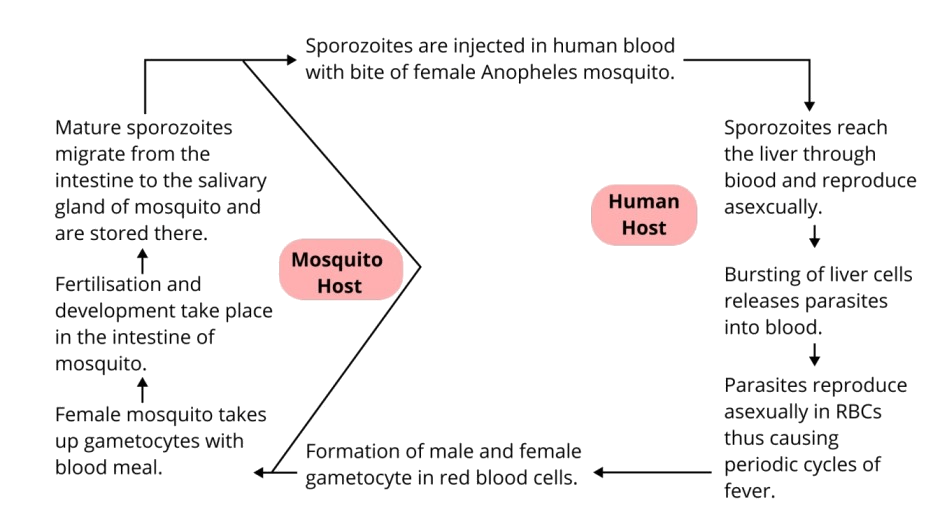
1. Sporozite, a motile infective form, is transmitted by the female anopheles mosquito to a vertebrate host, such as humans.
2. The sporozoites infiltrate the liver and grow into schizonts (asexual schizonts).
3. These schizonts are broken up and released by the Merozoites.
4. Merozoites have entered the RBC and are asexually reproducing and infecting an RBC, causing fever cycles.
5. The trophozoite evolves into schizonts, which create merozoites or parasites, at the ring stage.
6. Gametophytes are parasites that evolve into gametophytes.
7. The gametophytes generated when a female anopheles mosquito bites an infected person are eaten.
The parasites then multiply in the mosquito's gut, which is referred to as the sporogonic cycle.
9. These microgametes create zygotes when they enter macrogametes.
10. Sporozoites are zygotes that have become motile and elongated.