My Cart
Your Cart 0

    Your cart is empty.

  • Total (Amount) ₹0.00
NCERT Exemplar · Class 12 · Biology

Chapter 8: Human Health and Diseases

Practice each question, then open the answer or worked solution.

Short Answer Questions

23 questions
Q1Written answer

Differentiate between active immunity and passive immunity.

Show solutionHide solution
Worked solution

Ans:

Active Immunity

Passive Immunity

(i) Active immunity develops within the body after a disease has attacked it.

(i) Passive immunity is injected into the body after a pathogen attack.

(ii) It does not has memory cells 

(ii) It has memory cells that can detect and kill the virus more effectively in the second round.

(iii) Recollection is possible

(iii) Recollection is not possible

(iv) bacteria attacks are frequently eliminated by active immunity

(iv) Anti-venom after a snake bite, for example, is passive immunisation


Q2Written answer

Differentiate between a benign tumour and a malignant tumour.

Show solutionHide solution
Worked solution

Ans:

Benign Tumour

Malignant Tumour

(i) It can spread through the body.

(i) It grows in a single site and does not spread.

(ii) It causes extensive damage to neighboring cells.

(ii) It is the most hazardous type of tumor.


Q3Written answer

Do you consider passive smoking to be more dangerous than active smoking? Why?

Show solutionHide solution
Worked solution

Ans: When we hear the word "smoking," we usually picture someone who is actively smoking a cigarette or something similar. However, we overlook the term "passive smoking." It refers to the quantity of contaminants that enter our bodies through inhalation.

Because the death rate of those who live in an industrial region is substantially higher than that of people who smoke, passive smoking is more harmful. The victims of passive smoking are sometimes unaware of the dangers of the environment in which they live.


Q4Written answer

“Prevention is better than cure”. Comment.

Show solutionHide solution
Worked solution

Ans: "Prevention is better than cure" is an age-old adage that still holds true today.

There are many diseases, such as sexually transmitted diseases and viral disorders, that have yet to be cured. Only by preventing them through various treatments can a healthy person survive from them. Direct exposure to these diseases, which are incurable, can be lethal or severely painful. So, in this remark, it is stated that preventing illness spread is a better option than having a dangerous sickness and attempting to cure it.


Q5Written answer

Explain any three preventive measures to control microbial infections.

Show solutionHide solution
Worked solution

Ans: The measures are: 

1. In the human body, or the body of any animal, microbial infection can induce a variety of severe diseases. Bacteria, viruses, fungi, and protozoa are all possibilities. The one thing they all have in common is that they may all be fully eliminated by adopting basic prevention procedures. Personal and public hygiene should be maintained, for example, by keeping one's body clean, wearing clean clothes, and eating fresh food.

2. Cleanliness requirements and procedures should be followed. The public and private restrooms should be cleaned regularly, as should the roadsides, which should be cleansed and treated with antimicrobial liquid.

3. Vaccines (active immunity) and medicines (passive immunity) should be administered with caution and at the appropriate times.


Q6Written answer

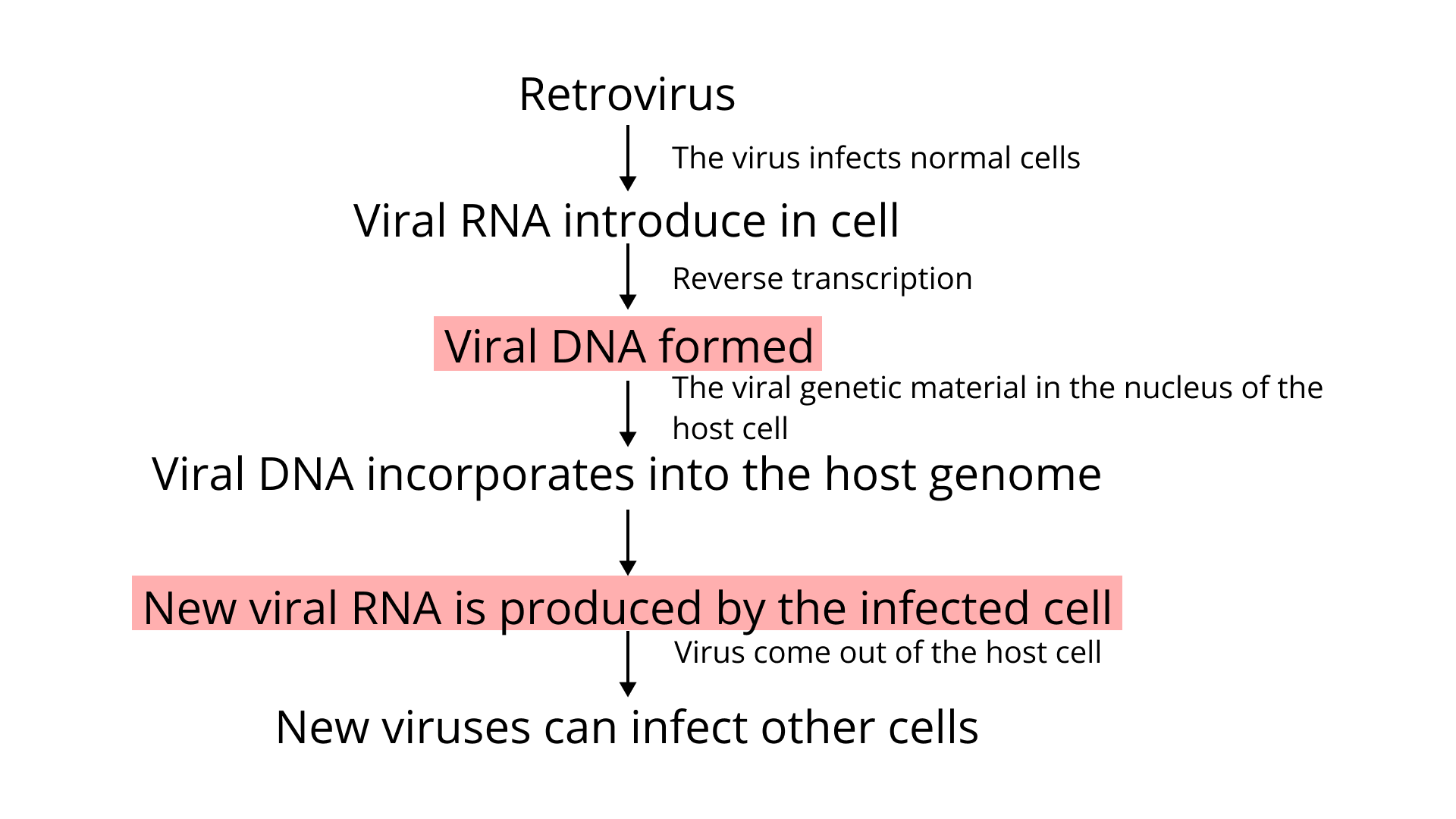
In the given flow diagram, the replication of retrovirus in a host is shown. Observe and answer the following questions.


seo images


(a) Fill in (1) and (2)

(b) Why is the virus called retrovirus?

(c) Can the infected cell survive while viruses are being replicated and released?

Show solutionHide solution
Worked solution

Ans: According to the flow diagram, viral DNA is injected into the host body and subsequently transformed to viral DNA using reverse transcriptase. As a result, the number one is: 'viral DNA produced.'

After integrating with the host DNA, the virus replicates its DNA and then releases its genetic material. "New viral RNA is created by the infected cell," says the second.


seo images


Ans: Retroviruses are those that employ RNA to store their genetic material before converting it to DNA once inside the host cell. Though HIV does the same thing, it is referred to as a retrovirus. 

Ans: Yes, the majority of cells survive and divide normally following infection. Without a robust immune reaction from the host, the virus can replicate and propagate.


Q7Written answer

“Maintenance of personal and public hygiene is necessary for prevention and control of many infectious diseases”. Justify the statement giving suitable examples.

Show solutionHide solution
Worked solution

Ans: The most significant factor in preventing infectious infections is personal hygiene. A person can avoid a variety of ailments by maintaining it. Personal hygiene entails keeping one's body clean, consuming only pure drinking water and food, and properly disposing of waste and excrement, among other things. When we do not maintain cleanliness, several fungal illnesses and pathogens might interfere with our way of life. Ringworms, eczema, and other skin conditions are among them.


Q8Written answer

The following table shows certain diseases, their causative organisms and symptoms. Fill in the gaps.


Name of the disease

Causative organism

Symptoms

1

Ascariasis

Ascaris 

____________

2

___________

trichophyton

The appearance of dry, scaly lesions

on various parts of the body

3

Typhoid

____________

High fever, weakness, headache,

Stomach pain, constipation.

4

Pneumonia

Streptococcus 

pneumonia 

______________

5

_______________

Rhino Viruses

Nasal congestion and discharge,

sore throat, cough, headache

6

Filariasis

_____________

Inflammation in lower limbs

Show solutionHide solution
Worked solution

Ans: 


Name of the disease

Causative organism

Symptoms

1

Ascariasis

Ascaris 

Internal bleeding, muscular pain,

fever, anaemia and blockage of

intestinal passage.

2

ringworms

trichophyton

The appearance of dry, scaly lesions

on various parts of the body

3

Typhoid

Salmonella typhi 

High fever, weakness, headache,

Stomach pain, constipation.

4

Pneumonia

Streptococcus 

pneumonia 

Fever, chills, cough and headache.

The lips and fingernails may turn

grey to reddish in severe cases.

5

Common cold

Rhino Viruses

Nasal congestion and discharge,

sore throat, cough, headache

6

Filariasis

Wuchereria (w.bancrofti and w. malayi)

Inflammation in lower limbs


Q9Written answer

The outline structure of a drug is given below.


seo images


a. Which group of drugs does this represent?

b. What are the modes of consumption of these drugs?

c. Name the organ of the body which is affected by the consumption of these drugs.

Show solutionHide solution
Worked solution

Ans: The structure of the cannabis molecule is depicted in this diagram.

Natural cannabinoids are derived from the inflorescence of the cannabis sativa plant, and include 'Ganja,' charas, and hashish, to mention a few.

Ans: Inhalation and oral ingestion are the most common methods of administration.

Ans: Cannabinoids bind to cannabinoid receptors, which are mostly found in the brain. These are also well-known for their impact on the body's cardiovascular system.


Q10Written answer

Give the full form of CT and MRI. How are they different from each other? Where are they used?

Show solutionHide solution
Worked solution

Ans: Both CT scans and MRIs are used to detect any abnormalities, such as malignant cell development.

These are written in complete form as follows:

CT stands for computer tomography, and MRI stands for magnetic resonance imaging.

CT and MRI are two completely different procedures. CT employs an x-ray to create a three-dimensional image of interior organs and, as a result, detect cancer expansion. A strong magnetic field and non-ionizing radiation are used in MRI to detect any form of alteration (both bacterial and physiological).