My Cart
Your Cart 0

    Your cart is empty.

  • Total (Amount) ₹0.00
NCERT Exemplar · Class 12 · Biology

Chapter 6: Molecular Basis of Inheritance

Practice each question, then open the answer or worked solution.

Long Answer Questions

9 questions
Q1Written answer

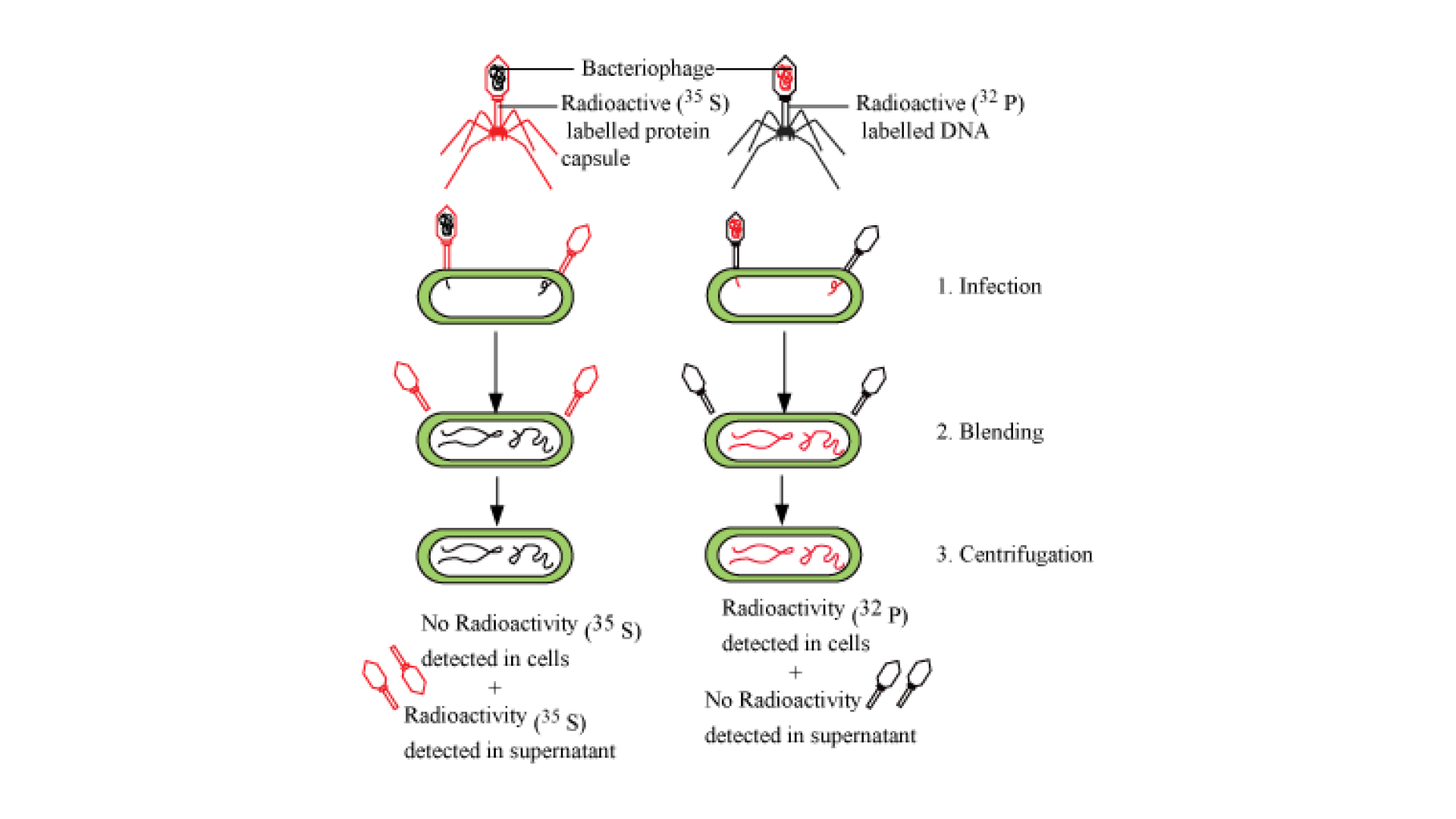
Give an account of the Hershey and Chase experiment. What did it conclusively prove? If both DNA and proteins contained phosphorus and sulfur, do you think the result would have been the same?

Show solutionHide solution
Worked solution

Ans: Hershey and Chase Experiment:

  • Viruses were produced on two different types of medium. Radioactive phosphorus was present in one medium, while radioactive Sulphur was present in another.

  • Because protein does not contain phosphorus, viruses cultured on radioactive phosphorus contained radioactive DNA but no such protein.

  • Because DNA does not contain Sulphur, viruses cultured on radioactive Sulphur contained radioactive protein bt no such DNA.

  • E. coli bacteria were permitted to bind to radioactive phages. Following the infection, the viral coat was removed from the bacterium, and viral particles were isolated from the bacteria for further examination.


Observation: 

  • Only those bacteria infected with phages growing on radioactive phosphorous showed radioactive DNA. 

  • In bacteria infected with phages cultured on radioactive Sulphur, no radioactive DNA was found.

Conclusion: DNA was discovered to be a genetic substance.

It would have been impossible to pinpoint the exact genetic material, i.e., DNA or proteins, if both DNA and proteins contained Sulphur and Phosphorus.

seo images


Q2Written answer

During the course of evolution why DNA was chosen over RNA as genetic material? Give reasons by first discussing the desired criteria in a molecule that can act as genetic material and in the light of biochemical differences between DNA and RNA.

Show solutionHide solution
Worked solution

Ans: The parameters for a molecule that can operate as genetic material are as follows:

It needs to be able to replicate itself. Chemically and structurally, it should be stable.

Slow changes (mutation) are essential for evolution; hence it should be able to accommodate - them.

It must be capable of expressing itself in Mendelian characteristics.

DNA and RNA Biochemistry:

  • DNA and RNA are both capable of replication because their base pairs are complementary.

  • Griffith's experiment demonstrated that DNA is more stable than RNA since it could withstand heat-killing during the experiment.

  • In RNA, there is a 2'-OH group. Because of this, RNA is labile and degradable, whereas DNA is not

  • Mutations can be passed on through both RNA and DNA. However, because DNA is more stable, it is better suited for long-term mutation storage.

  • As a result, during evolution, DNA was favored as the genetic material.


Q3Written answer

Give an account of post-transcriptional modifications of a eukaryotic mRNA.

Show solutionHide solution
Worked solution

Ans: Following events happen during the transformation of hnRNA (precursor of mature mRNA):

Polymerase II assists in the conversion of hnRNA to mature mRNA. Introns and exons are both present in primary transcripts, however, they are non-functional. Splicing occurs, resulting in the elimination of introns and the linking of exons in a predetermined order. In hnRNA, capping and tailing occur. It gets a methyl guanosine cap and a poly adenylate tail. At the $5^{\prime}$ end of hnRNA, a cap is added, and at the $3^{\prime}$ end, a Poly-A tail is added. The hnRNA is now transformed into mature mRNA.


Q4Written answer

Discuss the process of translation in detail.

Show solutionHide solution
Worked solution

Ans: Translation is the process of polymerizing amino acids to produce polypeptides. As a result, translation refers to the biological process of protein synthesis. The following are the main steps in the translation process:


Initiation: The ribosome forms a ring around the target mRNA, and we know that the ribosome is where protein is made. At the start codon, the first tRNA is connected. A codon is a three-amino-acid sequence. Elongation: occurs when the tRNA adds an amino acid to the tRNA that corresponds to the followin codon. In this phase, more amino acids are added to build a lengthy chain. This is the most important ste in the protein production process.


Translocation: The ribosome subsequently translocate to the next mRNA codon and repeats the process This results in the formation of an amino acid chain.

Termination: When a stop codon is reached, the polypeptide is released by the ribosome.


Q5Written answer

Define an operon. Giving an example, explain an Inducible operon.

Show solutionHide solution
Worked solution

Ans: An operon is a functional unit of genomic DNA that contains a cluster of genes controlled by a single promoter. In most cases, an operon is transcribed into polycistronic mRNA. Polycistronic mRNA is a type of mRNA that codes for several proteins. An operon consists of three basic DNA components:


(a) Promoter: A nucleotide sequence that empowers a gene to be transcribed is termed a promoter. It is known by RNA polymerase, which then pledges transcription.

(b) Operator: A section of DNA to which a repressor binds is titled, operator.

(c) Structural genes: The genes which are co-regulated by the operon are named structural genes.


Inducible Operon: Inducible operons are operons that are controlled by an inducer. The operon can be turned on or off using an inducer. An example of an inducible operon is the lac operon. Lactose is the inducer of the lac operon and is a substrate of the enzyme beta-galactosidase.

The lac operon's operation is depicted in the diagram below. The repressor attaches to the operator region and suppresses transcription in the absence of an inducer.

Repressor becomes inactive in the presence of an inducer. This enables transcription in the operator region, resulting in mRNA release. Following that, mRNA facilitates translation and protein synthesis occurs.


Q6Written answer

'There is a paternity dispute for a child'. Which technique can solve the problem? Discuss the principle involved.

Show solutionHide solution
Worked solution

Ans: DNA fingerprinting can be used to settle a paternity dispute for a kid. The following principle underpins DNA fingerprinting:


DNA fingerprinting is a technique for identifying a person's This entails finding changes in specific DNA regions. Repetitive DNA refers to the sequence found in these areas. In such sequences, a tiny region of DNA is repeated numerous times.


These sequences are isolated from bulk DNA as various peaks during density, gradient centrifugation. Major peaks are formed by bulk DNA, whereas smaller peaks are known as satellite DNA. Satellite DNA is divided into several categories based on the base makeup, segment length, and a number of repeating units. The sequence's base composition tells whether it's A: T or G: $C$ heavy. These sequences are polymorphic to a high degree and so serve as the foundation for DNA fingerprinting.


DNA from each tissue of an individual has the same degree of polymorphism. As a result, DNA from any tissue can be used to examine an individual's DNA fingerprinting. Polymorphism can also be passed down from parents to children. As a result, DNA fingerprinting can be used to determine a child's paternity.


Q7Written answer

Give an account of the methods used in sequencing the human genome.

Show solutionHide solution
Worked solution

Ans: The human genome was sequenced using two ways.


Using ESTs (Expressed Sequence Tags): All genes that are expressed as RNA are discovered and sequenced using this method.


Blind Methodology: This method entailed sequencing the entire set of genomes and then assigning functions to distinct parts of the sequence. Sequence annotation is the term for this. The steps in this procedure are as follows:


- Total DNA from a cell is isolated and fragmented into smaller pieces at random.


- Using specialized vectors, these fragments are cloned into a suitable host. Cloning causes each fragment to be amplified, making it easier to sequence the fragment. Bacteria and yeast are the most common hosts for this type of experiment. The vectors were dubbed BAC (bacterial artificial chromosomes) and YAC (yeast artificial chromosomes) (yeast artificial chromosomes).


- The fragments were sequenced using automated DNA sequencers. The sequences were then ordered based on the presence of some overlapping sections.


- Because it was impossible for humans to generate overlapping fragments in these sequences, computer tools were used to help. After that, each chromosome's sequences were annotated and assigned to it.


- Polymorphism in some DNA segments was used to create a genetic physical map of the genome.


Q8Written answer

List the various markers that are used in DNA fingerprinting.

Show solutionHide solution
Worked solution

Ans: A DNA marker is a gene sequence that can be used to identify an individual or a species on a known chromosome. A genetic marker, also known as a DNA marker, can be a short or long sequence. The following are some of the most regularly used DNA fingerprinting markers.


- RFLP (Restriction fragment length polymorphism) SSLP

(Simple sequence length polymorphism) AFLP

(Amplified fragment length polymorphism) RAPD

(Random amplification of polymorphic DNA) VNTR

(Variable number tandem repeat)

SSR Microsatellite polymorphism, (Simple sequence repeat)

SNP (Single nucleotide polymorphism)

  • STR (Short tandem repeat)

  • SFP (Single feature polymorphism) DArT

  • (Diversity Arrays Technology)

  • RAD markers (Restriction site associated DNA markers)


Q9Written answer

Replication was allowed to take place in the presence of radioactive deoxynucleotides precursors in E. coli that was a mutant for DNA ligase. Newly synthesized radioactive DNA was purified and strands were separated by denaturation. These were centrifuged using density gradient centrifugation. Which of the following would be a correct result?


seo images


Show solutionHide solution
Worked solution

Ans: Option ‘a’ displays the correct outcome. 


The subsequent illustration explains this:


Assume that in this experiment, heavier nitrogen was employed. This nitrogen molecule from the parents' cell would be passed down to the daughter cells in equal amounts. Half of the DNA in each daughter cell will be heavier nitrogen, while the other half will be lighter nitrogen.


Half of the daughter cells in the F2 generation will have a mix of radioactive and non-radioactive DNA. Non-radioactive DNA will be found in the remaining 50% of daughter cells. This is why the graph has two peaks, each reflecting a different type of nitrogen in DNA.