My Cart
Your Cart 0

    Your cart is empty.

  • Total (Amount) ₹0.00
NCERT Exemplar · Class 12 · Biology

Chapter 5: Principles of Inheritance and Variation

Practice each question, then open the answer or worked solution.

Long Answer Questions

5 questions
Q1Written answer

In a plant tallness is dominant over dwarfness and red flower is dominant over  white. Starting with the parents work out a dihybrid cross. What is standard dihybrid  ratio? Do you think the values would deviate if the two genes in question are  interacting with each other?

Show solutionHide solution
Worked solution

Ans:  The following Punnett Square shows cross between tall plant with red flowers (RRYY) and dwarf plant with white flowers (rryy). 

Gametes 

RY

Ry

rY

ry

RY

RRYY

RRYy

RrYY

RrYy

Ry

RRYy

RRyy

RrYy

Rryy

rY

RrYY

RrYY

rrYY

rrYy

ry

RrYy

Rryy

rrYy

rryy


All the plants in the F1 generation will be tall and produce red flowers.

When plants of F1 generation are allowed to self-pollinated, phenotype of plants in F2 generation can be shown by Punnett Square:

In this case, the standard dihybrid ratio 9:3:3:1 which can be shown as follows:

Tall plant red flower = 9

Tall plant white flower = 3

Dwarf plant red flower = 3

Dwarf plant white flower = 1

The standard dihybrid ratio works only when the genes for contrasting characters are on different chromosomes. If characters are on the same chromosome, they may interact with each other. In that situation, the dihybrid ratio would show variation from the standard dihybrid ratio.

Q2Written answer

(a) In humans, males are heterogametic and females are homogametic. Explain. Are there any examples where males are homogametic and females heterogametic? 

(b) Also, describe as to, who determines the sex of an unborn child? Mention whether temperature has a role in sex determination.

Show solutionHide solution
Worked solution

Ans: In humans, 23rd pair of chromosome contains and X chromosome and a Y chromosome. Hence, males are called heterogametic. Females, on the other hand, have XX chromosomes in the 23rd pair. Hence, females are called homogametic. But in bird females have ZW chromosome and male have ZZ Chromosome. So, in some cases, males can be homogametic and females can be heterogametic.


Ans: In case of humans, sex is determined by X and Y-chromosomes. Out of 23 pairs of chromosomes, the 23rd pair is called sex chromosome while the remaining pairs are autosomes. Males have X and Y-chromosomes in the 23rd pair while females have XX-chromosomes. Thus, a sperm can have either X or Y chromosome, while all the eggs will have X-chromosome. When a sperm with X chromosome fertilizes the ovum; the zygote will result in development of a girl child. If a sperm with Y chromosome fertilizes the ovum; the zygote will result in development of a male child. 

Temperature dependent sex determination is found in crocodiles etc. When eggs are incubated at high temperature, it results in the birth of male crocodiles.


Q3Written answer

A normal visioned woman, whose father is colour blind, marries a normal visioned man. What would be probability of her sons and daughters to be colour blind? Explain with the help of a pedigree chart.

Show solutionHide solution
Worked solution

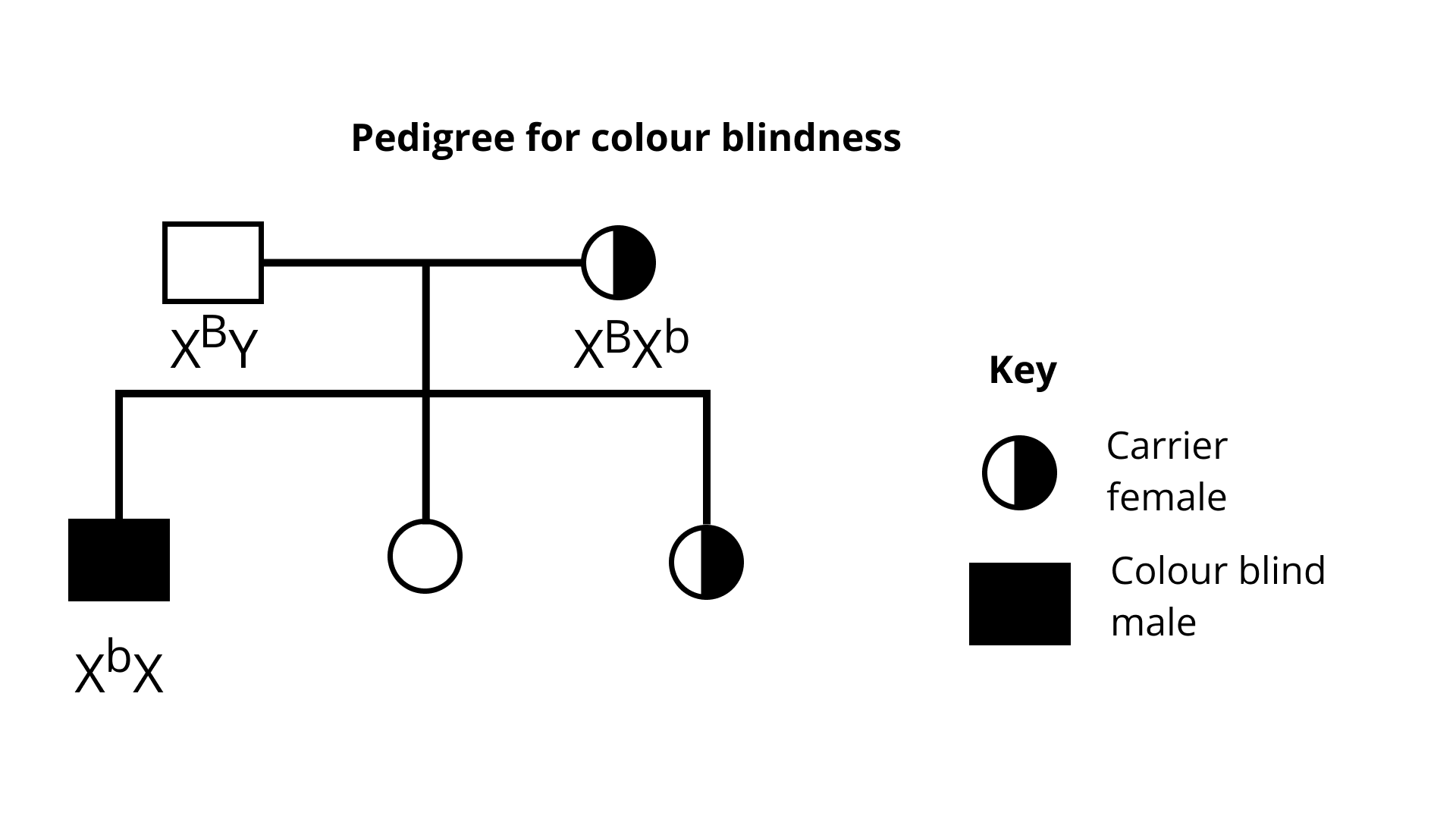
Ans:  Following pedigree analysis shows the probability of prevalence of colour blindness in offspring: 

seo images
  1. The P generation shows a normal husband and a carrier wife.

  2. The F1 generation shows one male child and two female children.

The male child will suffer from colour blindness and one of the females may be a carrier.

The genes for colour blindness are mostly present on X-chromosome. Hence if a boy has defective X-chromosome the boy would be colour blind. Females have another X chromosome which compensates for the deficiency of its counterpart. Due to this, females are carriers of this disease.


Q4Written answer

Discuss in detail the contributions of Morgan and Sturtevant in the area of genetics.

Show solutionHide solution
Worked solution

Ans:  Morgan and his group conducted experiments in the field of genetics. Sturtevant was Morgan’s student. Their contributions are: 

Morgan carried out dihybrid crosses of Drosophila. He observed that the phenotypic ratio was not similar to standard phenotypic ratio as observed by Mendel. Morgan and his team were aware that the genes were located on the X chromosome. They understood that when genes were situated on the same chromosome, they did not segregate independently of each other. However, when genes are situated on same chromosome, the chances of parental combination are higher than non-parental one. The physical association of genes on the same chromosome was termed linkage. 

Morgan also coined the term recombination to describe generation of non-parental combinations. 

Sturtevant revealed that the relative distance between two genes on the same chromosome was an important factor in recombination or lack of recombination. Genetic mapping could be developed because of contributions made by Morgan and his team.


Q5Written answer

Define aneuploidy. How is it different from polyploidy? Describe the individuals having following chromosomal abnormalities.

(a) Trisomy of 21st Chromosome

(b) XXY

(c) XO

Show solutionHide solution
Worked solution

Ans:  Failure of chromatid segregation during cell division results in either loss or gain of a chromosome (aneuploidy). Failure of cytokinesis; after telophase results in an increase in a whole set of chromosomes (polyploidy).

(a) Trisomy or 21st  chromosome: Presence of an additional copy of 21th chromosome is trisomy. This was described by Langdon Down and hence called Down’s Syndrome. A person suffering from Down’s syndrome is short and has a small round head. 

(b) XXY: This genetic disorder happens because of an additional copy of X chromosome resulting in a karyotype of 47. There are three chromosomes (XXY) in the 23rd set. This condition is known as Klinefelter’s syndrome. Such a person shows overall masculine development but also shows enlarged breasts.

(c) XO: This happens because of lack of an X chromosome resulting in a ploidy of 45 (XO). This condition is called Turner’s syndrome. Ovaries are rudimentary in such females and hence such females are sterile. Secondary sexual characters are also absent in such females.