My Cart
Your Cart 0

    Your cart is empty.

  • Total (Amount) ₹0.00
NCERT Exemplar · Class 12 · Biology

Chapter 16: Environmental Issues

Practice each question, then open the answer or worked solution.

Long Answer Questions

7 questions
Q1Written answer

Write a short note on electronic waste. List the various sources of e- wastes and the problems associated with its disposal. 

Show solutionHide solution
Worked solution

Ans: The waste including computers, mobiles, televisions and various other electronic gadgets which are discarded after use are referred to as the electronic or e-waste. These kinds of gadgets contain many metals including gold, nickel, silver, iron, copper, plastic, silver, etc. The main sources or gadgets involved in this kind of waste are printers, computers, phones, music players, e-reading gadgets, scanners, webcams, mobiles, music players, playstations, etc. The various problems that are associated with the e-waste disposal are:

  • The dumping of this kind of waste is going to lead to the accumulation of plastic on land.

  • Extraction of metals, like gold, iron, silver, etc. involves the incarnation of plastic components which creates further plastic pollution.

  • Manual holding of e-waste is fatal and harmful to workers dealing with the gadgets in this waste.

Q2Written answer

What is organic farming? Discuss the benefits of organic farming as a viable practice in the context of developing nations like India. 

Show solutionHide solution
Worked solution

Ans: Organic farming is a method of farming which ensures sustainable yield in an eco-friendly and a pollution-free system without causing any harm to the environment. The cultivation of land is done through various techniques like crop rotation, green manure usage, composting and use of biological pesticides. It also includes using beneficial microbes instead of synthetically made chemical fertilizers and pesticides.


Benefits of organic farming for developing nations:


  1. Long-term soil fertility is maintained.

  2. Control of pests and diseases is achieved without harming the environment in any way.

  3. Ensures safe water supply and underground water is clean.

  4. Make use of natural and raw resources that the farmer already has, to make it more economic.

  5. Nutritious, organic food and high-quality crops with good yield are produced.


Q3Written answer

Waterlogging and soil salinity are some of the problems that have come in the wake of the Green Revolution. Discuss their causes and adverse effects on the environment. 

Show solutionHide solution
Worked solution

Ans: Causes of waterlogging and salinity produced are given below:

  • Numerous canals were built to implement the Green Revolution which made it considerably easy to access water for irrigation but use of excess water in irrigation results in waterlogging. This draws salt to the surface of the soil being irrigated and increases soil salinity. 

  • Excess and inconsiderable use of fertilizers has to lead to an accumulation of many unused salts in the soil resulting in an increased soil salinity.

  • Various effects due to Waterlogging are:

  • Increase in soil salinity.

  • Many crops cannot survive in water-logged conditions and thus die leading to an economic loss.

  • Waterlogging over a long time shall reduce the number of microorganisms and creatures in the soil thus, reducing biodiversity in the soil which is harmful for the environment. 

  • Decomposition of organic matter which lies in stagnant water will release methane which is a potent greenhouse gas and can lead to more global warming.

  • Effects of an increase in soil salinity are:

  • Most plants cannot survive in saline soil and would not grow or produce any yield.

  • The soil with high salinity cannot grow any plants and thus, will become barren and unsuitable for farming.


Q4Written answer

What are multipurpose trees? Give the botanical and local names of any two multipurpose trees known to you and list their uses.

Show solutionHide solution
Worked solution

Ans: Multipurpose trees, as is evident from the name, are those that have more than one uses; two of which are as follows:


1. Banana: Musa paradisiaca

Uses: 

  • Raw bananas are used for making various snacks.

  • Fiber from the stem of a banana plant is used in textiles.

  • The stem of a banana plant is also used for making a makeshift raft.

2. Coconut: Cocos nucifera

Uses: 

  • Fruit, coconut, is used as food and additive in many culinary items.

  • Coconut leaves are used for making various daily use things like hand-fans, baskets, mats, etc.

  • Veins of coconut leaf are used in making brooms or cleaning equipment.


Q5Written answer

What are the basic characteristics of a modern landfill site? List any three and also mention the reasons for their use. 

Show solutionHide solution
Worked solution

Ans:

Characteristics of a modern landfill site should include: 


  1. Methods to contain the leachates such as lining clay or plastic liners to avoid leaching after the site has been filled or dumped in.

  2. Compaction and covering of the waste after dumping to prevent it from being blown or scattered by the wind. 

  3. Installation of a landfill gas extraction system which is used to extract the gas for generating power.


Q6Written answer

How does an electrostatic precipitator work?

Show solutionHide solution
Worked solution

Ans:

Working of electrostatic precipitator can be described as follow:


  1. Electrode wires produce a corona to release the electrons.

  2. The electrons so produced attach to the dust particles and confer to them a net negative charge.

  3. Grounded collecting plates attract these negatively charged dust particles. 

  4. Thus, dust particles are hence, removed from the air passing.

  5. A spray of water or lime in the scrubber is generated and exhaust is passed through this spray of water or lime.

  6. This scrubber removes the gases mixed in air like sulfur dioxide. 

  7. Thus, the polluting gases or pollutants, like sulfur dioxide are removed from the air.


Q7Written answer

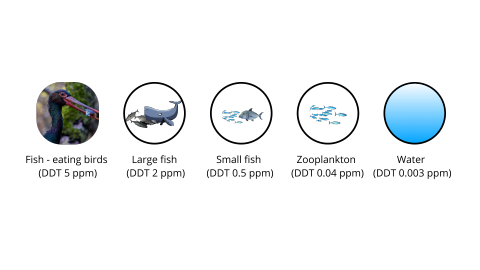
Observe the figure and answer the following questions.


seo images


i. What ecological term is used to describe the DDT accumulation at different trophic levels? 

Show solutionHide solution
Worked solution

Ans: At different trophic levels, the accumulated DDT is defined by the term biomagnification.

ii. List any one effect of DDT accumulation on birds.

Ans: In birds, the eggshells of the eggs laid in birds having exposure to DDT are thin which causes death of newborns before the eggs are even hatched and thus causes a decline in bird population.

iii. Will DDT accumulation lead to eutrophication? 

Ans: Eutrophication is a process which means that the water body undergoing eutrophication becomes excessively nutrient rich such that it changes from accommodating phytoplankton to an overgrowth of aquatic vegetation and then more fauna. DDT cannot render an aquatic body this nutrient rich so no, it does not lead to eutrophication.

iv. Does it affect the BOD? 

Ans: Biological oxygen demand of the water is not disturbed or affected by DDT concentration as it leads to no disturbance in aquatic microflora.

v. Name a disease caused by the accumulation of any heavy metal.

Ans: Minamata disease is seen after accumulation of mercury in water bodies.


NCERT Exemplar for Class 12 Biology Chapter 16 - Environmental Issues (Book Solutions)

The NCERT Exemplar for Class 12 Biology Chapter 16 - Environmental Issues (Book Solutions) provides you with detailed answers to all the questions. There are more than 50 questions in the NCERT Exemplar for Class 12 Biology Chapter 16 - Environmental Issues (Book Solutions) to help you revise and practice the Chapter. Since Chapter 16 is an important part of the Class 12 Biology syllabus, these solutions will benefit you and provide you with a deep understanding of the concepts related to Environmental Issues.