Ans: A community's P/R ratio is the proportion of gross output to communal respiration. This could be one, a number less than one, or a number more than one.
In a pioneer town, the P/R ratio can be less than or more than one.
A climax community's P/R ratio, on the other hand, is 1.
There are two possible scenarios in a pioneer village.
(a) Respiratory loss is minimised when gross output is higher and there are fewer consumers. As a consequence, the P/R ratio will be greater than 1.
(b) When decomposition rates are higher due to a significant decomposer population, gross productivity is poorer than respiratory losses.
The P/R ratio is smaller than one in this scenario.
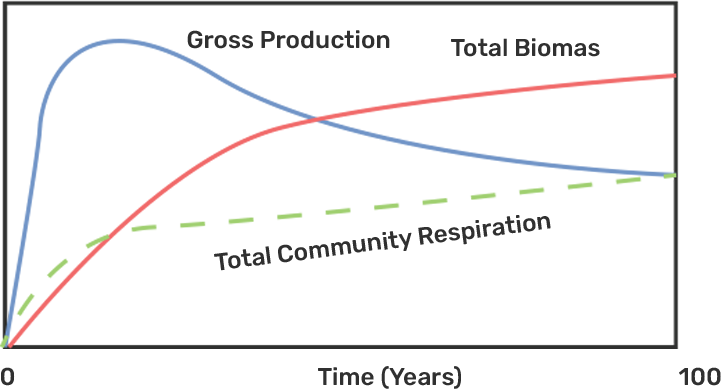
In the case of the climax community, the P/R ratio is one. As a consequence of the community's stability, this happens. The P/R ratio is depicted in the graph below at various stages of community succession. The primary community is at the top of the diagram, whereas the climax community is at the base.
Benefits of Exemplar Problems for Class 12 Biology
These NCERT Exemplar problems for Class 12 Biology are intended to boost students' knowledge and learning rather than serve as a question bank for exams. These NCERT Exemplar problems for Class 12 Biology are meant to motivate instructors and students to think of good discussion topics. These example books feature high-quality questions based on the most recent CBSE Syllabus for thorough Chapter practice. Every year, exceptional questions are added in CBSE Board Papers to increase exam quality.
The NCERT Biology Exemplar Solution Chapter 14 Ecosystem’s principal purpose is to provide instructors and students with a large number of high-quality problems of varied cognitive levels to aid in the teaching-learning of topics in all NCERT solutions for Classes 6 to 12. The questions in these volumes are designed to assist teachers in developing balanced question papers for unit and terminal examinations, as well as preparing assignments, evaluating their teaching effectiveness, and learning about their students' achievements.
Teachers who want to improve the quality of their Classroom instruction could benefit from feedback based on student reactions. Furthermore, the Biology questions are difficult to answer. Exemplar Solutions Chapter 14 Ecosystems are required to assist instructors in comprehending the elements of high-quality questions and encouraging them to create their own. Students may benefit from completing the self-assessment questions in the Exemplar book and understanding the basic problem-solving processes. Some of the book's questions are intended to assess students' grasp of concepts and their ability to apply them in new settings.