My Cart
Your Cart 0

    Your cart is empty.

  • Total (Amount) ₹0.00
NCERT Exemplar · Class 12 · Biology

Chapter 14: Ecosystem

Practice each question, then open the answer or worked solution.

Long Answer Questions

12 questions
Q1Written answer

A farmer harvests his crop and expresses his harvest in three different ways.

a. I have harvested 10 quintals of wheat.

b. I have harvested 10 quintals of wheat today in one acre of land.

c. I have harvested 10 quintals of wheat in one acre of land, 6 months after sowing.

Do the above statements mean one and the same thing? If your answer is yes, give reasons. And if your answer is ‘no’ explain the meaning of each expression.

Show solutionHide solution
Worked solution

Ans: Different statements imply different things.

The first statement merely reflects the amount of biomass generated, but not the time or region over which it was produced.

The second statement reveals the quantity and area of the product, but not the time it took to make it.

The third statement is complete as it demonstrates the quantity, area and duration.

The third statement's data can be utilised to estimate primary productivity on the farm in terms of biomass produced.
Q2Written answer

Justify the following statement in terms of ecosystem dynamics. “Nature tends to increase the gross primary productivity, while man tends to increase the net primary productivity”.

Show solutionHide solution
Worked solution

Ans: The pace at which organic matter is created in an ecosystem is known as gross primary productivity (GPP). We acquire Net Primary Productivity by subtracting respiratory losses (R) from GPP (NPP).

Nature provides a wide range of biotic and abiotic factors that aid in increasing Gross Primary Productivity. As a result, nature has a tendency to boost gross primary productivity.

Humans, on the other hand, must make the best use of the biomass created. This is done in a variety of methods, including harvesting the crop at the right time and picking the fruits at the right time.

Fruits that are kept on the tree for an extended period of time would cause more respiratory losses. NPP will be reduced if there is a higher rate of respiratory loss.

By plucking the fruits at the right time, man aims to boost net primary productivity.


Q3Written answer

Which of the following ecosystems will be more productive in terms of primary productivity? Justify your answer. 

A young forest, a natural old forest, a shallow polluted lake, alpine meadow.

Show solutionHide solution
Worked solution

Ans: A young forest might be thought of as a society that has not yet reached its climax. This suggests a decreased tree density in the woodland. Fewer trees are related to poorer primary output. An old forest in the wild might be thought of as a community that has achieved its peak. Tall trees with lush foliage must make up the majority of the vegetation.


As a result, there will be an increase in primary productivity. There may not be many producers in a shallow contaminated lake. Pollution must have had a negative impact on the environment in this pond.


As a result, this pond may have a low primary productivity. An alpine meadow is a grassy area with few or no trees. Primary productivity is lower when there are fewer trees. In light of the foregoing, it is reasonable to conclude that the natural ancient forest does have the highest degree of primary productivity.


Q4Written answer

What are the three types of ecological pyramids? What information is conveyed by each pyramid with regard to structure, function and energy in the ecosystem?

Show solutionHide solution
Worked solution

Ans: Below given are the three types of ecological pyramids:

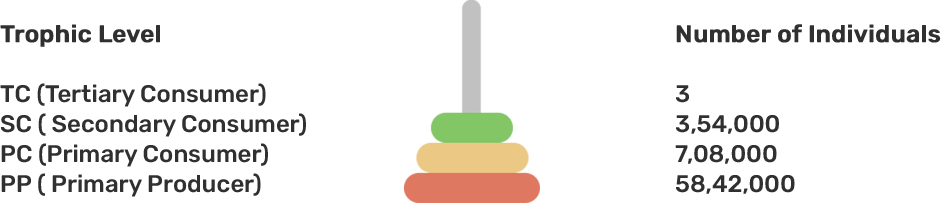
Pyramid of Number: The number of people at different trophic levels is depicted in this pyramid. The bottom of the pyramid is occupied by producers, who are followed by primary consumers, secondary consumers, and so on. In most situations, the pyramid's bottom is substantial. In certain situations, the shape of this pyramid could be inverted.

seo images


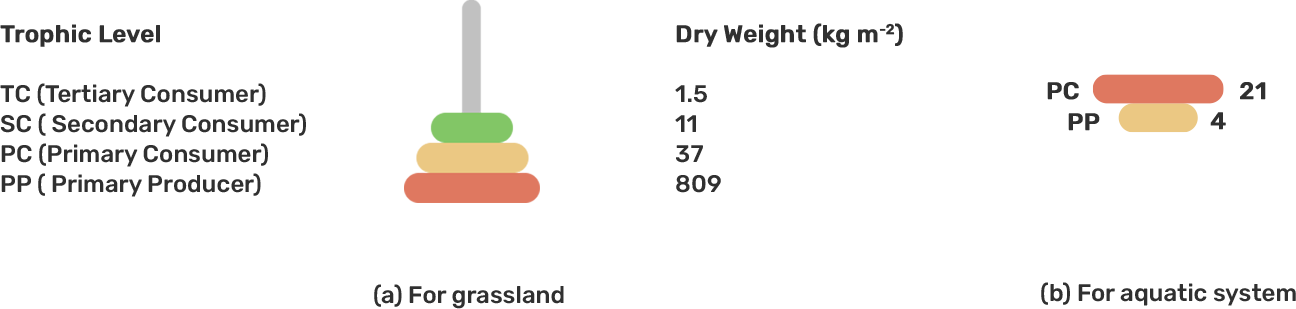
Pyramid of Biomass: The biomass (in units of dry weight) at different trophic levels is depicted in this pyramid. Producers are at the base of the pyramid, followed by primary consumers, secondary consumers, and so on. In most cases, the pyramid's bottom is substantial. In some situations, the shape of this pyramid could be inverted.

seo images


Pyramid of Energy: This pyramid demonstrates energy consumed at a distinct trophic level. The bottom of the pyramid is occupied by producers, who are followed by pyramid consumers, secondary consumers, and so on. In most situations, the shape of the pyramid bottom is heavy. It is impossible for this pyramid to be inverted.

seo images


In any type of pyramid, a specific trophic level demonstrates a functional level. A single organism can exist on multiple levels. Flow of energy would always be from prey to predator. The amount and availability of energy varies at different levels, and reduces at subsequent levels.


Q5Written answer

Write a short note on the pyramid of numbers and pyramid of biomass.

Show solutionHide solution
Worked solution

Ans: Pyramid of numbers: A graphical representation of the number of creatures at each trophic level is called a pyramid of numbers. Because the producers are always more numerous than the other trophic levels in an ecosystem, this is an upright pyramid. Charles Elton proposed the pyramid of numbers in 1927. The number of species engaged in each rung of the food chain varies dramatically, as Charles found out. The number of predators at the peak of the trophic structure decreases significantly as the links of the trophic structure progress.


Pyramid of Biomass: A biomass pyramid is a graphical representation of the biomass present in a unit of land at various trophic levels. It also shows the relationship between biomass and trophic level, evaluating the biomass obtainable at any particular time in each trophic degree of an energy network.


The changed biomass pyramid and the upstanding biomass pyramid are the two types of biomass pyramids. In a lake biological system, the mass of phytoplankton, the major producers, would constantly be lower than that of the mass of heterotrophs including fish and creepy crawlies, demonstrating the rearranging pyramid of biomass. The pyramid takes on an odd structure as the biomass estimation grows larger, with tertiary shoppers appearing at the top.


Q6Written answer

Given below is a list of autotrophs and heterotrophs. With your knowledge about the food chain, establish various linkages between the organisms on the principle of ‘eating and being eaten’. What is this inter-linkage established known as?


Algae, hydrilla, grasshopper, rat, squirrel, crow, maize plant, deer, rabbit, lizard, wolf, snake, peacock, phytoplankton, crustaceans, whale, tiger, lion, sparrow, duck, crane, cockroach, spider, toad, fish, leopard, elephant, goat, Nymphaea, Spirogyra.

Show solutionHide solution
Worked solution

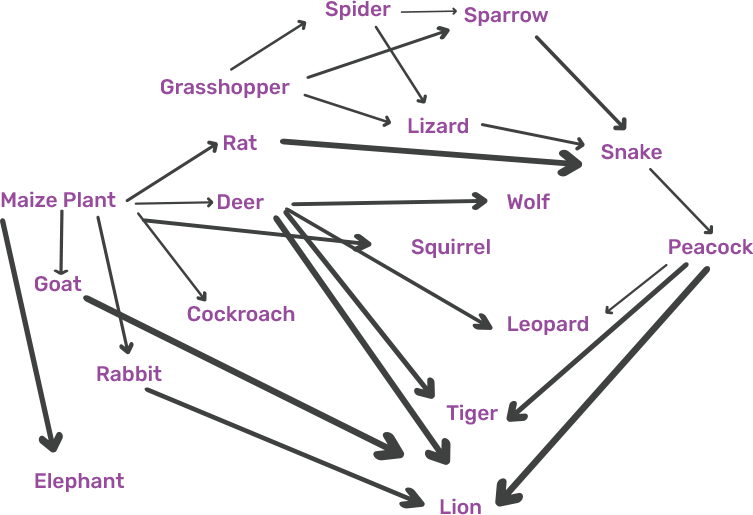
Ans: The term "food web" refers to the interconnection of many creatures. With the above list of creatures, the following two food webs are possible.

seo images


seo images


Q7Written answer

“The energy flow in the ecosystem follows the second law of thermodynamics.” Explain.

Show solutionHide solution
Worked solution

Ans: An isolated system's entropy never decreases, according to the second rule of thermodynamics; such a system would reach thermodynamic equilibrium on its own. In thermodynamic equilibrium, the configuration with the highest entropy is used.  To synthesise the molecules that an ecosystem requires, it requires a steady supply of energy.


As per the law of thermodynamics, Energy flows in an ecosystem have always been unidirectional since a reverse movement of energy would throw the system out of balance.  It has been noticed how producers capture solar energy and act as a conduit for delivering energy to the following trophic levels. Since it is a difficult task to stay in link with the rule of thermodynamics, energy never passes from a higher trophic level to a lower trophic level.


Q8Written answer

What will happen to an ecosystem if:

a. All producers are removed;

b. All organisms of herbivore level are eliminated; and

c. All top carnivore population is removed

Show solutionHide solution
Worked solution

Ans: When all producers are removed from an ecosystem, the primary consumers are left hungry. Because of hunger, all of the primary consumers would perish. This means there would be no food for secondary and tertiary customers, who will be gratified in due course. The ecosystem would come to an end as a result of this.

Ans: If all herbivores are destroyed from an ecosystem, predators will have no food. Due to a scarcity of food, all of the carnivores might eventually starve to death. In the absence of herbivores, plant populations will grow exponentially. However, if there aren't enough other biotic components, the biogeochemical cycle will come to a standstill. This will bring the ecosystem to a close.

Ans: Herbivore populations would explode if all of the top carnivores are destroyed. Due to overgrazing, the survival of green plants would be endangered. The absence of green flora will compel animals to starve to death.


Q9Written answer

Give two examples of artificial or man-made ecosystems. List the salient features by which they differ from natural ecosystems.

Show solutionHide solution
Worked solution

Ans: Two examples of artificial ecosystems are Crop fields and an aquarium.


Natural ecosystems

Man-made ecosystems

(i) Natural ecosystems are the ones that do not involve human intervention. 

(i) Man-made ecosystems are the ones that involve human intervention.

(ii) Numerous natural ecosystems are being spanned over huge areas.

(ii) These are the ecosystems which span within a limited area.

(iii) Replenishment of nutrients happens via biogeochemical cycles.

(iii) Replenishment of nutrients is done by humans.

(iv) There is an equilibrium between the producers and consumers population. 

(iv) There remains an imbalance in the producers and consumers population.

(v) Natural ecosystems are self-sustaining. 

(v) Man-made ecosystems are not self-sustaining. 


Q10Written answer

The biodiversity increases when one moves from the pioneer to the climax stage. What could be the explanation?

Show solutionHide solution
Worked solution

Ans: The food availability for customers determines a community's biodiversity. If a community's flora is diverse, this could sustain a wider range of consumer kinds.


The much more typical plants in a pioneer colony include bryophytes, lichens, and pteridophytes. Such plants don't really generate adequate biomass to support a diversified fauna.


As a result, biodiversity would be restricted at this time. Gymnosperms and angiosperms proliferate once the community reaches its peak. The biomass produced by these plants is sufficient to support a diversified fauna. As a consequence, biodiversity is currently expanding.