My Cart
Your Cart 0

    Your cart is empty.

  • Total (Amount) ₹0.00
NCERT Exemplar · Class 12 · Biology

Chapter 14: Ecosystem

Practice each question, then open the answer or worked solution.

Short Answer Questions

16 questions
Q11Written answer

Sometimes due to biotic/abiotic factors the climax remains in a particular seral stage (pre climax) without reaching climax. Do you agree with this statement. If yes, give a suitable example.

Show solutionHide solution
Worked solution

Ans: A sere refers to the full succession of communities which shift in a given location (s). All biotic and abiotic elements play an important part in this shift, allowing a community to achieve its climax. If the community's biotic and abiotic conditions are insufficient to support climax, this might stay in a given seral stage without attaining the climax. Table Top Mountain, with its sparse vegetation, is an instance of a community in the seral stage. Just mosses and ferns might be found in the community at the tabletop mountain's peak. In time, this would pave the way for taller plants.

Q12Written answer

What is an incomplete ecosystem? Explain with the help of suitable example.

Show solutionHide solution
Worked solution

Ans: An incomplete ecosystem is the one that is missing certain biotic or abiotic components. An ecology that isn't complete can't be self-sustaining. The aquarium is a nice example of a partially completed ecosystem. Even though there are producers and consumers in the aquarium, there are no decomposers. Due to a shortage of decomposers, the aquarium should be cleaned frequently and maintained regularly.


Q13Written answer

What are the shortcomings of ecological pyramids in the study of Ecosystems?

Show solutionHide solution
Worked solution

Ans: The below are some of the problems with ecological pyramids:

α. It ignores the fact that the same species might be found in two or more trophic levels.

β. It is dependent on a simple food chain assumption. A simple food chain, on the other hand, does not occur in nature. It's the natural world's intricate food web. 

χ. The decomposers are not included in the food pyramid. Decomposers, at the second hand, are essential components of the nutrition cycle.


Q14Written answer

How do you distinguish between humification and mineralisation?

Show solutionHide solution
Worked solution

Ans: The detritus food chain includes both humification and mineralization. Decomposition results in the production of inorganic compounds from organic matter, whereas humification results in the formation of a dark-colored amorphous material termed humus. Mineralisation, unlike humifaction, results in the full breakdown of organic molecules into inorganic compounds.


Q15Written answer

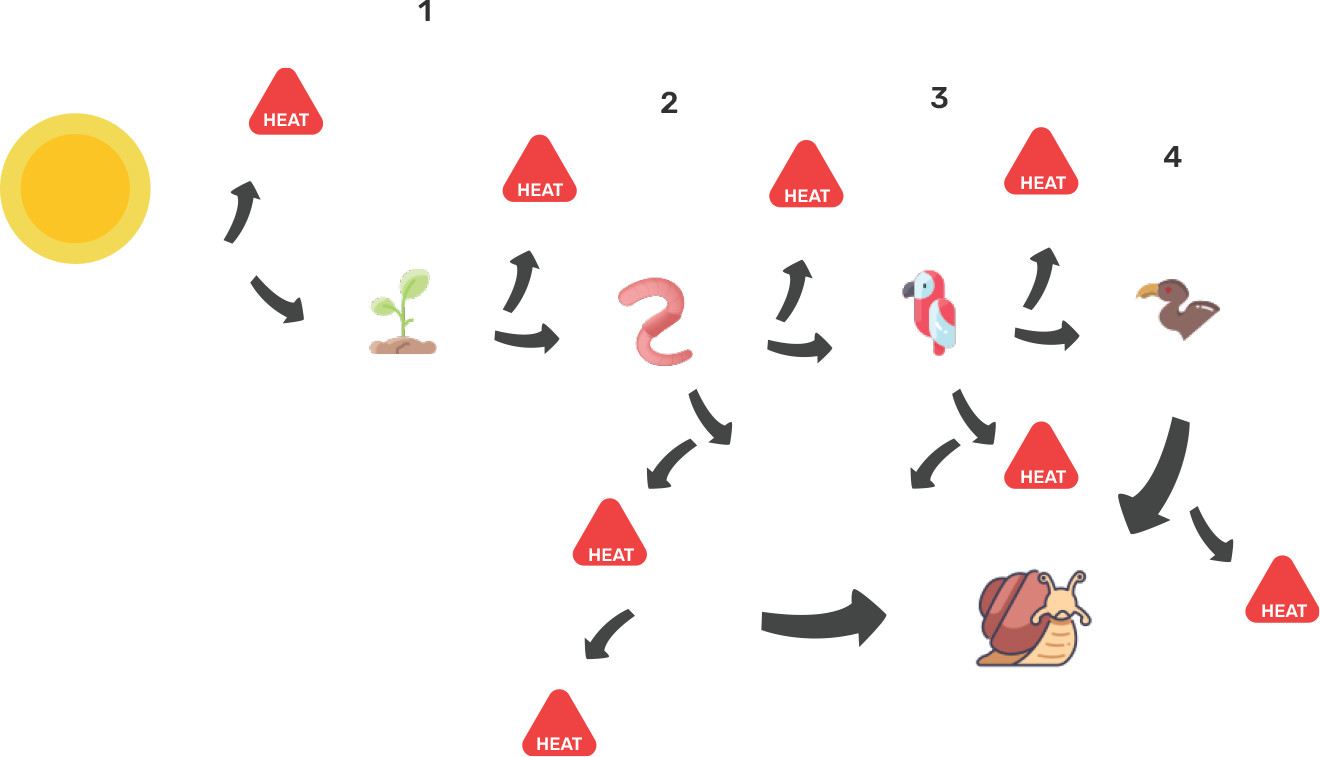
Fill in the trophic levels (1, 2, 3 and 4) in the boxes provided in the figure.

seo images


Show solutionHide solution
Worked solution

Ans:

1. Producer,

2. Primary Consumer,

3. Secondary Consumer,

4. Tertiary Consumer.


Q16Written answer

The rate of decomposition of detritus is affected by the abiotic factors like availability of oxygen, pH of the soil substratum, temperature etc. Discuss.

Show solutionHide solution
Worked solution

Ans: Living creatures are responsible for decomposition, albeit the rate of decomposition is regulated by a variety of abiotic variables. Because this is an oxygen-intensive mechanism, the rate of decomposition is influenced by the supply of oxygen. If there is more oxygen available, decomposition will proceed more quickly. The rate of decomposition is higher in warm weather than in cold weather. pH has an impact on the pace of decomposition. The rate of breakdown in neutral soil is higher than in acidic soil.