My Cart
Your Cart 0

    Your cart is empty.

  • Total (Amount) ₹0.00
NCERT Exemplar · Class 12 · Biology

Chapter 13: Organisms and Populations

Practice each question, then open the answer or worked solution.

LONG ANSWER TYPE QUESTIONS

12 questions
Q1Written answer

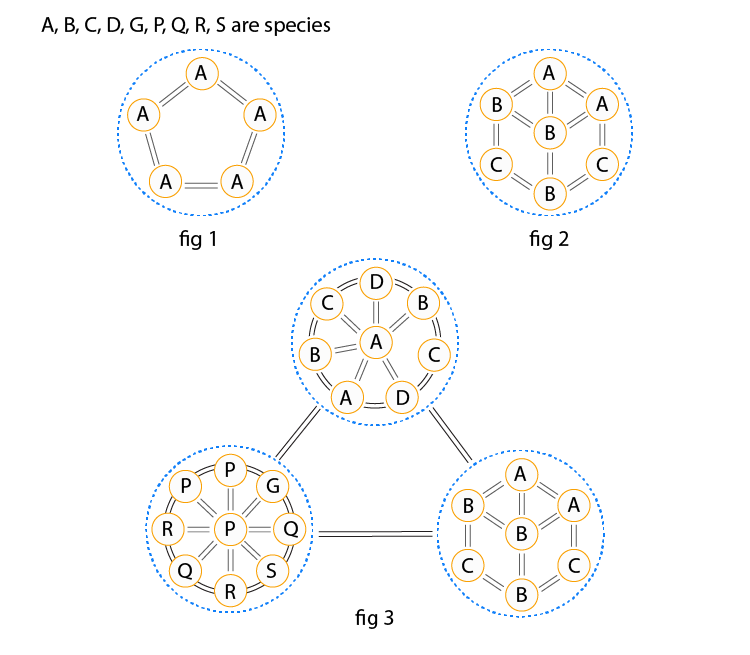
Comment on the following figures: 1, 2 and 3:
NCERT Exemplar Solution of Class 12 Biology Chapter 13 Organisms and Populations-4

Show solutionHide solution
Worked solution

1. Figure 1 shows a single population (A). All individuals of the same species interact among themselves and their environment only.

2. Figure 2 shows three species which are A, B and These three species are interacting among themselves and their environment.

3. Figure 3 shows a biome. It has three communities. Each community has a different species. These three communities interact with each other and the environment forming a biome.
Q2Written answer

An individual and population have certain characteristics. Name these attributes with definitions.

Show solutionHide solution
Worked solution

A) A population has birth rate (natality) and death rate (mortality) whereas an individual has birth and death.

B) Population density: The density is referred to as the individual per unit area and density changes with space and time

C) Population Growth: It is the growth rate seen in a population over time.

D) Natality: It is the rate of reproduction or birth rate per unit time.

E) Mortality: It is the rate of deaths per unit time. Increased mortality shows a decline in population.

Q3Written answer

The following diagrams are the age pyramids of different populations. Comment on the status of these populations.

Show solutionHide solution
Worked solution

The base is the pre-reproductive population. The mid part of the pyramid is the reproductive population and the top is the post-reproductive population. Figure ‘A’ is a pyramid-shaped figure. This structure has a larger base than the mid and the top.

Status: This shape indicates the population would grow rapidly.

Figure ‘B’ is an inverted bell-shaped pyramid. In this, both the pre-reproductive and reproductive population is the same.

Status: This shape indicates the population is stable.

Figure ‘is an urn-shaped pyramid. The pre-reproductive and reproductive population is lesser than the post-reproductive population.

Figure ‘B’ is an inverted bell-shaped pyramid. In this, both the pre-reproductive and reproductive population is the same.

Status: This shape indicates the population is stable.

Q4Written answer

Comment on the growth curve given below.

NCERT Exemplar Solution of Class 12 Biology Chapter 13 Organisms and Populations-5

Show solutionHide solution
Worked solution

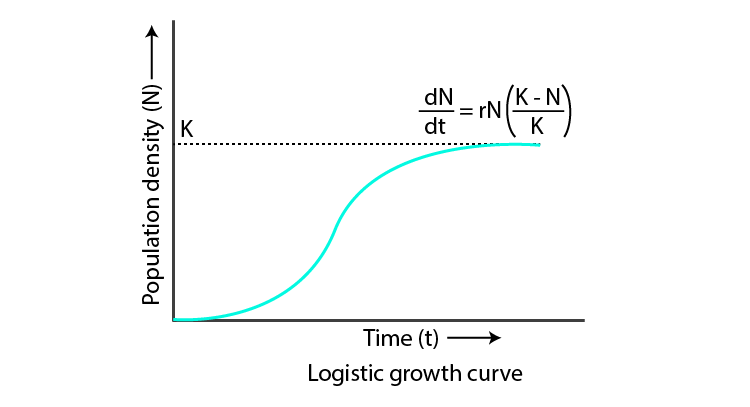
The above graph shows a population growing in a habitat having limited resources. The graph shows an initial lag phase. After that, an increase in population takes place, known as acceleration, following which deceleration takes place and at last, asymptote occurs. A sigmoid curve plot is formed when the population reaches carrying capacity. This is called Verhulst-Pearl logistic growth. This is represented by an equation: dN/dT=rN(K-N/K)

dN/dT=rN(1-N/K)

Here, (1-N/K) is environmental resistance.

Q5Written answer

A population of Paramoecium caudatum was grown in a culture medium. After 5 days the culture medium became overcrowded with Paramoeium and had depleted nutrients. What will happen to the population and what type of growth curve will the population attain? Draw the growth curve.

Show solutionHide solution
Worked solution

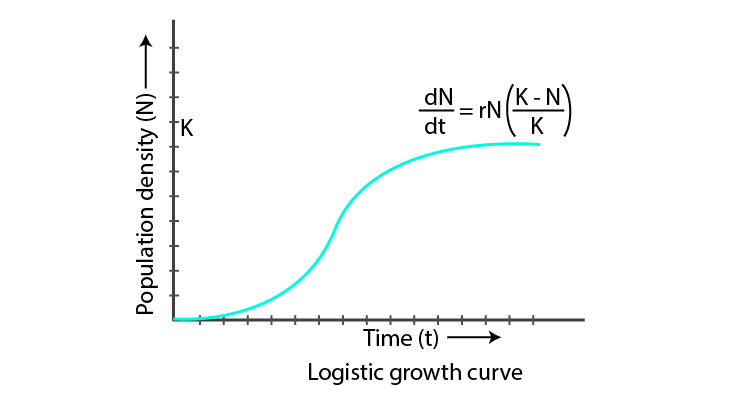
Sigmoid type of growth curve would be obtained. It shows a population growing in a habitat having limited resources.

The graph obtained is shown below:

NCERT Exemplar Solution of Class 12 Biology Chapter 13 Organisms and Populations-6

The graph initially shows the lag phase. Due to acceleration, a sudden increase has taken place. After that it is followed by deceleration as the available nutrients got depleted because of excessive usage and growth of paramoecium stops. At last, asymptote occurs.

Q6Written answer

Discuss the various types of positive interactions between species.

Show solutionHide solution
Worked solution
POSITIVE POPULATION INTERACTIONS
Species A

+

+

Species B

+

0

Nature of interaction

Mutualism

Commensalism

Q7Written answer

In an aquarium, two herbivorous species of fish are living together and feeding on phytoplankton. As per the Gause’s Principle, one of the species is to be eliminated in due course of time, but both are surviving well in the aquarium. Give possible reasons.

Show solutionHide solution
Worked solution

According to Gause’s principle, one of the species is to be eliminated, i.e., no two species can live in the same niche and hence one of them need to be eliminated. But in the given scenario, two herbivorous species are living in the same niche and feeding on phytoplankton may be due to sufficient availability of phytoplanktons.

Q8Written answer

While living in and on the host species, the animal parasite has evolved certain adaptations. Describe these adaptations with examples.

Show solutionHide solution
Worked solution

The loss of unnecessary sense organs, for example, lice, mites and fleas don’t have wings, Presence of adhesive organs or suckers to cling on to the host in tapeworms and leeches. Loss of digestive system i.e., tapeworm. High reproductive capacity i.e., roundworm produces large progeny.

Q9Written answer

Do you agree that regional and local variations exist within each biome? Substantiate your answer with a suitable example.

Show solutionHide solution
Worked solution

Yes, regional and local variations exist within each biome. A biome is a large community in the world. The main biome of the world does not show the boundary of any country. Regional and local variations lead to the formation of a wide variety of habitats. On earth, life exists even in extreme and harsh habitats – scorching Rajasthan desert, perpetually rain-soaked Meghalaya forest, deep ocean trenches, torrential streams, permafrost Polar Regions, high mountain tops, boiling thermal springs and stinking compost pits, etc.

Q10Written answer

Which element is responsible for causing soil salinity? At what concentration does the soil become saline?

Show solutionHide solution
Worked solution

The elements responsible for causing soil salinity are Na+, K+, Ca2+, Mg2+ and Cl-.

Soil salinity is the salt content in the soil, which is caused by improper irrigation. Causes of Soil Salinity are improper irrigation and human activities like fertilizing crops.