My Cart
Your Cart 0

    Your cart is empty.

  • Total (Amount) ₹0.00
NCERT Exemplar · Class 12 · Biology

Chapter 13: Organisms and Populations

Practice each question, then open the answer or worked solution.

SHORT ANSWER TYPE QUESTIONS

19 questions
Q1Written answer

Why are coral reefs not found in the regions from West Bengal to Andhra Pradesh but are found in Tamil Nadu and on the east coast of India?

Show solutionHide solution
Worked solution

For this, the tropical area is required and also high salinity. The influx of freshwater should not be there, and also no silation should occur. All these are found in Tamil Nadu and on the east coast of India but are not found in the regions from West Bengal to Andhra Pradesh.
Q2Written answer

If a freshwater fish is placed in aquarium containing seawater, will the fish be able to survive? Explain, giving reasons.

Show solutionHide solution
Worked solution

If a freshwater fish is placed in an aquarium containing seawater, the fish may not survive. Marine or sea fish is exposed to high salt concentration whereas freshwater fish is exposed to low salt concentration.

Q3Written answer

Why do all freshwater organisms have contractile vacuoles, whereas the majority of marine organisms lack them?

Show solutionHide solution
Worked solution

Freshwater fish are exposed to low salt concentration. So, they require contractile vacuoles to remove excess water.

Q4Written answer

Define heliophytes and sciophytes. Name a plant from your locality that is either heliophyte or sciophyte.

Show solutionHide solution
Worked solution

Heliophytes are also known as sun-loving plants, and for their optimum growth, they need high-intensity sunlight. Example Thyme, sunflower etc.

Sciophytes are also known as shade-loving plants. They require low-intensity sunlight for optimum growth. An example is Lycopodium.

Q5Written answer

Why do submerged plants receive weaker illumination than exposed floating plants in a lake?

Show solutionHide solution
Worked solution

The sunlight reaches the plant by passing through deep water. Floating plants are exposed to high-intensity sunlight because they float on the surface of the water. Sunlight directly reaches the plant.

Q6Written answer

In a seashore, the benthic animals live in sandy, muddy and rocky substrata and accordingly develop the following adaptations.

a. Burrowing

b. Building cubes

c. Holdfasts/peduncle

Find a suitable substratum against each adaptation.

Show solutionHide solution
Worked solution

a. Sandy

b. Muddy

c. Rocky

Q6 (2)Written answer

6. Categorise the following plants into hydrophytes, halophytes, mesophytes and xerophytes. Give reasons for your answers.

a. Salvinia

b. Opuntia

c. Rhizophora

d. Mangifera

Show solutionHide solution
Worked solution

a. Hydrophyte

b. Xerophyte

c. Halophyte

d. Mesophyte

Q8Written answer

In a pond, we see plants which are free-floating; rooted–submerged; rooted emergent; rooted with floating leaves. Write the type of plants against each of them.

Show solutionHide solution
Worked solution
Plant Name Type
a. Hydrilla

b. Typha

c. Nymphaea

d. Lemna

e. Vallisneria

……………

……………

……………

……………

……………

a. Submerged

b. Rooted emergent

c. Rooted with floating leaves

d. Free-floating

e. Rooted submerged

Q9Written answer

The density of a population in a habitat per unit area is measured in different units. Write the unit of measurement against the following:

a. Bacteria _______________

b. Banyan _______________

c. Deer _______________

d. Fish _______________

Show solutionHide solution
Worked solution

a. Nos. / Vol

b. Coverage/area

c. Biomass/area

d. Nos. / area

e. Wt. / area

Q10Written answer

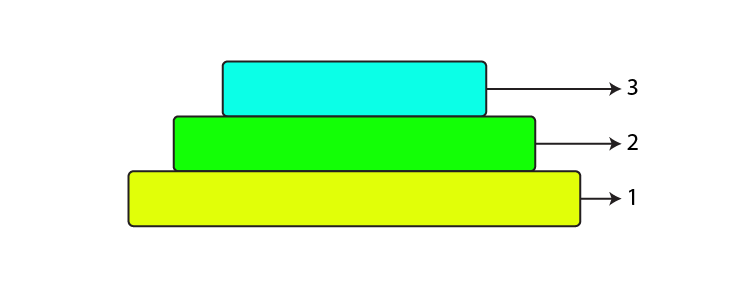
NCERT Exemplar Solution of Class 12 Biology Chapter 13 Organisms and Populations-1

a. Label the three tiers 1, 2, 3 given in the above age pyramid.

b. What type of population growth is represented by the above age pyramid?

Show solutionHide solution
Worked solution

(a) The three tiers represent:

Tier 1: Pre-reproductive population

Tier 2: Reproductive population

Tier 3: Post Reproductive population

(b) The pyramid represents a growing or expanding population as the pre-reproductive and reproductive population is growing.