My Cart
Your Cart 0

    Your cart is empty.

  • Total (Amount) ₹0.00
NCERT Exemplar · Class 12 · Biology

Chapter 13: Organisms and Populations

Practice each question, then open the answer or worked solution.

SHORT ANSWER TYPE QUESTIONS

19 questions
Q11Written answer

In an association of two animal species, one is a termite which feeds on wood and the other is a protozoan Trichonympha present in the gut of the termite. What type of association do they establish?

Show solutionHide solution
Worked solution

The association in which one is termite and the other is Trichonympha is a type of mutualism relation that is both the interacting species are benefitted.
Q12Written answer

Lianas are vascular plants rooted in the ground and maintain the erectness of their stem by making use of other trees for support. They do not maintain a direct relationship with those trees. Discuss the type of association the lianas have with the trees.

Show solutionHide solution
Worked solution

The association in which one is Lianas and the other is trees are commensalism one species is benefitted, and the other is neither benefitted nor harmed The Lianas plant has a long flexible stem, it gets the support of the tree without affecting harming or providing any benefit to the tree.

Q13Written answer

Give the scientific names of any two microorganisms inhabiting the human intestine.

Show solutionHide solution
Worked solution

The scientific names of two microorganisms inhabiting the human intestine are Escherichia coli and Lactobacillus.

Q14Written answer

What is a tree line?

Show solutionHide solution
Worked solution

Treeline is an altitude beyond which no tree is seen, and beyond the tree line, only shrubs and herbs are found.

Q15Written answer

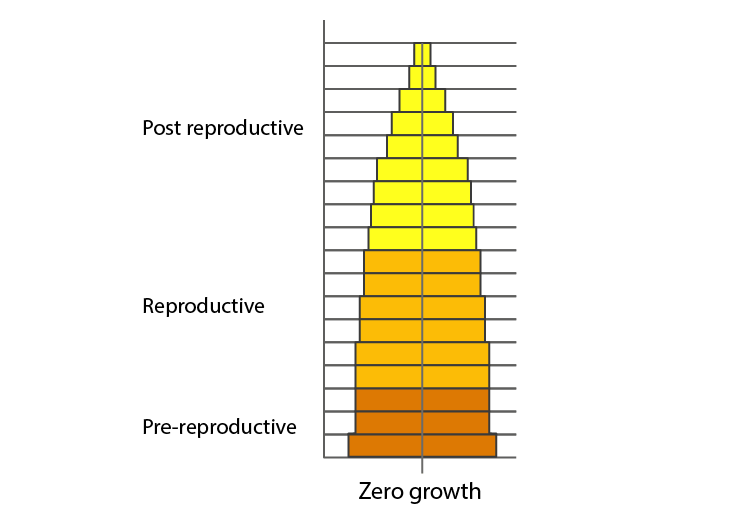
Define ‘zero population growth rate’. Draw an age pyramid for the same.

Show solutionHide solution
Worked solution

Zero Population growth rate is a condition wherein the population neither grows nor declines.

NCERT Exemplar Solution of Class 12 Biology Chapter 13 Organisms and Populations-2

Q16Written answer

List any four characters that are employed in the human population census.

Show solutionHide solution
Worked solution

Natality and mortality

Sex ratio

Population density

Age distribution

Q17Written answer

Give one example for each of the following types.

a) Migratory animal

b) Camouflaged animal

c) Predator animal

d) Biological control agent

e) Phytophagous animal

f) Chemical defence agent

Show solutionHide solution
Worked solution

a) Migratory animal – Siberian crane, salmon, dolphin, etc

b) Camouflaged animal – Grasshopper, chameleon, Frog, etc

c) Predator animal – Tiger, sparrow, lion, etc

d) Biological control agent – Myxoma virus to kill European rabbit, Gambusia fish to check the growth of mosquito larvae, moth against prickly pear cactus, etc

e) Phytophagous animal – Locusta insect, beetle, butterfly, etc

f) Chemical defence agent – Cardiac glycosides produced by Calotropis

Q18Written answer

Fill in the blanks

Species A Species B Type of interaction Example
+

+

+

–

+

…A……….

………B………..

…………C……..

Commensalism

……D……

………E…

……F…….

Show solutionHide solution
Worked solution

A = 0

B = Parasitism

C = Mutualism

D = Commensalism

E = Cuscuta

D = Lichen

E = Orchid or mango branch.

Q19Written answer

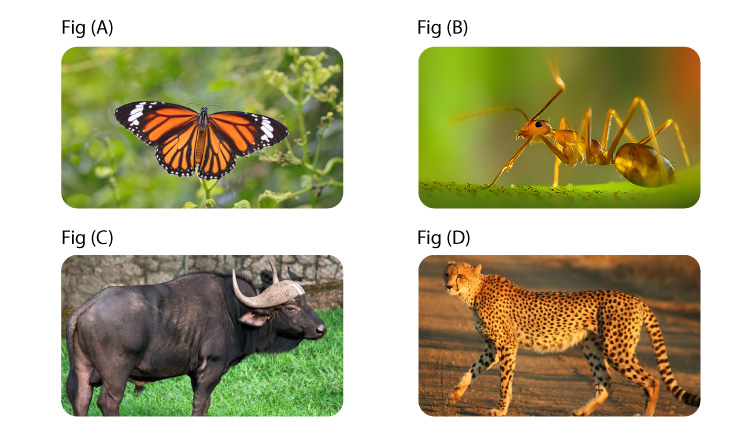
Observe the set of 4 figures A, B, C and D and, answer the following questions

i. Which one of the figures shows mutualism?

ii. What kind of association is shown in D?

iii. Name the organisms and the association in C.

iv. What role is the insect performing in B?

NCERT Exemplar Solution of Class 12 Biology Chapter 13 Organisms and Populations-3

Show solutionHide solution
Worked solution

i) Figure A shows mutualism

ii) Figure D shows an association of predation

iii) Figure C shows the egrets and grazing cattle.

iv) In figure B the insect is phytophagous that feed on the sap of the flower.