My Cart
Your Cart 0

    Your cart is empty.

  • Total (Amount) ₹0.00
NCERT Exemplar · Class 12 · Biology

Chapter 11: Biotechnology: Principles and Processes

Practice each question, then open the answer or worked solution.

Long Answer Questions

3 questions
Q1Written answer

For a,visualizespecific recognitionselection of recombinants, insertional inactivation of antibiotic marker has been superseded by insertional inactivation of a marker gene coding for a chromogenic substrate. Give reasons.

Show solutionHide solution
Worked solution

Ans: Selection of recombinants due to inactivation of antibiotics is a very difficult process because it requires simultaneous plating on two plates having different antibiotics. So, alternative selectable markers were developed which differentiate recombinants from non- recombinants based onthe their ability to produce color in the presence of a chromogenic substrate. In an enzyme beta-galactosidase. This results in the inactivation of the enzyme, which is referred to as insertional inactivation. The presence of chromogenic substrate gives blue color colonies if the plasmid in the bacteria does not have an insert. The presence of insert results into insertional inactivation of the alpha-galactosidase and colonies do not produce any color these are identified as recombinant colonies

Q2Written answer

Describe the role of Agrobacterium tumefaciens in transforming a plant cell.

Show solutionHide solution
Worked solution

Ans: Agro bacterium tumefaction's is a pathogen of several dicot plants which has the ability to insert a piece of DNA called ‘T-DNA’ to transform normal cells into tumour cells to produce a certain chemical which is needed by the pathogen.


Thus, the tumour-inducing Ti plasmid is now modified into a cloning vector which is no more pathogenic to the plants but is still able to use the mechanism of delivering genes of interest into a variety of plants.


Q3Written answer

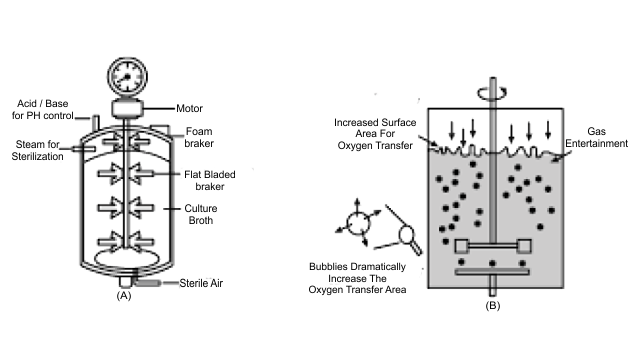
Illustrate the design of a bioreactor. Highlight the difference between a flask in your laboratory and a bioreactor which allows cells to grow in a continuous culture system.

Show solutionHide solution
Worked solution

Ans: Bioreactors are the large vessels in which raw materials are converted into specific products by biological means. The most common type of bioreactor is the stirring type. It is cylindrical in shape with a curved base to facilitate the mixing of the materials in the reactor. It has an agitator system, oxygen delivery system, foam control system, temperature control system. A sampling port (a small volume of products are collected periodically) is present.


On the other side, a flask in the laboratory cannot be used for producing rDNA on a large scale and it cannot be used to grow culture continuously.


seo images


The Best Study Material For Ncert Exemplar Class 12 Chapter 11 Biotechnology

The NCERT Class 12 Biology Exemplar for Chapter 11 Biotechnology: Principles and Processes is a valuable resource for studying for your CBSE Class 12 Biology test and graduate admission exams. This study guide includes exemplar questions from the NCERT exemplar book, key questions from previous year's question papers, sample papers, worksheets, and exercises.


The NCERT Class 12 Biology Exemplar for Chapter 11 gives you the opportunity to practice several types of questions that may be given in exams. MCQ’S, kindly fill in the blanks, true or false questions, such as the following, etc are popular types of questions that you should practice in order to perform well in exams, particularly entrance exams.


What is Biotechnology?

Biotechnology can be described as the effective use of biology to the development of products and technologies that benefit humans. The rise of genetic engineering and the development of vaccinations aided in the development of modern biotechnology. Waste management, energy production, and therapeutics are just a few of the industries where it's used.


The following are some of the most important biotechnology applications:

  • Genetic Engineering

  • Insertional activation 

  • Recombinant DNA technology

  • Cloning in Plants