My Cart
Your Cart 0

    Your cart is empty.

  • Total (Amount) ₹0.00
NCERT Exemplar · Class 11 · Maths

Chapter 7: Permutations and Combinations

Practice each question, then open the answer or worked solution.

Exercise · Page 122

Textbook page 122 · 32 questions
Q11Written answer

Find the number of positive integers greater than 6000 and less than 7000, which are divisible by 5, provided that no digit is to be repeated.

Show solutionHide solution
Worked solution

(i)Thousand’s Place can be filled with 6 alone.

Hence, number of ways =1

6

Unit place can be filled with either 0 or 5.

Hence, number of ways =2

6 0 or 5

Hundred’s place can be filled with the remaining 8 digits.

Hence, the number of ways =8

6 9, 8, 7, 4, 3, 2, 1 (0 or 5) 0 or 5

Ten’s place can be filled with 7 digits.

Number of ways= 7.

6 9, 8, 7, 4, 3, 2, 1 (0 or 5) Remaining 7 0 or 5

Thus, the required number will be

=1 x 8 x 7 x 2

=112

Q12Written answer

There are 10 persons named P1,P2,P3, … P10. Out of 10 persons, 5 persons are to be arranged in a line such that in each arrangement, P1 must occur, whereas P4 and P5 do not occur. Find the number of such possible arrangements. [Hint: Required number of arrangement =7C4× 5!]

Show solutionHide solution
Worked solution

We know that,

nCr
NCERT Exemplar Solutions For Class 11 Maths Chapter 7-14

According to the question,

There are 10 people named P1, P2, P3, … P10.

Number of ways in which P1 can be arranged =5! =120

Number of ways in which others can be arranged,

7C4 = 7!/(4!3!) = 35

Therefore, the required number of arrangements =C47 × 5

=35 x 120

=4200

Q13Written answer

There are 10 lamps in a hall. Each one of them can be switched on independently. Find the number of ways in which the hall can be illuminated.[Hint: Required number = 210 – 1].

Show solutionHide solution
Worked solution

We know that,

nCr
NCERT Exemplar Solutions For Class 11 Maths Chapter 7-15

We also know that,

NCERT Exemplar Solutions For Class 11 Maths Chapter 7-16

According to the question,

Number of lamps in a hall =10

Given that,

One of the lamps can be switched on independently

Hence, the number of ways in which the hall can be illuminated is given by,

C110 + C210 + C310 + C410 + C510 + C610 + C710 + C810 + C910 + C1010

=210-1

=1024-1

=1023

Q14Written answer

A box contains two white, three black and four red balls. In how many ways can three balls be drawn from the box, if at least one black ball is to be included in the draw?
[Hint: Required number of ways =3C1×6C2+3C2x 6C1+3C3.]

Show solutionHide solution
Worked solution

We know that,

nCr
NCERT Exemplar Solutions For Class 11 Maths Chapter 7-17

Drawing 1 black and 2 other ball = 3C1 × 6C2

Drawing 2 black and 1 other ball = 3C2 × 6C1

Drawing 3 black balls = 3C3

Number of ways in which at least one black ball can be drawn =

=(1 black and 2 other )or( 2 black and 1 other )or (3 black)

3C1 × 6C2 + 3C2 × 6C1 + 3C3 =3×15+3×6+1

= 45 + 18 + 1

= 64

Q15Written answer

If nCr – 1 = 36, nCr = 84 and nCr + 1 = 126, then find rC2.

[Hint: From equation using nCr / nCr + 1 and nCr / nCr – 1 to find the value of r.]

Show solutionHide solution
Worked solution

We know that,

nCr
NCERT Exemplar Solutions For Class 11 Maths Chapter 7-18

According to the question,

nCr – 1 =36,

nCr =84,

nCr +1=126

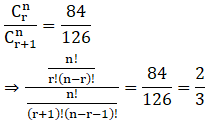
NCERT Exemplar Solutions For Class 11 Maths Chapter 7-19

2n-2r=3r+3

⇒2n – 3 = 5r … (i)

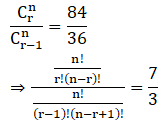
NCERT Exemplar Solutions For Class 11 Maths Chapter 7-20

=3n-3r+3=7r

3n+3=10r … (ii)

From (i) and (ii),

We get,

2(2n – 3) = 3n+3

4n – 3n – 6 – 3=0

n=9

And r=3

Now

rC2=3C2 = 3!/2!

=3

Q16Written answer

Find the number of integers greater than 7000 that can be formed with the digits 3, 5, 7, 8 and 9 where no digits are repeated. [Hint: Besides 4-digit integers greater than 7000, five digit integers are always greater than 7000.]

Show solutionHide solution
Worked solution

According to the question,

Digits that can be used = 3,5,7,8,9

Since, no digits can be repeated,

The number of integers is 5P5 = 5! = 120

For a four-digit integer to be greater than 7000,

The four-digit integer should begin with 7,8 or 9.

The number of such integer = 3 × 4P3 =3 × 4P3 = 3(24) =72

Therefore, the total no of ways = 120+72 = 192

Q17Written answer

If 20 lines are drawn in a plane such that no two of them are parallel and no three are concurrent, at how many points will they intersect each other?

Show solutionHide solution
Worked solution

Let the number of intersection point of first line =0

Let the number of intersection point of 2nd line = 1

Let the number of intersection point of 3rd line = 2+1

Let the number of intersection point of 4th line = 3+2+1

. . .

Let the number of intersection point of nth line =(n-1) +(n-2)…..(3)(2)(1), where n=20

S = ( n – 1) × n/2

=19×10

=190

Q18Written answer

In a certain city, all telephone numbers have six digits, the first two digits always being 41 or 42 or 46 or 62 or 64. How many telephone numbers have all si x digits distinct?

Show solutionHide solution
Worked solution

According to the question,

All telephone numbers have six digits

Given that,

The first two digits = 41 or 42 or 46 or 62 or 64

Hence, the number of 2 digits that the telephone number begins with =5

First, two digits can be filled in 5 ways,

The remaining four-digits can be filled in 8P4 ways,

8P4 = 8!/(8 – 4)! = 1680

Therefore, the number of telephone numbers having six distinct digits =5×1680

=8400

Q19Written answer

In an examination, a student has to answer 4 questions out of 5 questions; questions 1 and 2 are, however, compulsory. Determine the number of ways in which the student can make a choice.

Show solutionHide solution
Worked solution

We know that,

nCr
NCERT Exemplar Solutions For Class 11 Maths Chapter 7-21

According to the question,

Total number of questions =5

Number of questions to be answered =4

Compulsory questions are question number 1 and 2

Hence, the number of ways in which the student can make the choice = 3C2

3C2 = 3!/(2!1!) =3 ways

Q20Written answer

A convex polygon has 44 diagonals. Find the number of its sides. [Hint: Polygon of n sides has (nC2 – n) number of diagonals.]

Show solutionHide solution
Worked solution

We know that,

nCr
NCERT Exemplar Solutions For Class 11 Maths Chapter 7-22

Let the number of sides the given polygon have = n

Now,

The number of line segments obtained by joining n vertices = nC2

So, number of diagonals of the polygon = nC2 – n = 44

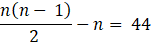
NCERT Exemplar Solutions For Class 11 Maths Chapter 7-23

n2 – 3n – 88 = 0

(n – 11) (n + 8) = 0

n = 11 or n = – 8

The polygon has 11 sides.

Long Answer Type