My Cart
Your Cart 0

    Your cart is empty.

  • Total (Amount) ₹0.00
NCERT Exemplar · Class 11 · Maths

Chapter 6: Linear Inequalities

Practice each question, then open the answer or worked solution.

Exercise · Page 107

Textbook page 107 · 16 questions
Q11Written answer

The longest side of a triangle is twice the shortest side and the third side is 2 cm longer than the shortest side. If the perimeter of the triangle is more than 166 cm then find the minimum length of the shortest side.

Show solutionHide solution
Worked solution

Let the length of shortest side = ‘x’ cm

According to the question,

The longest side of a triangle is twice the shortest side

⇒ Length of largest side = 2x

Also, the third side is 2 cm longer than the shortest side

⇒ Length of third side = (x + 2) cm

Perimeter of triangle = sum of three sides

= x + 2x + x + 2

= 4x + 2 cm

Now, we know that,

Perimeter is more than 166 cm

⇒ 4x + 2 ≥ 166

⇒ 4x ≥ 164

⇒ x ≥ 41

Hence, minimum length of the shortest side should be = 41 cm.
Q12Written answer

In drilling world’s deepest hole, it was found that the temperature T in degree Celsius, x km below the earth’s surface was given by T = 30 + 25 (x – 3), 3 ≤ x ≤ 15. At what depth will the temperature be between 155°C and 205°C?

Show solutionHide solution
Worked solution

According to the question,

T = 30 + 25(x – 3), 3 ≤ x ≤ 15; where, T = temperature and x = depth inside the earth

The Temperature should be between 155°C and 205°C,

So, we get,

⇒ 155 < T < 205

⇒ 155 < 30 + 25(x – 3) < 205

⇒ 155 < 30 + 25x – 75 < 205

⇒ 155 < 25x – 45 < 205

Adding 45 to each term, we get

⇒ 200 < 25x < 250

Dividing each term by 25, we get

⇒ 8 < x < 10

Hence, temperature varies from 155° C to 205° C at a depth of 8 km to 10 km.

Long Answer Type

Q13Written answer

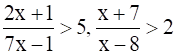
Solve the following system of inequalities

NCERT Exemplar Solutions Class 11 Maths Chapter 6-10

Show solutionHide solution
Worked solution

According to the question,

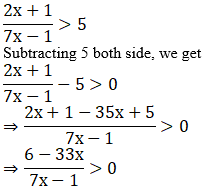
NCERT Exemplar Solutions Class 11 Maths Chapter 6-11

For the above fraction be greater than 0, either both the denominator and numerator should be greater than 0 or both should be less than 0.

⇒ 6 – 33x > 0 and 7x – 1 > 0

⇒ 33x < 6 and 7x > 1

⇒ x < 2/11 and x > 1/7

⇒ 1/7 < x < 2/11 …(i)

Or

⇒ 6 – 33x < 0 and 7x – 1 < 0

⇒ 33x > 6 and 7x < 1

⇒ x > 2/11 and x < 1/7

⇒ 2/11< x < 1/7 …(which is not possible since 1/7 > 2/11)

Also,

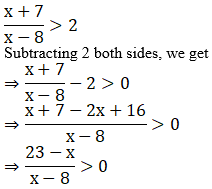
NCERT Exemplar Solutions Class 11 Maths Chapter 6-12

For the above fraction be greater than 0, either both the denominator and numerator should be greater than 0 or both should be less than 0.

⇒ 23 – x > 0 and x – 8 > 0

⇒ x < 23 and x > 8

⇒ 8 < x < 23 …(ii)

Or

23 – x < 0 and x – 8 < 0

⇒ x > 23 and x < 8

⇒ 23 < x < 8 …(which is not possible, as 23 > 8]

Therefore, from equations (i) and (ii), we infer that there is no solution satisfying both inequalities.

Hence, the given system has no solution.

Q14Written answer

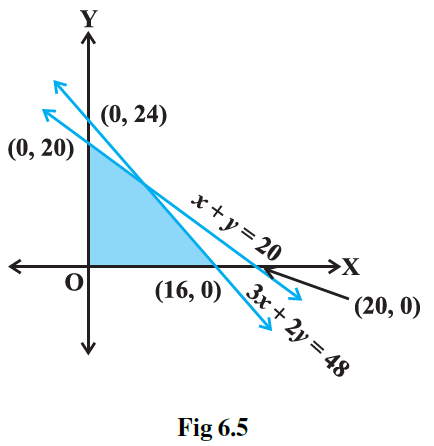
Find the linear inequalities for which the shaded region in the given figure is the solution set.

NCERT Exemplar Solutions Class 11 Maths Chapter 6-13

Show solutionHide solution
Worked solution

According to the question,

Considering 3x + 2y = 48,

The shaded region and the origin are both on the same side of the graph of the line, and (0, 0) satisfy the constraint 3x + 2y ≤ 48.

Considering x + y = 20,

The shaded region and the origin both are on the same side of the graph of the line, and (0, 0) satisfy the constraint x + y ≤ 20.

We also know that,

Shaded region is in the first quadrant i.e. x ≥ 0 and y ≥ 0,

Hence, the linear inequalities are

3x + 2y ≤ 48

x + y ≤ 20

x ≥ 0

y ≥ 0

Q15Written answer

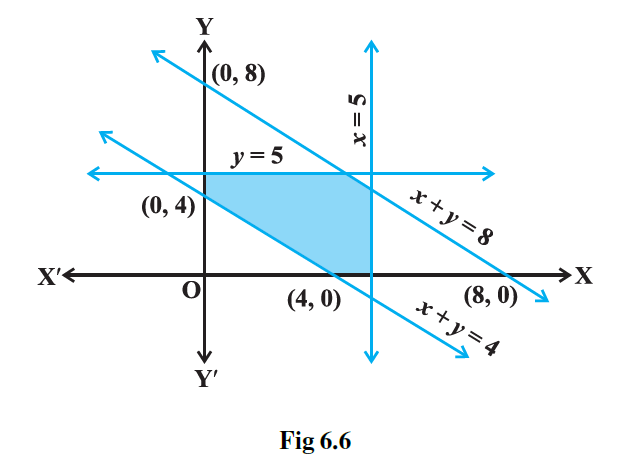
Find the linear inequalities for which the shaded region in the given figure is the solution set.

NCERT Exemplar Solutions Class 11 Maths Chapter 6-14

Show solutionHide solution
Worked solution

According to the question,

Considering x + y = 8,

The shaded region and the origin are both on the same side of the graph of the line, and (0, 0) satisfy the constraint x + y ≤ 8.

Considering x + y = 4,

The origin is on the opposite side of the shaded region, and (0, 0), hence, doesn’t satisfy the constraint x + y ≥ 4; therefore required constraint is x + y ≥ 4

We see that,

The shaded region is in the first quadrant i.e. x ≥ 0 and y ≥ 0,

Also, shades region is below the line y = 5 and left to the line x = 5

⇒ y ≤ 5 and x ≥ 5

Hence, the linear inequalities are

x + y ≤ 8

x + y ≥ 4

x ≥ 0

y ≥ 0

x ≤ 5

y ≤ 5

Q16Written answer

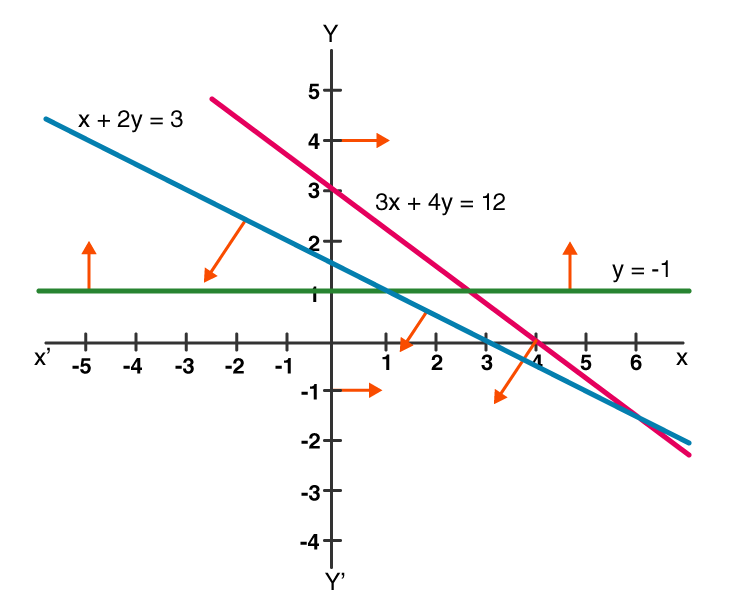
Show that the following system of linear inequalities has no solution x + 2y ≤ 3, 3x + 4y ≥ 12, x ≥ 0, y ≥ 1

Show solutionHide solution
Worked solution

According to the question,

x + 2y ≤ 3

Line: x + 2y = 3

x 3 1
y 0 1

Also, (0, 0) satisfies the x + 2y ≤ 3, hence region is towards the origin

3x + 4y ≤ 12

Line: 3x + 4y = 12

x 0 4
y 3 0

Also, (0, 0) satisfies the 3x + 4y ≤ 3, hence region is towards the origin

x ≥ 0 ⇒ region is to the right of the y-axis

And, y ≥ 1 ⇒ region is up above the line x = 1,

Therefore graph can be plotted as,

NCERT Exemplar Solutions Class 11 Maths Chapter 6-15

Hence, we can conclude from the graph that the above system has no common region as a solution.