My Cart
Your Cart 0

    Your cart is empty.

  • Total (Amount) ₹0.00
NCERT Exemplar · Class 11 · Chemistry

Chapter 6: Thermodynamics

Practice each question, then open the answer or worked solution.

Long Answer Questions

5 questions
Q58Written answer

Derive the relationship between H and U for an ideal gas. Explain each term involved in the equation.

Show solutionHide solution
Worked solution

Ans: We know that the change in internal energy equals the heat absorbed at constant volume, i.e., U= qV.m. However, the majority of chemical reactions are carried out in flasks or test tubes under constant atmospheric pressure U= qp -PV under constant pressure, where qp is the heat absorbed by the system and -PV is the expansion work done by the system.

Let's call the beginning state with subscript 1 and the end state with subscript 2.

The above equation can be rewritten as

U2-U1= P(V2-V1)

On rearranging, we get

qp= (U2+pV2) - (U1 + pV1)...........(1)

Now, we can define another thermodynamic function, the enthalpy H [Greek word enthalpien, to warm or heat content] as:

H = U + pV………(2)

So, equation (1) becomes

qp = H2- H1 = ΔH

Despite the fact that q is a path dependent function, H is a state function because it is reliant on state functions U, p, and V. As a result, H is path-independent. As a result, qp is path-independent.

Equation (2) can be written as for finite changes at constant pressure.

ΔH= ΔU + ΔpV

Since, P is constant, we can write:

ΔH = ΔU + PΔV……………(3)

It's worth noting that we're actually measuring changes in the enthalpy when heat is absorbed by the system at constant pressure. Remember  ΔH= qp , heat absorbed by the system at constant pressure. H is negative for exothermic reactions, which produce heat, and positive for endothermic reactions, which absorb heat from the environment.

As a result, equation (3) becomes U = qv at constant volume (V=0).

ΔH= ΔU=qv

Let's have a look at a gaseous reaction. If VA is the total volume of gaseous reactants, VB is the total volume of gaseous products, nA is the number of moles of gaseous reactants, and nB is the number of moles of gaseous products, then we write using the ideal gas law.,

PVA = nART

PVB = nBRT

Thus, PVB- PVA = nBRT - nART = (nB-nA)RT

Or, P(VB- VA) = (nB - nA)RT

Or, pΔV = ΔngRT……….(4)

The number of moles of gaseous products minus the number of moles of gaseous reactants is denoted by ng.

Equation (3) is obtained by substituting the value of PV from equation (4) in equation (3).

ΔH = ΔU + ΔngRT…………(5)

Q59Written answer

Extensive properties depend on the quantity of matter but intensive properties do not. Explain whether the following properties are extensive or intensive. Mass, internal energy, pressure, heat capacity, molar heat capacity, density, mole fraction, specific heat, temperature and molarity.

Show solutionHide solution
Worked solution

Ans: A contrast is drawn in thermodynamics between extensive and intense qualities. An extensive property is one whose value is proportional to the amount or size of matter in the system. Extensive properties include mass, volume, internal energy, enthalpy, and heat capacity, to name a few.

Properties that are independent of the amount or size of matter present are known.

As though they were intensive properties Temperature, density, and pressure, for example, are intense properties. A molar property, 𝝌m, is the value of an extensive property of the system for 1 mol of the substance. If n is the amount of matter, 𝝌m = 𝝌/n, is independent of the amount of matter. An intensive property is always the ratio of two extensive properties.

Extensive/Extensive = Intensive

E.g., Mole Fraction = Moles / Total number of moles = Extensive/Extensive


Q60Written answer

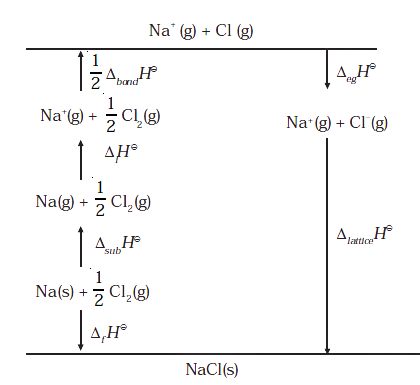
The lattice enthalpy of an ionic compound is the enthalpy when one mole of an ionic compound present in its gaseous state, dissociates into its ions. It is impossible to determine directly by experiment. Suggest and explain an indirect method to measure lattice enthalpy of NaCl(s).

Show solutionHide solution
Worked solution

Ans:  The enthalpy change that occurs when one mole of an ionic compound dissociates into its ions in a gaseous state is called the lattice enthalpy of an ionic compound.

Na+ + Cl- (s) → Na+ (g) + Cl- (g)

Δlattice H0 → +788 KJmol-1

Let us now calculate the lattice enthalpy of Na+Cl- (s) by following steps given below:


seo images


1. Na (s) → Na (g), sublimation of sodium metal, ΔsubH0 = 108.4 KJmol-1

2. Na (g) → Na+ (g) + e- (g) the ionization sodium atoms, ionization enthalpy.

ΔiH0 = 496 KJ/mol 

3. ½ Cl2 (g)  → 2Cl (g), the dissociation of chlorine, the reaction enthalpy is half the bond dissociation enthalpy.

1/2 Δbond H0 = 121 KJ/mol

4. Cl (g) + e- → Cl- (g) electron gained by chlorine atoms. The electron gain enthalpy,  

Δe.g H0 = -348.6 KJ/mol.

5. Na+(g) + Cl- (g) → Na+Cl- (s) 


Q61Written answer

ΔG is net energy available to do useful work and is thus a measure of “free energy”. Show mathematically that ΔG is a measure of free energy. Find the unit of ΔG. If a reaction has positive enthalpy change and positive entropy change, under what condition will the reaction be spontaneous?

Show solutionHide solution
Worked solution

Ans: We know,

ΔStotal = ΔSsys + ΔSsurr

When a system is in thermal equilibrium with its surroundings, the surroundings' temperature is the same as the system's. Furthermore, a rise in the enthalpy of the surroundings equals a decrease in the system's enthalpy. As a result of the entropy shift in the environment,

ΔSsurr = ΔHsurr/T = -ΔHsys/T

ΔStotal = ΔSsys = (-ΔHsys/T)

Rearranging the above equation:

ΔStotal = TΔSsys - ΔHsys

For spontaneous process,

ΔStotal > 0, so 

TΔSsys - ΔHsys> 0

⇒ ( - ΔHsys - TΔSsys) > 0

The above equation can be written as

- ΔG > 0

ΔG = ΔH - TΔS < 0

ΔHsys is the enthalpy change of a reaction, TΔSsys is the energy which is not available to do

useful work. As a result, G is a measure of 'free energy,' as it is the net energy available to conduct beneficial work. As a result, it's also known as the reaction's free energy. At constant pressure and temperature, G gives a set of conditions for spontaneity,

(i) If ΔG is negative (<0), the process is spontaneous.

(ii) If ΔG is positive (>0), the process is nonspontaneous.

• Unit of ΔG is Joule.

• The reaction will be spontaneous at high temperature.


Q62Written answer

Graphically show the total work done in an expansion when the state of an ideal gas is changed reversibly and isothermally from (Pi, Vi) to (Pf, Vf) . With the help of a pV plot compare the work done in the above case with that carried out against a constant external pressure Pf.


seo images


Show solutionHide solution
Worked solution

Ans: (i) Reversible work is represented by the combined areas

seo imagesseo images

(ii) Work against constant pressure, Pf  is represented by the area

seo images


The Approach While Dealing With the Concept of Thermodynamics

  • Since the concept of Thermodynamics and the terminologies of Chemistry are a bit new to the students, they should first learn the names of different chemical components and how to write the chemical equations properly by joining the free Classes on Vedantu and by consulting the NCERT Exemplars and Solutions books.

  • While writing the chemical equations, they might make some mistakes. To avoid making errors, they should practice writing the equations at home.

  • Solving previous years' question papers will help them to manage time and quickly analyze the answers in their minds.

  • Comparing their own answers with the solutions provided in the NCERT Exemplar Solutions will help them to be sure of the fact that how efficient they are at answering the questions of Chemistry. It will help them to boost their confidence as well.

  • Revising is extremely important when it comes to answering Chemistry questions since a lack of practice and habits of writing can make the students forget some important information that they should include in their answers. The mock papers are beneficial for them to serve this purpose

  • Rational thinking plays an important part in answering the questions in Chemistry. The students need to have a clear idea of the basic physical characteristics of different chemical compounds and how they will react depending on the presence of other external factors. Practicing is the only way to sharpen their thinking ability and analysis power.