My Cart
Your Cart 0

    Your cart is empty.

  • Total (Amount) ₹0.00
NCERT Exemplar · Class 11 · Chemistry

Chapter 6: Thermodynamics

Practice each question, then open the answer or worked solution.

Multiple Choice Questions (Type-II)

43 questions
Q45Written answer

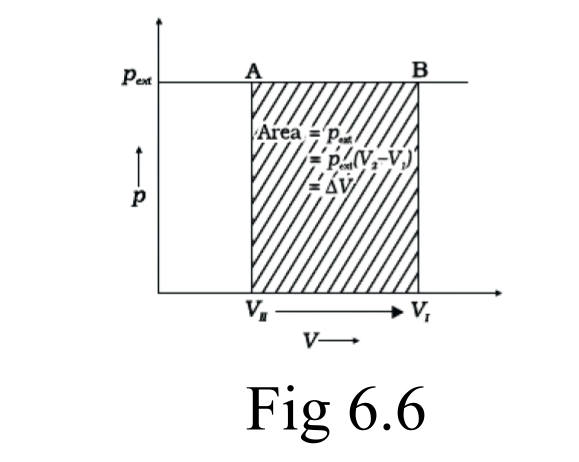
What will be the work done on an ideal gas enclosed in a cylinder, when it is compressed by a constant external pressure, pext in a single step as shown in Fig. 6.2. Explain graphically.


seo images


Show solutionHide solution
Worked solution

Ans: Assumption: Cylinder is filled with one mole gas, and the piston is frictionless. Let the pressure of gas inside be p and the volume of gas be V_{I}.

Piston is moved towards the inside to make the external pressure (P_{ext}) equal to p. Now, let us assume that this change takes place in a single step, hence, V is the final volume. The work done by the piston is depicted in the graph shown below by shading the area.

Pext$\Delta $V= AV1$\times $(V1-V2)

seo images


Q46Written answer

How will you calculate work done on an ideal gas in a compression, when change in pressure is carried out in infinite steps?

Show solutionHide solution
Worked solution

Ans: When a process can be reversed by bringing an extremely small change in it, we call it a reversible process. The pressure-volume graph can be used to calculate the work done. The pressure is not constant, and changes in infinitesimal amounts as compression happens from initial volume Vi to the final volume Vf. The below graph depicts the work done with the shaded area.


seo images


Q47Written answer

Represent the potential energy/enthalpy change in the following processes graphically.

(a) Throwing a stone from the ground to roof.

(b) $\frac{~~1~~}{2}$H2(g)+ $\frac{~~1~~}{2}$Cl2(g)$\to $HCl (g) $\Delta $rH$\Theta $=-92.32kJmol-1

In which of the processes potential energy/enthalpy change is a contributing factor to the spontaneity?

Show solutionHide solution
Worked solution

Ans:

(a) Throwing a stone from ground to roof


seo images


b) the reaction involved is a process where the energy decreases after the reaction. It can be represented as:

In process b), potential energy/enthalpy change is a contributing factor to the spontaneity.


seo images


Q48Written answer

Enthalpy diagram for a particular reaction is given in Fig. 6.3. Is it possible to decide spontaneity of a reaction from a given diagram? Explain.


seo images


Show solutionHide solution
Worked solution

Ans: No, for the state of spontaneity, the enthalpy change is not the only criteria. Entropy also needs to be taken into account here.


Q49Written answer

1.0 mol of a monatomic ideal gas is expanded from state (1) to state (2) as shown in figure. Calculate the work done for the expansion of gas from state (1) to state (2) at 298 K.


seo images


Show solutionHide solution
Worked solution

Ans: We can conclude from the figure that this change is a reversible change.

Now,

W= -2.303 $\times $nRT log$\frac{~~~p1~~}{p2}$

=-2.303 $\times $8.314$\times $1$\times $298$\times $log2

= -2.303 $\times $8.314$\times $298$\times $0.3010J

=-1717.46J


Q50Written answer

An ideal gas is allowed to expand against a constant pressure of 2 bar from 10 L to 50 L in one step. Calculate the amount of work done by the gas. If the same expansion were carried out reversibly, will the work done be higher or lower than the earlier case?

(Given that 1 L bar = 100 J)

Show solutionHide solution
Worked solution

Ans: We know that the amount of work done =-pext$\Delta $V

On substituting the values in the formula, we get,

-2bar$\times $(50-10)L=-80Lbar

According to the described problem,1LBar = 100J

Therefore, -80 Lbar=(-80$\times $100)=-8000J

=-8kJ, which is the amount of work done

The significance of the negative sign states that the work is done on the surroundings of the system. In the case of reversible expansion, the work done will be more.


In the following questions, more than one correlation is possible between options of both columns.

Q51Written answer

Match the followings:

A

B

(i) Adiabatic process

(a) Heat

(ii) Isolated system

(b) At constant volume

(iii) Isothermal change

(c) First law of thermodynamics

(iv) Path function

(d) No exchange of energy and matter

(v) State function

(e) No transfer of heat

(vi) ΔU= q

(f) Constant temperature

(vii) Law of conservation of energy

(g) Internal energy

(viii) Reversible process

(h) Pext=0

(ix) Free expansion

(i) At constant pressure

(x) ΔH=q

(j) Infinitely slow process which proceeds through a series of equilibrium states.

(xi)  Intensive property

(k) Entropy

(xii) Extensive property

(l) Pressure


(k) Specific heat


Show solutionHide solution
Worked solution

Ans: 

(i)- (e)

(ii)- (d)

(iii)- (f)

(iv)- (a)

(v)- (g)

(k)- (L)

(vi)- (b)

(vii)- (c)

(viii)- (j)

(ix)- (h)

(x)- (i)

(xi)- (a), (l), (m)

(xii)- (g), (k)


Q52Written answer

Match the following processes with entropy change:

Reaction

Entropy Change

(i) A liquid vapourises

(a) ΔS=0

(ii) Reaction is nonspontaneous at all temperatures and ΔH is positive.


(b) ΔS= positive

(iii) Reversible expansion of an ideal gas

(c) ΔS= negative


Show solutionHide solution
Worked solution

Ans: 

(i) (b)

(ii) (c)

(iii) (a)


Q53Written answer

Match the following parameters with description for spontaneity:

Δ (parameters)

ΔH0          ΔrS0              ΔrG0

Description

+               -                    +    

(a) Non-spontaneous at high temperature.

-                 -                   + at high temperature

(b) Spontaneous at all temperatures.

-                  +                   -

(c) Non-spontaneous at all temperatures.


Show solutionHide solution
Worked solution

Ans: (i)- (c)

(ii)- (a)

(iii)- (b)


Q54Written answer

Match the following:

Column I

Column II

(i) Entropy of vaporisation

(a) decreases

(ii) K for spontaneous process

(b) is always positive

(iii) Crystalline solid state

(c) lowest entropy

(iv) ΔU in adiabatic expansion of ideal gas.

(d) ΔHvap/Tb


Show solutionHide solution
Worked solution

Ans: 

(i)- (b), (d)

(ii)- (b)

(iii)- (c)

(iv)- (a)


In the following questions a statement of Assertion (A) followed by a statement of reason (R) is given. Choose the correct option out of the choices given below each question.