My Cart
Your Cart 0

    Your cart is empty.

  • Total (Amount) ₹0.00
NCERT Exemplar · Class 11 · Chemistry

Chapter 6: Thermodynamics

Practice each question, then open the answer or worked solution.

Multiple Choice Questions (Type-II)

43 questions
Q25Written answer

The enthalpy of atomisation for the reaction CH4(g)$\to $C(g) + 4H (g)  is 1665kJ mol-1. What is the bond energy of C-H bond?

Show solutionHide solution
Worked solution

Ans: The reaction presented in the question is

CH4(g)$\to $C(g) + 4H (g)

Now, $\Delta $aH = 1665  kJ mol-1

The mean bond enthalpy of the C-H bond should be used here. For the atomisation of 4 moles of C-H bonds, the value is 1665 kJ/mol-1. So, per mole energy = 1665/4 = 416.2 kJ / mol-1.

Q26Written answer

Use the following data to calculate $\Delta $ latticeH$\ominus $for NaBr.

$\Delta $sub H$\ominus $for sodium metal = 108.4 kJ mol–1

Ionization enthalpy of sodium = 496 kJ mol-1

Electron gain enthalpy of bromine = – 325 kJ mol-1

Bond dissociation enthalpy of bromine = 192 kJ mol-1

$\Delta $fH$\ominus $for NaBr (s) = – 360.1 kJ mol-1

Show solutionHide solution
Worked solution

Ans: In order to calculate the lattice enthalpy of NaBr,

(i)Na(s) $\to $Na(g) ;$\Delta $ subH$\circ $=108.4 kJ mol-1

(ii) Na$\to $Na+ + e-   ; $\Delta $iH$\circ $ = 496kJ mol-1

(iii) $\frac{~~~1~}{2}$Br2$\to $ Br, $\frac{~~1~~}{2}\Delta $ dissH$\circ $=96kJ mol-1

(iv) Br+e-$\to $Br-;  $\Delta $ egH$\circ $= - 325 kJmol-1

$\Delta $fH$\circ $= $\Delta $ subH$\circ $+ $\frac{~~1~~}{2}\Delta $ dissH$\circ $+$\Delta $iH$\circ $+ $\Delta $ egH$\circ $+ $\Delta $ latticeH$\circ $

= -360.1 -108.4-96-496+325 = -735.5KJ mol-1


Q27Written answer

Given that ΔH= 0 for mixing of two gases. Explain whether the diffusion of these gases into each other in a closed container is a spontaneous process or not?

Show solutionHide solution
Worked solution

Ans: It is a spontaneous process. Although enthalpy change is zero, randomness or disorder (ΔS) increases and ΔS is positive. Therefore, in the equation, ΔG = ΔH – TΔS, the term TΔS will be negative. Hence ΔG will be negative.


Q28Written answer

Heat has a randomising influence on a system and temperature is the measure of average chaotic motion of particles in the system. Write the mathematical relation which relates these three parameters.

Show solutionHide solution
Worked solution

Ans: Heat has a randomising influence on a system and temperature is the measure of average chaotic motion of particles in the system. The mathematical relation which relates these three parameters is ΔS = qrev/ T

Here, ΔS = change in entropy                                                  ^

qrcv = heat of reversible reaction ‘

T = temperature


Q29Written answer

Increase in enthalpy of the surroundings is equal to decrease in enthalpy of the system. Will the temperature of the system and surroundings be the same when they are in thermal equilibrium?

Show solutionHide solution
Worked solution

Ans: Yes, when the system and the surroundings are in thermal equilibrium, their temperatures are the same.


Q30Written answer

At 298 K, Kp for the reaction N204(g)⇌ 2N02(g) is 0.98. Predict whether the reaction is spontaneous or not.

Show solutionHide solution
Worked solution

Ans: ΔrG° = -RT ln Kp

= -RT ln (0.98)

Since In (0.98) is negative

.’. ΔrG° is positive the reaction is non spontaneous


Q31Written answer

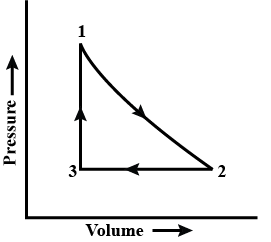
A sample of 1.0 mol of a monatomic ideal gas is taken through a cyclic process of expansion and compression as shown in the figure. What will be the value of ΔHfor the cycle as a whole?

Show solutionHide solution
Worked solution

Ans: 


seo images


For a cyclic process, ΔH = 0


Q32Written answer

The standard molar entropy of H2O(l) is 70 J K-1 mol-1. Will the standard molar entropy H2O(s) be more, or less than 70 J K -1 mol-1?

Show solutionHide solution
Worked solution

Ans: The standard molar entropy of H20 (1) is 70 J K-1 mol-1. The solid form of H20 is ice. In ice, molecules of H20 are less random than in liquid water. Thus, molar entropy of H20 (s) < molar entropy of H20 (1). The standard molar entropy of H20 (s) is less than 70 J K 1 mol-1.


Q33Written answer

Identify the state functions and path functions out of the following: enthalpy, entropy, heat, temperature, work, free energy.

Show solutionHide solution
Worked solution

Ans: State functions: Enthalpy, entropy, temperature, free energy Path functions: Heat, work


Q34Written answer

The molar enthalpy of vaporization of acetone is less than that of water. Why?

Show solutionHide solution
Worked solution

Ans:  Molar enthalpy of vaporization is more for water due to hydrogen bonding between water molecules.