My Cart
Your Cart 0

    Your cart is empty.

  • Total (Amount) ₹0.00
NCERT Exemplar · Class 11 · Chemistry

Chapter 3: Classification of Elements and Periodicity in Properties

Practice each question, then open the answer or worked solution.

Short Answer Questions

25 questions
Q24Written answer

Explain why the electron gain enthalpy of fluorine is less negative than that of chlorine.

Show solutionHide solution
Worked solution

Ans: As the atomic size of F is much smaller which leads to high e--e- repulsion upon addition of electrons thus its electron gain enthalpy is less than that of Cl.
Q25Written answer

All transition elements are d-block elements, but all d-block elements are not transition elements. Explain.

Show solutionHide solution
Worked solution

Ans: Transition elements are named so because they form a bridge between s-block elements and p-block elements. Zn, Cd and Hg are among those elements that are d-block elements but they do not exhibit most of the properties of transition elements.


Q26Written answer

Identify the group and valency of the element having atomic number 119. Also predict the outermost electronic configuration and write the general formula of its oxide.

Show solutionHide solution
Worked solution

Ans: 

Group

1

Valency

1

Outermost electronic configuration

8s1

Formula of Oxide

M2O


Q27Written answer

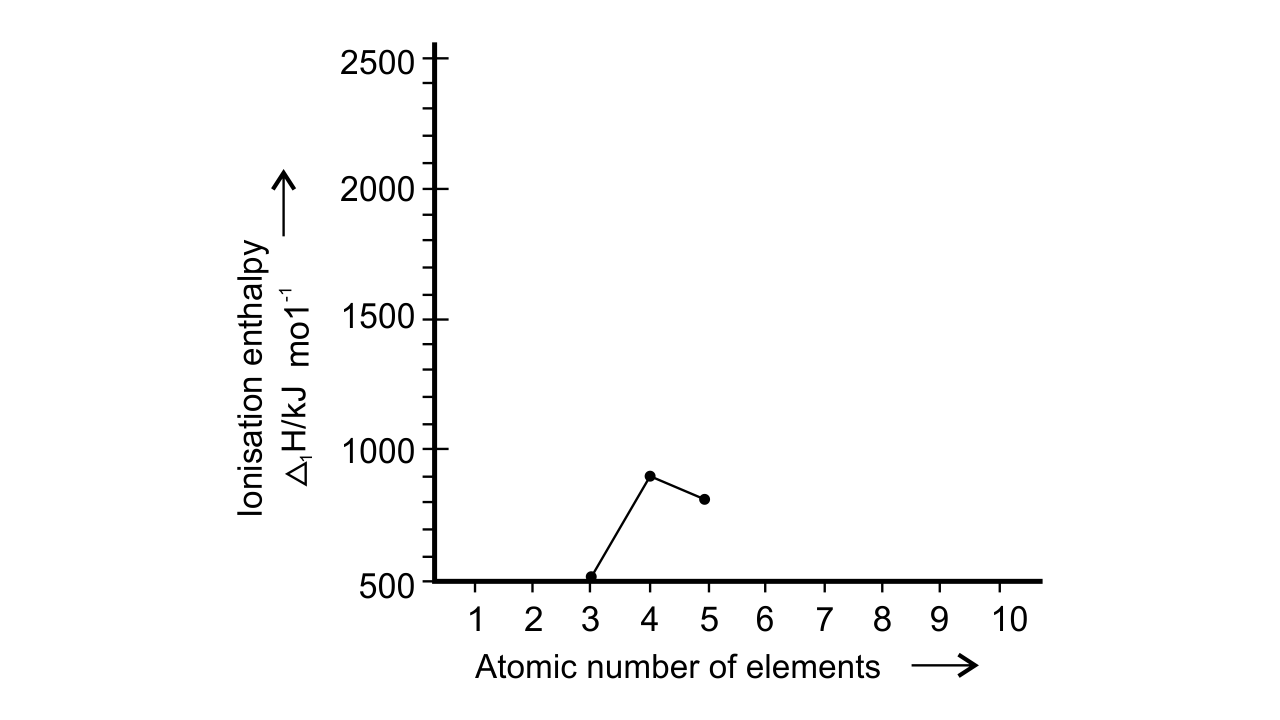
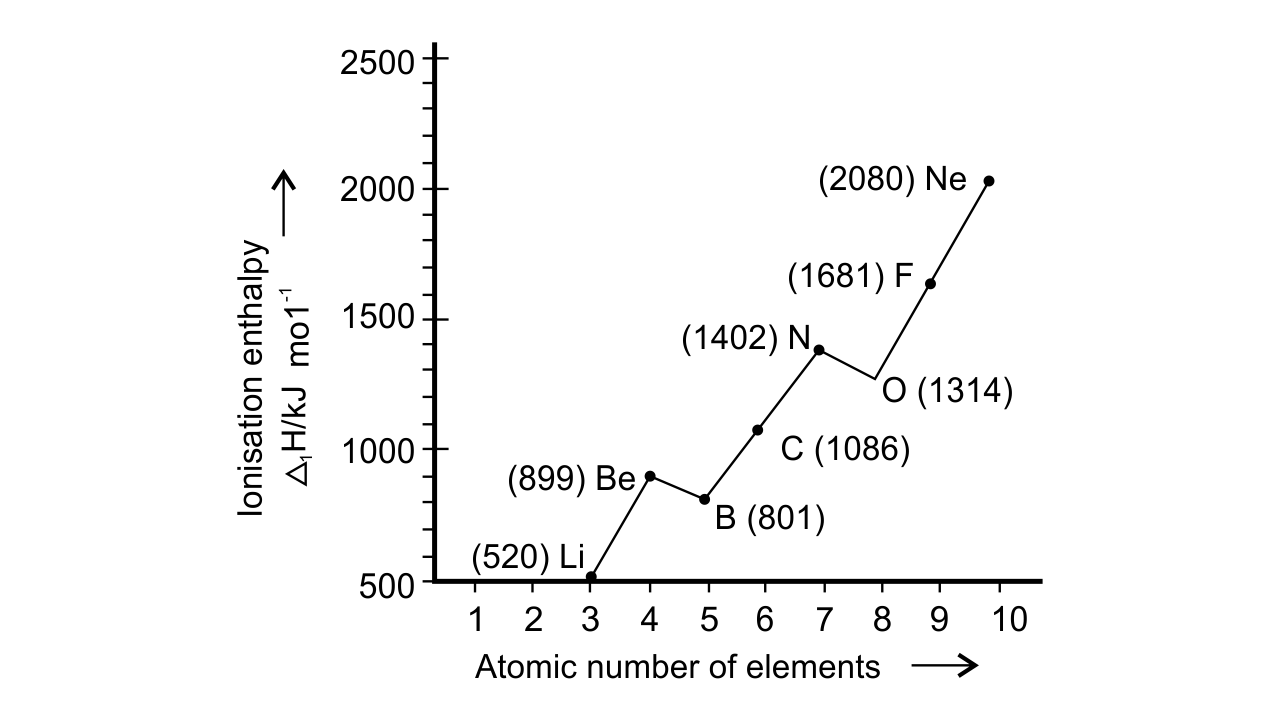
Ionisation enthalpies of elements of second period are given below : Ionisation enthalpy/ k cal mol–1 : 520, 899, 801, 1086, 1402, 1314, 1681, 2080.


seo images


Match the correct enthalpy with the elements and complete the graph given in Fig. 3.1. Also write symbols of elements with their atomic number.

Show solutionHide solution
Worked solution

Ans:


seo images


Q28Written answer

Among the elements B, Al, C and Si, 

(i) which element has the highest first ionisation enthalpy? 

(ii) which element has the most metallic character? Justify your answer in each case.

Show solutionHide solution
Worked solution

Ans: C has the highest ionization energy among the given elements as along the period ionization enthalpy increases whereas it decreases down the group.


Ans: Al is the most metallic element among the given elements because down the group metallic character increases.


Q29Written answer

Write four characteristic properties of p-block elements

Show solutionHide solution
Worked solution

Ans: The characteristics properties of p-block elements are as follows:-

(i) It contain metals,nonmetals and metalloids

(ii) Mostly involved in covalent bonding

(iii) Some elements show variable oxidation states

(iv) It possesses relatively higher ionization enthalpy compared to the s-block elements.


Q30Written answer

Choose the correct order of atomic radii of fluorine and neon (in pm) out of the options given below and justify your answer. 

(i) 72, 160 

(ii) 160, 160 

(iii) 72, 72 

(iv) 160, 72

Show solutionHide solution
Worked solution

Ans: (i)

As across the period the atomic radius decreases due to the increase of effective nuclear charge


Q31Written answer

Illustrate by taking examples of transition elements and non-transition elements that oxidation states of elements are largely based on electronic configuration

Show solutionHide solution
Worked solution

Ans: The electronic configuration of Cr= 1s2 2s2 2p6 3s2 3p6 4s1 3d10

The electronic configuration of Cr after losing one electron= 1s2 2s2 2p6 3s2 3p6 3d10

The electronic configuration of F= 1s2 2s2 2p6 3s2 3p5

The electronic configuration of F after gaining one electron= 1s2 2s2 2p6 3s2 3p6

From the above electronic configuration we can see that chromium will achieve stable electronic configuration after losing one 4s electron and fluorine will achieve stable electronic configuration after gaining one electron. So, the oxidation of chromium will be +1 and that of fluorine will be -1.


Q32Written answer

Nitrogen has positive electron gain enthalpy whereas oxygen has negative. However, oxygen has lower ionisation enthalpy than nitrogen. Explain.

Show solutionHide solution
Worked solution

Ans: The N possesses a half filled p-orbital which provides it extra stability due to symmetry due to which its electron gain enthalpy is positive and its ionization enthalpy is larger than that of O.


Q33Written answer

First member of each group of representative elements (i.e., s and p-block elements) shows anomalous behaviour. Illustrate with two examples.

Show solutionHide solution
Worked solution

Ans: The anomalous behaviour of the first member of each group of representative elements i.e. of second period can be attributed to their small size, high charge/radius ratio, high electronegativity and absence of vacant d-orbitals to expand their oxidation state.The first member of each group of p-Block elements displays their greater ability to form multiple bond with itself ,e.g.  C=C,O=O, N=N and to other second periodic elements, e.g. C=O,C=N,N=N.