My Cart
Your Cart 0

    Your cart is empty.

  • Total (Amount) ₹0.00
NCERT Exemplar · Class 11 · Chemistry

Chapter 11: The p-Block Elements

Practice each question, then open the answer or worked solution.

II. Multiple Choice Questions (Type-II)

25 questions
Q16Written answer

The reason for the small radius of Ga compared to Al is _______.

(i) poor screening effect of d and f orbitals

(ii) increase in nuclear charge

(iii) presence of higher orbitals

(iv) higher atomic number

Show solutionHide solution
Worked solution

Option (i) and (ii) are the answers.
Q17Written answer

The linear shape of CO2 is due to _________.

(i) sp3 hybridisation of carbon

(ii) sp hybridisation of carbon

(iii) pπ– pπ bonding between carbon and oxygen

(iv) sp2 hybridisation of carbonSolution:

Option (ii) and (iii) are the answers.

Show solutionHide solution
Worked solution

Solution coming soon.

Q18Written answer

Me3SiCl is used during polymerisation of organic silicones because

(i) the chain length of organic silicone polymers can be controlled by adding

Me3SiCl

(ii) Me3SiCl blocks the end terminal of a silicone polymer

(iii) Me3SiCl improves the quality and yield of the polymer

(iv) Me3SiCl acts as a catalyst during polymerisationSolution:

Option (i) and (ii) are the answers.
Show solutionHide solution
Worked solution

Solution coming soon.

Q19Written answer

Which of the following statements are correct?

(i) Fullerenes have dangling bonds

(ii) Fullerenes are cage-like molecules

(iii) Graphite is a thermodynamically most stable allotrope of carbon

(iv) Graphite is slippery and hard and therefore used as a dry lubricant in

Machines

Show solutionHide solution
Worked solution

Option (ii) and (iii) are the answers.

Q20Written answer

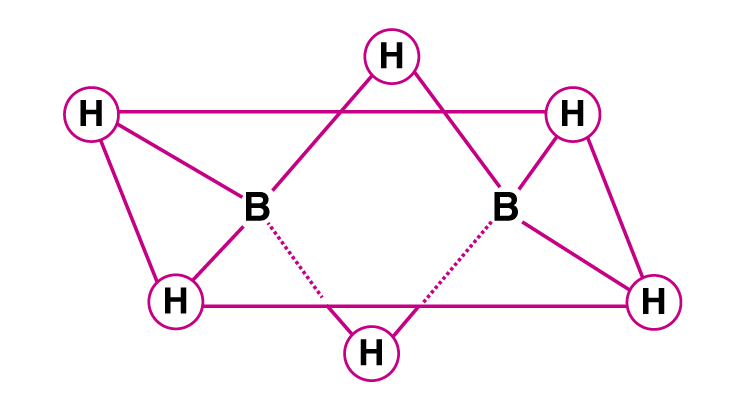
Which of the following statements are correct. Answer based on Fig.11.1.

(i) The two bridged hydrogen atoms and the two boron atoms lie in one plane;

(ii) Out of six B–H bonds two bonds can be described in terms of 3 centre 2-electron bonds.

(iii) Out of six B-H bonds, four B-H bonds can be described in terms of 3 centres 2 electron bonds;

(iv) The four-terminal B-H bonds are two centre-two electron regular bonds.

NCERT Exemplar Solutions of Class 11 Chemistry Chapter 11 The p- Block Elements-1

Show solutionHide solution
Worked solution

Option (i), (ii) and (iv) are the answers.

Q21Written answer

Identify the correct resonance structures of carbon dioxide from the ones given

below :

(i) O – C ≡ O

(ii) O = C = O

(iii) –O ≡ C – O+

(iv) –O – C ≡ O+

Show solutionHide solution
Worked solution

Option (ii) and (iv) are the answers.

III. Short Answer Type

Q22Written answer

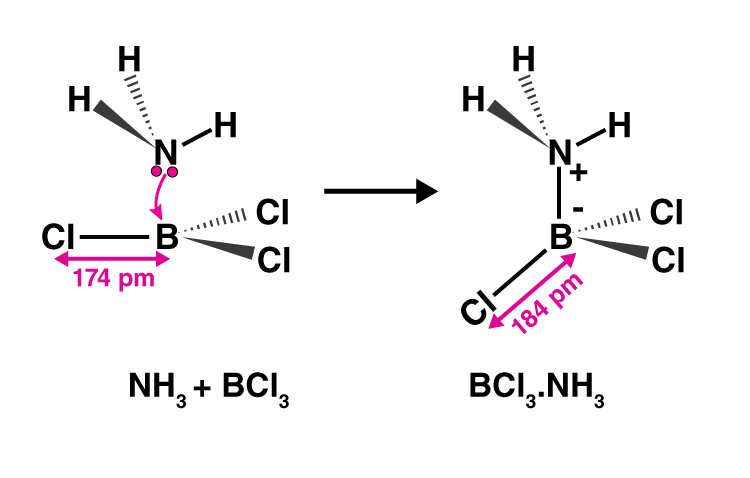
Draw the structures of BCl3.NH3 and AlCl3 (dimer).

Show solutionHide solution
Worked solution

NCERT Exemplar Solutions of Class 11 Chemistry Chapter 11 The p- Block Elements-2

Q23Written answer

Explain the nature of boric acid as a Lewis acid in water.

Show solutionHide solution
Worked solution

Boric acid is a weak monobasic acid and acts as a Lewis acid by accepting electrons from a hydroxyl ion.

B(OH)3 + 2H2O → [B(OH)4]– + H3O+

OH- is accepted by the Boric acid and the formation of hydroxyl ion takes place.

Thus, Boric acid act as a Lewis acid in water.

Q24Written answer

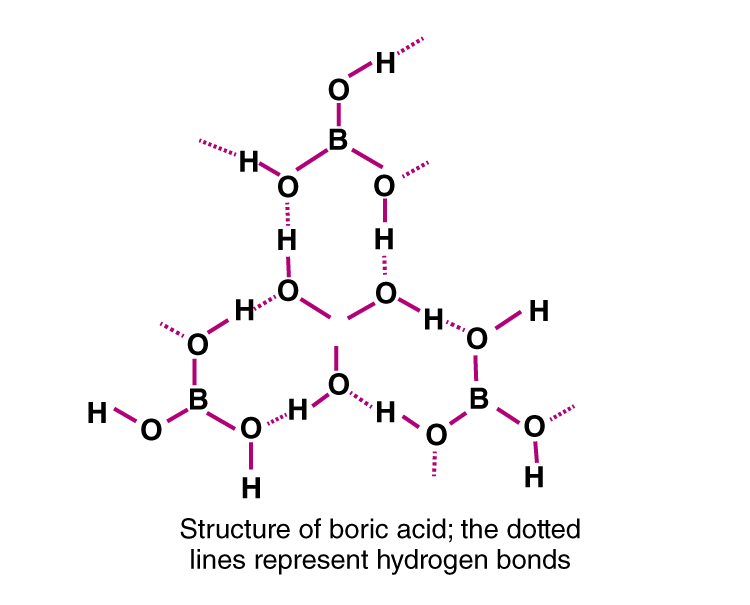
Draw the structure of boric acid showing hydrogen bonding. Which species is present in water? What is the hybridisation of boron in this species?

Show solutionHide solution
Worked solution

NCERT Exemplar Solutions of Class 11 Chemistry Chapter 11 The p- Block Elements-3

When boric acid reacts with water it forms [B(OH)4]– species.

B(OH)3 + 2H2O → [B(OH)4]– + H3O+

The hybridization of Boron in this species is sp3.

Q25Written answer

Explain why the following compounds behave as Lewis acids?

(i) BCl3

(ii) AlCl3

Show solutionHide solution
Worked solution

(i) BCL3 is an electron-deficient compound because it has 6 electrons in its outermost orbital and a vacant p orbital. Hence, it acts as Lewis acid and accepts a lone pair of electrons.

(ii) AlCl3 forms a covalent bond with chlorine by forming three single bonds of chlorine as aluminium has three electrons in its valence shell and act as an electron-deficient compound and act as lewis acid.