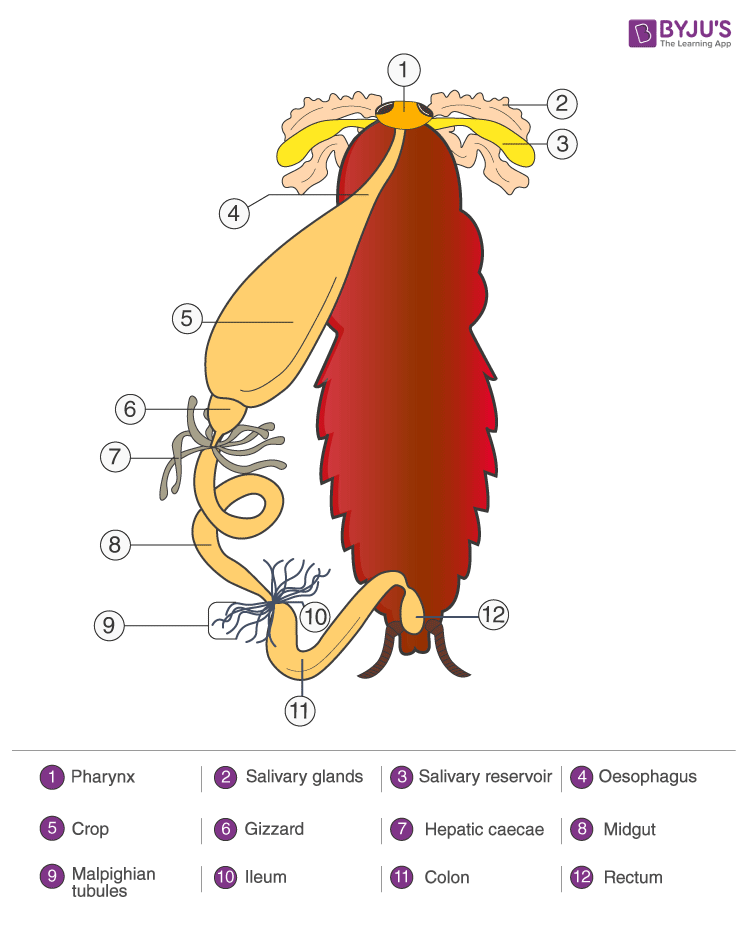
Their alimentary canal consists of three parts:
(A) Foregut
(B) Midgut
(C) Hindgut
(A) Foregut: The foregut consists of the mouth in cockroaches. The oesophagus is a narrow tube-like structure which leads to an organ known as a crop. The crop is used to store food materials. It consists of the tongue and hypopharynx
B) Midgut: Midgut is a narrow and short tube-like structure. It has an organ known as gizzard which grinds the food into simpler components.
(C) Hindgut: The hindgut is further divided into three major parts: Ileum, Colon, and Rectum. Malpighian tubules help in the elimination of the nitrogenous wastes and convert them to uric acid.
The anus is the last part of the digestive system of the cockroach.
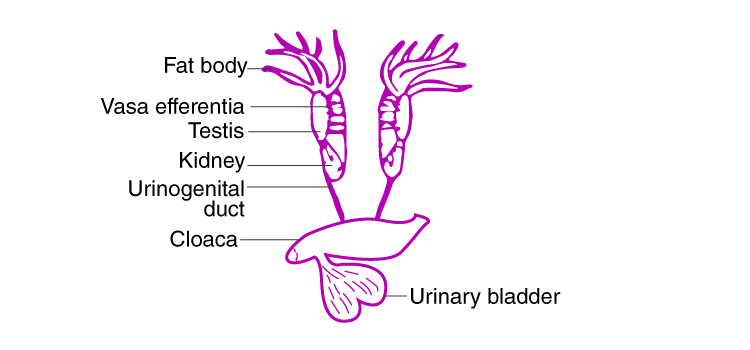
5. Draw a neat and well-labelled diagram of the male reproductive system of a frog.
We know that for life, certain systems and processes need to function in tandem. Similarly, life has a certain organisational structure, which is dictated by millions of years of evolution.
For instance, a snail and a squid belong to the same phylum – Mollusca. But they evolved and have varied characteristics to adjust to their environment. A squid uses jet propulsion to move around in the ocean. Meanwhile, a snail uses muscular contractions that help it move around slowly. And most land snails have shells that protect them from predators. Squids had shells millions of years ago, but they lost them in favour of features that avoided predators more efficiently.
- Animal Tissues
- Epithelial Tissue
- Connective Tissue
- Muscle Tissue
- Neural Tissue
- Organ and Organ System
- Earthworm
- Morphology
- Anatomy
- Cockroach
- Morphology
- Anatomy
- Frogs
- Morphology