My Cart
Your Cart 0

    Your cart is empty.

  • Total (Amount) ₹0.00
NCERT Exemplar · Class 11 · Biology

Chapter 20: Locomotion and Movement

Practice each question, then open the answer or worked solution.

Long Answer Questions

6 questions
Q1Written answer

Calcium ion concentration in blood affects muscle contraction. Does it lead to tetany in certain cases? How will you correlate fluctuation in blood calcium with tetany? 

Show solutionHide solution
Worked solution

Ans: In muscular contraction, calcium plays a crucial role. A neural signal from the central nervous system sends a signal to a motor neuron, which causes muscle contraction. This arises as a result of a calcium ion gradient. When calcium ions enter muscle cells, actin and myosin filaments begin to slide towards each other. Muscle is considered the contraction that takes place as a result of this. Actin and myosin filaments return to their original locations as calcium ions leave the muscle cells, and the muscle relaxes. As a result, a higher level of calcium ions in the blood means less calcium in the muscles. Muscle contractility will suffer as a result of this. The person may become drowsy as a result of this. When the calcium level in the blood is low, the calcium level in the muscles is higher. Tetany is the uncontrollable contraction of muscles as a result of this. The level of calcium in body fluids is controlled by parathyroid hormone and calcitonin. 

Q2Written answer

An elderly woman slipped in the bathroom and had severe pain in her lower back. After X-ray examination doctors told her it is due to a slipped disc. What does that mean? How does it affect our health? 

Show solutionHide solution
Worked solution

Ans: Each successive vertebra has a rubber-like disc between them. This disc performs the function of a shock absorber. The disc can become displaced in some situations, resulting in a condition known as slipping disc or prolapsed disc. The nerve exiting the vertebral column is particularly irritated by the slipped disc. This can result in significant back discomfort. This can also result in numbness and pain in the area controlled by the afflicted nerve. Sciatica pain can also be caused by a slipped disc. In this situation, the discomfort starts in the upper thigh and spreads to the lower legs. The sensation of pins and needles might last for a long time in some circumstances. A slipped disc can have a negative impact on a patient's quality of life.


Q3Written answer

Explain sliding filament theory of muscle contraction with neat sketches. 

Show solutionHide solution
Worked solution

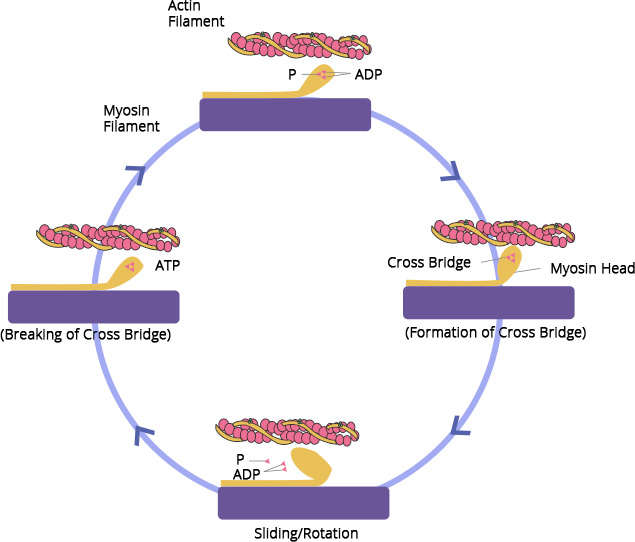
Ans: Muscle is considered to be a contraction when it is known by the sliding filament theory. Two research teams were the first to introduce it in 1954. One team represented the University of Cambridge, while the other represented MIT. Muscle contraction occurs when actin and myosin filaments slide towards one other, according to this idea. When a brain signal reaches the neuromuscular junction, a neurotransmitter (acetylcholine) is released, causing an action potential to be generated in the sarcolemma. Calcium channels in muscle cells open once the action potential is created, allowing calcium ions to enter. Increased \[Ca^{++}\] levels cause calcium to bind to troponin on the actin filament, causing conformational alterations. The masking of active areas on myosin filaments is removed as a result of this. The main elements of myosin, a polymer of meromyosin, are the head, arm, and tail. The head, also known as heavy meromyosin (HMM), uses the energy released by ATP hydrolysis to connect to the protein. A cross bridge between actin and myosin is formed as a result of this. This draws the connected actin filaments into the 'A' band's core. The Z-line linked to actin is also dragged inwards, resulting in muscle fiber contraction. 


seo images


Q4Written answer

How does a muscle shorten during its contraction and return to its original form during relaxation? 

Show solutionHide solution
Worked solution

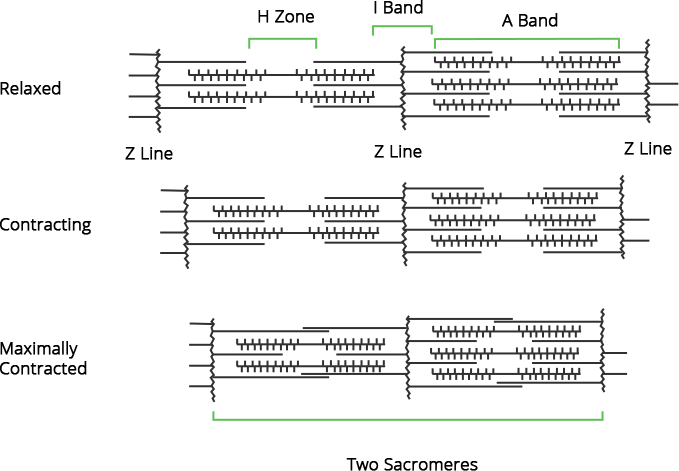
Ans: Muscle contraction occurs when actin and myosin filaments slide towards one other, according to the sliding filament theory. Muscle relaxation occurs when actin and myosin filaments glide away from each other. The striations of striated muscles are caused by alternate bands of actin and myosin. The I band of actin is a light-colored band of actin. The A band, which is darker in color, is the myosin band. An elastic band termed Z line holds the actin filaments together in the center. An elastic band termed M line holds the myosin filaments together in the middle. The position of the Z line in reference to the M line changes during contraction, and the muscle fiber becomes shorter. The actin filaments return to their original position after relaxation, making the muscle fiber appear longer.


Q5Written answer

Discuss the role of Ca2+ ions in muscle contraction. Draw neat sketches to illustrate your answer. 

Show solutionHide solution
Worked solution

Ans: Calcium ions are essential for muscular contraction. Calcium ions enter muscle cells through a network of tiny channels. Calcium channels are what they're called. An action potential is triggered when a neurotransmitter enters a muscle cell. Calcium channels open as a result, allowing calcium ions to enter. The troponin on the action filament binds to calcium ions.


seo images


As a result, the masking on myosin's active site is removed. The energy from ATP is then used by myosin to go towards actin and form a cross-bridge. Actin slides towards each other as a result, and the muscle contracts as a result. The calcium ions are then expelled from the muscle cells, and actin is formed.


Q6Written answer

Differentiate between Pectoral and Pelvic girdle. 

Show solutionHide solution
Worked solution

Ans: The differences are: 

Pectoral girdle

Pelvic girdle

(1) It is also known as the shoulder girdle because of its presence in the shoulders.

(1) It is found in the lower abdomen region of the body. 

(2) It is composed of four bones: 2 scapula and 2 clavicles. 

(2) It is composed of 2 bones: coccyx and sacrum. 

(ii) It is present in the anterior portion of the body.

ii) It is present in the posterior portion of the body


(iii) Glenoid cavity is the articulation point.

(iii) Acetabulum is the articulation point


(iv) Humerus bone articulates with pectoral girdle forming the ball and socket joint of the shoulder. 

(iv) Femur articulates with pelvic girdle forming the ball and socket joint of legs. 

(v) It helps in lifting and holding. 

(v) It helps in walking and standing.