My Cart
Your Cart 0

    Your cart is empty.

  • Total (Amount) ₹0.00
NCERT Exemplar · Class 11 · Biology

Chapter 16: Digestion and Absorption

Practice each question, then open the answer or worked solution.

Long Answer Questions

5 questions
Q1Written answer

A person had roti and dal for his lunch. Trace the changes in those during its passage through the alimentary canal. 

Show solutionHide solution
Worked solution

Ans: Roti is rich in carbohydrates and fibre, but dal is full of proteins. Dal may include fat due to the inclusion of oil or ghee during the cooking process. During their journey through the alimentary canal, these foods would undergo the following transformations.

Oral Cavity: 

Food is chewed in the oral cavity until it becomes a semisolid paste. Food is combined with saliva. Saliva aids in the digestion of meals. Furthermore, salivary amylase digests starch. During this process, starch is transformed into maltose.

\[Starch\xrightarrow[pH=6.8]{Sali\operatorname{var}y\text{ amylase}}Maltose\]

Stomach: Food passes from the buccal cavity into the stomach via the oesophagus. In the oesophagus, there is no digestion of food. Food is churned into an even smoother paste in the stomach. Further, the food is mixed with hydrochloric acid. If there are germs in the food, HCl destroys them and makes the pH acidic enough for pepsin to work appropriately. In the stomach, just a portion of the protein is digested. Pepsin converts dal protein into peptones and proteases in this step.

\[Protein+Pepsin\to Peptones+Proteases\]

Small Intestine: Pancreatic amylase present in the pancreatic juice converts the polysaccharides into disaccharides. In this step, the carbohydrates in the roti are further assimilated.

$Polysaccharides\xrightarrow{Pancreatic\text{ }Amylase}Disaccharides$

The proteins, peptones and proteases are converted by Chymotrypsin present in pancreatic juice into dipeptides.

\[Proteins,peptones,proteoses\xrightarrow[Carboxypeptidase]{Try\sin /\text{ }Chymotryp\sin }Dipeptides\]

Lipase digests the fats in the roti.

\[Fats~~\xrightarrow{Lipase}Diglycerides~\to ~Monoglycerides\]

Intestinal juice includes several enzymes that aid in the breakdown of all nutrients. The digestion of several nutrients in roti and dal are shown below:

\[Sucrose\xrightarrow{Sucrase}Glucose+Fructose\]

\[Lactose\xrightarrow{Lactase}Glucose+Galactose\]

\[Maltose\xrightarrow{Maltase}Glucose+Glucose\text{ }\]

\[Dipeptides\xrightarrow{Dipeptidase}Amino\text{ }acids\]

\[Di\text{ }and\text{ }Monoglycerides\xrightarrow{Lipases}Fatty\text{ }acids+Glycerol\]

The simple molecules are absorbed by the small intestine walls after all of the nutrients have been transformed into simpler compounds.

Food that has not been digested is subsequently passed via the large intestine and stored into the rectum until it is ejected through the anus


Q2Written answer

What are the various enzymatic types of glandular secretions in our gut helping digestion of food? What is the nature of end products obtained after complete digestion of food? 

Show solutionHide solution
Worked solution

Ans: The various glandular secretions in our stomach that aid in food digestion are listed below.

Secretions from Gastric glands: Stomach juice, which comprises hydrochloric acid and the enzyme pepsin, is secreted by the gastric glands. The stomach also releases rennin in infants—Rennin aids in milk digestion.

Secretions from the Liver: Bile juice is produced by the liver. Bile does not contain any enzymes. However, it is essential for digestion. Bile aids in the emulsification of lipids, making fat digestion simpler. Bile also offers an alkaline environment for the small intestine's enzymes to function correctly.

Secretions from Pancreas: Pancreatic juice, which comprises inactive enzymes such as amylase, lipase, and nuclease, as well as trypsinogen and chymotrypsinogen, is secreted by the pancreas. Enterokinase, an enzyme released by the intestinal mucosa, converts trypsinogen into active trypsin. Additional enzymes in the pancreatic juice are then activated by trypsin. Trypsin/chymotrypsin metabolises protein, while amylase digests carbohydrates.

Secretions from Small Intestine: The small intestine secretes succus entericus, which includes a range of enzymes such as Dipeptidases, lipase, and lactase.

End Products of Digestion: The products of digestion formed are simple substances such as glucose, fatty acids, amino acids and glycerol. The villi situated in the intestine easily absorb these materials.


Q3Written answer

Discuss mechanisms of absorption. 

Show solutionHide solution
Worked solution

Ans: The Villi in the small intestine absorb the majority of the digestive end products. Passive, active, and assisted transport methods are used to absorb digested food. The processes of absorption of different end products of digestion are discussed below.

Simple Diffusion: 

Diffusion absorbs small quantities of simple sugars like monosaccharides, amino acids, and certain electrolytes. The concentration gradient influences the transit of these chemicals into the bloodstream.

Facilitated Transport:

Carrier ions such as $N{{a}^{+}}$ aid in the absorption of fructose and several amino acids. This approach is termed Facilitated transportation.

Transport of Fatty Acids and Glycerol: 

Because these molecules are insoluble, they cannot be absorbed into the bloodstream. They are initially formed into micelles, which are minute droplets. The micelles go to the intestinal mucosa. Here, these micelles are transformed into very tiny protein-coats. These globules are called chylomicrons. The chylomicrons are carried into the villi's lymph vessels. They are subsequently released into the bloodstream through lymph veins.


Q4Written answer

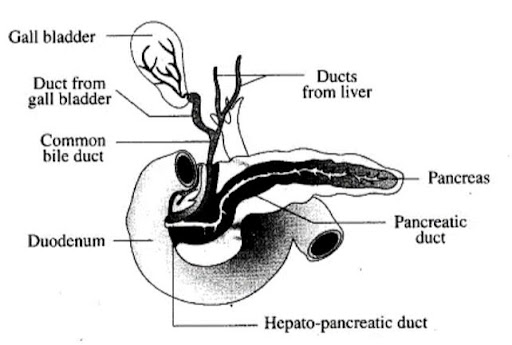
Discuss the role of hepatopancreatic complex in the digestion of carbohydrate, protein and fat components of food. 

Show solutionHide solution
Worked solution

Ans: The carbohydrates, proteins and fats are mainly digested in the Hepato-pancreatic complex.

Role of Liver: 

The primary function of the liver is to produce bile juice. Bile does not comprise any enzymes. However, it is essential for digestion. Bile aids in the emulsification of lipids, making fat digestion simpler. Bile offers a suitable alkaline environment for the proper functioning of the small intestine,

Role of Pancreas:

Pancreatic juice, which includes inactive enzymes such as amylase, lipase, nuclease, trypsinogen, and chymotrypsinogen, is secreted by the pancreas. Enterokinase, an enzyme released by the intestinal mucosa, converts trypsinogen to active trypsin. Other enzymes in the pancreatic juice are then activated by trypsin. Trypsin/chymotrypsin breakdown proteins, while amylase digests carbs. Lipase is an enzyme that breakdowns down triglycerides into diglycerides and monoglycerides.


seo images


Hepato-pancreatic complex

The conversions occurring in the Hepato-pancreatic complex are as follows:

Carbohydrate digestion:

$Polysaccharides\xrightarrow{Pancreatic\text{ }Amylase}Disaccharides$

Protein digestion:

$Proteins,peptones,proteoses\xrightarrow[Carboxypeptidase]{Try\sin /\text{ }Chymotryp\sin }Dipeptides$

Fat digestion

\[Fats~\xrightarrow{Lipase}Diglycerides~\to ~Monoglycerides\]


Q5Written answer

Explain the process of digestion in the buccal cavity with a note on the arrangement of teeth. 

Show solutionHide solution
Worked solution

Ans: Food is chewed in the mouth cavity and combines with the saliva to form a semisolid paste called Chyme.  Saliva aids in the formation of a bolus from meal particles. Saliva assists in the digestion of food. It is possible to say that the oral cavity conducts the functions of chewing and swallowing. Furthermore, starch is digested by salivary amylase.  During this step, starch is transformed into maltose.

\[Starch\xrightarrow[pH=6.8]{Sali\operatorname{var}y\text{ amylase}}Maltose\]

Arrangement of Teeth: 

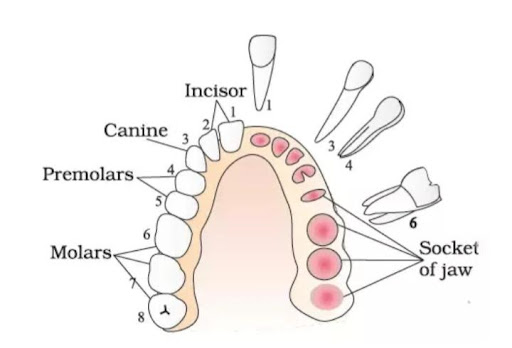
Every tooth in a human being is contained in a socket inside the jaw bone. This form of tooth attachment is termed phycodont. Humans have two sets of teeth during their lifetime: temporary teeth and permanent teeth. Temporary teeth, often known as milk teeth, are lost and replaced with permanent teeth. This is known as a diphyodont arrangement.

seo images

Arrangement of teeth

In humans, there are four main types of teeth: incisors, canines, premolars, and molars. In brief, they are denoted by the letters I, C, PM, and M. Each half of a jaw has a specific number of each tooth type. 

The dental formula of human teeth is given below:

$Dental\text{ formula=}\dfrac{2123}{2123}$

The above formula demonstrates that in humans, each half of the jaw has two incisors for cutting, one canine for tearing, two premolars, and three molars for grinding and crushing. In a human adult, there are a total of 32 teeth.


Students wishing to get an edge over others in the exams mentioned must surely solve the NCERT Exemplar. The best thing about solving the NCERT exemplar for Biology is that the questions are highly conceptual. Students get familiar with the exam pattern and the marking scheme. They get to know the topics which are more important from the examination point of view. Students become more analytical and gain better time management skills. 


The secret to success in any competitive examination is question practice. The more questions one solves the more they increase their chances of getting selected. All students run behind numerous books but they forget to focus on the real gold that is NCERT. All toppers have thoroughly studied NCERT for such stellar marks. 


Even teachers frame their questions from NCERT only. The majority of questions in NEET and JEE are NCERT based. Thus, students should stop wasting money on buying numerous books for a single subject and focus on NCERT with a full heart.


Studying NCERT and NCERT Exemplar diligently will surely guarantee the success of students in any exam they are preparing for.


Some of the topics which have been covered in the Biology Chapter 16 - Digestion and Absorption chapter are:

  • Digestive system

  • Alimentary canal

  • Digestive glands

  • Digestion of food

  • Absorption of digested food

  • Disorders of the digestive system


The digestion and Absorption chapter describes the digestion and absorption process. It takes place in the alimentary canal which is a long tunnel starting from our mouth and ending at the anus. The digestive system contains the oesophagus, stomach, large intestine, small intestine, mouth, and glands such as the salivary gland, and gallbladder. It has a description of the digestive system and its processes. This chapter is a very important chapter in Biology for both school exams and competitive exams like NEET.


Why Should Students Choose Vedantu?

If you are preparing for any competitive examination like JEE or NEET or even CBSE boards or other international examinations, Vedantu is the best place for you to join. Our lessons are very flexible to suit the needs of every student. They can attend the classes online or can even watch the videos offline by downloading them on their device. 


Students just need to have a mobile, laptop, or a tablet with an internet connection. Students can attend classes from any corner of the world. There is no reason for them to feel discouraged if they are from a city with no coaching classes. Vedantu is here to help you with your examination preparations.


We make sure not only to make the learning process productive but fun too. We want to make learning an enjoyable process where students are actually happy and fascinated by the wonders education can create. If this approach to education seems appealing to you, join us today and fall in love with learning!


NCERT textbooks are a very useful resource for any student. No matter which exam you are preparing for, NCERT will help you boost your marks. We have provided the solutions to NCERT Exemplar for Class 11 Biology - Digestion and Absorption. The solutions are easy to understand. You can easily download the solutions by signing up on Vedantu with your email or mobile number. The solutions have been provided in PDF format for easy navigation.


Going through the solutions at least once during the preparatory phase is going to help students immensely.


Free PDF download of NCERT Exemplar for Class 11 Biology Chapter 16 - Digestion and Absorption solved by expert Biology teachers on Vedantu.com as per NCERT (CBSE) Book guidelines. All Chapter 16 - Digestion and Absorption exercise questions with solutions will help you to revise and complete the syllabus and to score more marks in your examinations.


Students can easily download the solutions to NCERT Exemplar for Class 11 Biology - Digestion and Absorption from the Vedantu website. We have carefully curated the solutions keeping in mind the challenges students face while solving them. The solutions are easy to understand and concise which makes them perfect for students to glance through quickly. The solutions are free to download and are provided in PDF format for easy access.