My Cart
Your Cart 0

    Your cart is empty.

  • Total (Amount) ₹0.00
NCERT Exemplar · Class 11 · Biology

Chapter 11: Transport in Plants

Practice each question, then open the answer or worked solution.

LONG ANSWER TYPE QUESTIONS.

7 questions
Q1Written answer

Minerals are present in the soil in sufficient amounts. Do plants need to adjust the types of solutes that reach the xylem? Which molecules help to adjust this? How do plants regulate the type and quantity of solutes that reach xylem?

Show solutionHide solution
Worked solution

Yes, plants need to adjust the type and quantity of solutes that reach the xylem. The transport proteins of end dermal cell help in maintaining and adjusting solute movement. Mineral ions are frequently remobilised particularly from older senescing parts. Older dying leaves export much of their mineral content to younger leaves. Similarly, before leaf fall in deciduous plants, minerals are removed to other parts. Elements most readily mobilised are phosphorus, sulphur, nitrogen and potassium. Some elements that are structural components like calcium are not remobilised.
Q2Written answer

Plants show temporary and permanent wilting. Differentiate between the two. Do any of them indicate the water status of the soil?

Show solutionHide solution
Worked solution

In temporary wilting, plants lose turgidity when the rate of transpiration is more than the rate of water absorption from the soil but in permanent wilting, wilting of the plant occurs and is a permanent phenomenon as the soil is unable to meet the water requirement of the plant.

Q3Written answer

Why are natural membranes selectively permeable. Give examples.

Show solutionHide solution
Worked solution

Natural membranes like the cell membrane are selectively permeable, which means that it allows only certain molecules to get in or go out of the cell. Example of a cell membrane is where it allows only non-polar and small molecules through the lipid bilayer along the concentration gradient.

Q4Written answer

Halophytes may show cell pressure very much higher than atmospheric pressure. Explain how this can happen?

Show solutionHide solution
Worked solution

Due to the higher concentration of salt, their cell cytoplasm is hypertonic causing water from the surrounding cells or region to enter the cell cytoplasm. The pressure exerted by the cell will be higher. Salt secreting glands will be present for controlling this pressure that removes excess of salts.

Q5Written answer

The radiolabelled carbon in carbon dioxide supplied to potato plants in an experiment was seen in the tuber eventually. Trace the movement of the labelled carbon dioxide.

Show solutionHide solution
Worked solution

When the potato plant carries out photosynthesis using the CO2 which is radiolabelled, it forms Oxygen and glucose (C6H12O6) where the carbon in the glucose molecule has the radiolabelled carbon present. The process of measuring is by autoradiography which detects the radioactive carbon and traces the components along with the movement in the plant body.

Q6Written answer

Water molecule is very polar. Polar end of molecule attracts opposite charges on another water molecule (acts like a magnet). How will you explain this property of water with reference to the upward movement of water? Comment on the upward movement of water given the intermolecular hydrogen bonding in water.

Show solutionHide solution
Worked solution

The process by which water molecules remain attached to one another via hydrogen bonding in between them is known as the cohesion of the water molecules. The upward movement of the water through xylem vessels leaves a transpiration pull which does not break due to adhesion. Tensile strength is provided by cohesion which pulls water from the root to tips.

Q7Written answer

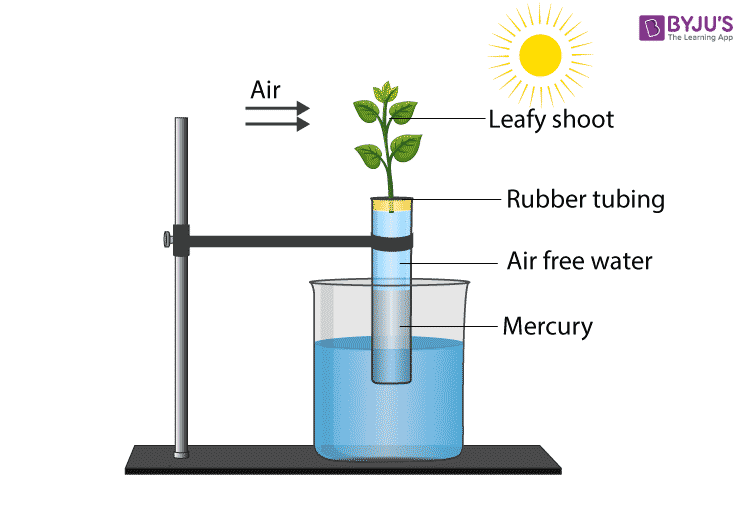
Comment on the experimental setup

. What does the setup demonstrate?

b. What will happen to the level of water if a blower is placed close to setup?

c. Will the mercury level fluctuate (go up/down) if phenylmercuric acetate is sprayed on leaves?

NCERT Exemplar Solutions of Class 11 Biology Chapter 11 Transport in plants-5

Show solutionHide solution
Worked solution

a) The setup demonstrates the process of transpiration pull which is the force when water pulls upwards from root to leaves.

b) If a blower is placed close to the setup it will provide a wind speed due to which the rate of transpiration will increase this the level of water will rise even upwards as the transpiration pull will be more.

c) Phenyl mercuric acetate is an anti-transpirant. If it is sprayed on leaves, transpirational loss of water will stop and mercury levels will remain stable.

The transportation in plants refers to the method by which they carry nutrients and minerals to their various parts. Plants use the autotrophic mode of nutrition by taking in carbon dioxide from air and water to produce their own food. Photosynthesis is the process by which plants produce food in their leaves. They need to transport food, water and minerals to their parts to ensure the circulation of nutrients.

  1. Means of Transport
    1. Diffusion
    2. Facilitated Diffusion
    3. Active Transport
    4. Comparison of Different Transport Processes
  2. Plant-Water Relations
    1. Water Potential
    2. Osmosis
    3. Plasmolysis
    4. Imbibition
  3. Long Distance Transport of Water
    1. How Do Plants Absorb Water?
    2. Water Movement up a Plant
  4. Transpiration
    1. Transpiration and Photosynthesis – A Compromise
  5. Uptake and Transport of Mineral Nutrients
    1. Uptake of Mineral Ions
    2. Translocation of Mineral Ions
  6. Phloem Transport: Flow from Source to Sink
    1. The Pressure Flow or Mass Flow Hypothesis