My Cart
Your Cart 0

    Your cart is empty.

  • Total (Amount) ₹0.00
NCERT Exemplar · Class 11 · Biology

Chapter 11: Transport in Plants

Practice each question, then open the answer or worked solution.

SHORT ANSWER TYPE QUESTIONS

25 questions
Q21Written answer

Differentiate between diffusion and translocation in plants.

Show solutionHide solution
Worked solution

Diffusion is the movement of substances from a region of their higher concentration to a region of their lower concentration

Translocation is the bulk transport of material in solution inside plant channels.
Q22Written answer

How is facilitated diffusion different from diffusion?

Show solutionHide solution
Worked solution

Diffusion occurs through phospholipid layer and facilitated diffusion occurs through membrane proteins

Q23Written answer

Explain the mass flow hypothesis of transport in phloem

Show solutionHide solution
Worked solution

In 1930, Munch proposed the mass flow hypothesis which explains the movement of sap through the phloem. When there is a high concentration of sugar present in the source (which is where the food is prepared) then a diffusion gradient gets created between the sugar source and the sugar shrink where the sugar is stored. This is responsible for drawing water into the cells from the neighbouring xylem. When this happens, turgor pressure gets created (bidirectional movement)

Q24Written answer

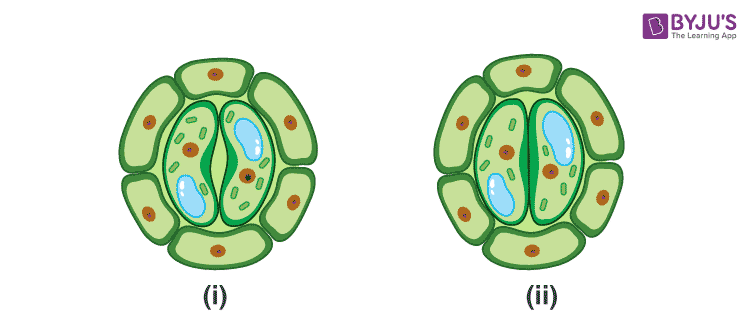
Observe the diagram and answer the following;

NCERT Exemplar Solutions of Class 11 Biology Chapter 11 Transport in plants-4

a. Are these types of guard cells found in monocots or dicots?

b. Which of these shows a higher water content (i) or (ii)?

c. Which element plays an important role in the opening and closing of stomata?

Show solutionHide solution
Worked solution

a) These types of guard cells are found in dicots because as we know the shape is bean-shaped. Whereas for monocots, it is usually dumble-shaped.

b) Higher water content is shown in figure (i)

c) The element that plays an important role in the opening and closing of stomata is potassium ion.

Q25Written answer

Define Uniport, Symport and Antiport. Do they require energy?

Show solutionHide solution
Worked solution

1. Uniport: When a single substance moves in a single direction across a cell membrane, it is called uniport.

2. Antiport: When two substances move in the opposite direction across a cell membrane, it is called antiport.

3. Symport: When two substances move in the same direction across a cell membrane, it is called symport

They do not need energy directly.