My Cart
Your Cart 0

    Your cart is empty.

  • Total (Amount) ₹0.00
NCERT Exemplar · Class 11 · Biology

Chapter 11: Transport in Plants

Practice each question, then open the answer or worked solution.

SHORT ANSWER TYPE QUESTIONS

25 questions
Q11Written answer

Will the ascent of sap be possible without the cohesion and adhesion of the water molecules? Explain.

Show solutionHide solution
Worked solution

No. it is not possible because these are responsible for the same. The continuous water column in the xylem vessels for the sap ascent is maintained by the adhesive and the cohesive forces of water. Absence of which would have led to cavitation of xylem vessels or breakage of the water column or the sap movement upwards.
Q12Written answer

Keep some freshly cut flowers in a solution of food colour. Wait for some time for the dye to rise in the flower, when the stem of the flower is held up in light, coloured strands can be seen inside. Can this experiment demonstrate which tissue is conducting water up the stem?

Show solutionHide solution
Worked solution

This experiment can demonstrate which tissue is conducting water up the stem. Coloured strands are indicative that the food colour has been conducted upwards through a conducting vessel which is the xylem.

Q13Written answer

When a freshly collected Spirogyra filament is kept in a 10% potassium nitrate solution, it is observed that the protoplasm shrinks in size:

a. What is this phenomenon called?

b. What will happen if the filament is replaced in distilled water?

Show solutionHide solution
Worked solution

a. This phenomenon is called exosmosis

b. If the filament is replaced in distilled water, then the protoplasm again becomes turgid as water flows in as the shrunken protoplasm swells up or gets deplasmolysed.

Q14Written answer

Sugar crystals do not dissolve easily in ice-cold water. Explain

Show solutionHide solution
Worked solution

The dissolution or diffusion of the solid crystal of sugar does not occur since the number of striking water molecules is less when water is ice cold.

Q15Written answer

Salt is applied to tennis lawns to kill weeds. How does salting tennis lawns help in the killing of weeds without affecting the grass?

Show solutionHide solution
Worked solution

The salt solution being hypertonic causes exo-osmosis in plants. 1 cup salt in 2 cups of water, fairly well dissolved when sprayed on weed plants, start killing them.

Q16Written answer

What is the chemical composition of xylem and phloem sap?

Show solutionHide solution
Worked solution

Xylem sap: Water and concentration of minerals in dilute form. It is mildly acidic.

Phloem sap: traces of minerals, water, sucrose and amino acids In some species, it also transports fructose or raffinose etc

Q17Written answer

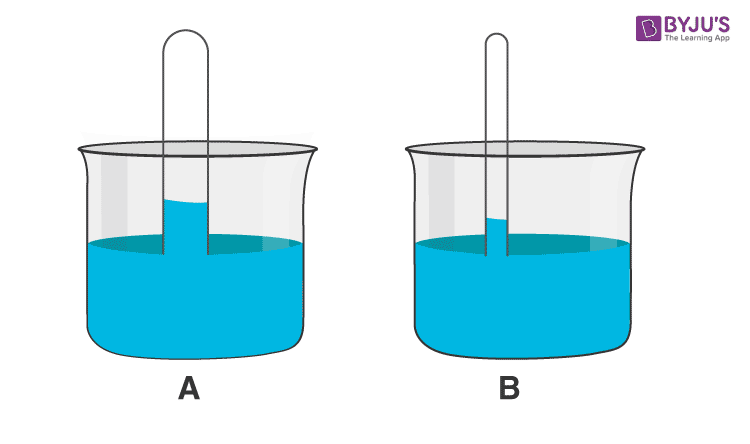
Observe the figure and answer the question provided below the figure.

NCERT Exemplar Solutions of Class 11 Biology Chapter 11 Transport in plants-3

Why does tube B show higher water rise than A?

Show solutionHide solution
Worked solution

Tube B shows higher water rise than tube A because the surface area is less in the narrow tube or tube B due to which the surface tension is more in that so the level of rising of water is more in that as well.

Q18Written answer

What are ‘aquaporins’? How does the presence of aquaporins affect osmosis?

Show solutionHide solution
Worked solution

Aquaporins are a kind of membrane proteins that form channels in the membrane and are usually facilitating the transport of water between cells. Presence of aquaporins would increase the rate of osmosis thus facilitating it.

Q19Written answer

ABA (Abscisic acid) is called a stress hormone.

a. How does this hormone overcome stress conditions?

b. From where does this hormone gets released in leaves?

Show solutionHide solution
Worked solution

a) Abscisic acid is a stress hormone and during stress conditions, it induces changes like the closing of stomata to prevent further water loss during the scarcity of water, aids in seed germination when conditions are favourable and dormancy when not and other changes as and when required.

b) This hormone, abscisic acid gets released in the leaves from the mesophyll cells of the plant.

Q20Written answer

We know that plants are harmed by excess water. But plants survive under flooded condition. How are they able to manage excess water?

Show solutionHide solution
Worked solution

There is a deprivation of oxygen in the plant roots causing an anaerobic condition. Thus aeration is affected.