My Cart
Your Cart 0

    Your cart is empty.

  • Total (Amount) ₹0.00
NCERT Exemplar · Class 11 · Biology

Chapter 10: Cell Cycle and Cell Division

Practice each question, then open the answer or worked solution.

Long Answer Questions

6 questions
Q1Written answer

Comment on the statement — Telophase is the reverse of prophase.

Show solutionHide solution
Worked solution

Ans: Following contrasting features of prophase and telophase show that telophase is the reverse of prophase.

Prophase

Telophase

i. Mitochondria, ER, Golgi Complex, etc. disappear.

i. Mitochondria, ER, Golgi Complex, etc. reappear.


ii. Nuclear membrane disintegrates.

ii. Nuclear membrane gets reformed.


iii. Chromosomes become clearly visible.

iii. Chromosomes lose their visible identity.


seo images


seo images


Q2Written answer

What are the various stages of meiotic prophase-I? Enumerate the chromosomal events during each stage?

Show solutionHide solution
Worked solution

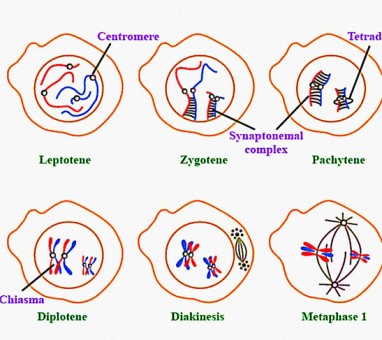
Ans: Following are the various stages of meiotic prophase – I:

seo images

a. Leptotene: In this stage, chromosomes are visible clearly  under the light microscope. The chromosomal compaction continues through this stage. The bound between the sister chromatids is so much  that one cannot be differentiated from another.


b. Zygotene: During this stage , chromosomes start forming the pairs. This process is called synapsis. Formation of synapsis is accompanied by formation of synaptonemal complexes. Each & every pair is called a bivalent or the tetrad.


c. Pachytene: The bivalent chromosomes distincts & the recombination nodules(site at which crossing over takes place) appear on the tetrads.The process of crossing over takes place between non-sister chromatids of homologous chromosomes & it facilitates exchange of genes between them.


d. Diplotene: During this stage, the synaptonemal complex gets dissolved & the recombined chromosomes begin to separate from each other. But they remain attached at the site of crossing over. This makes an X-shaped structure  that is termed as chiasmata.


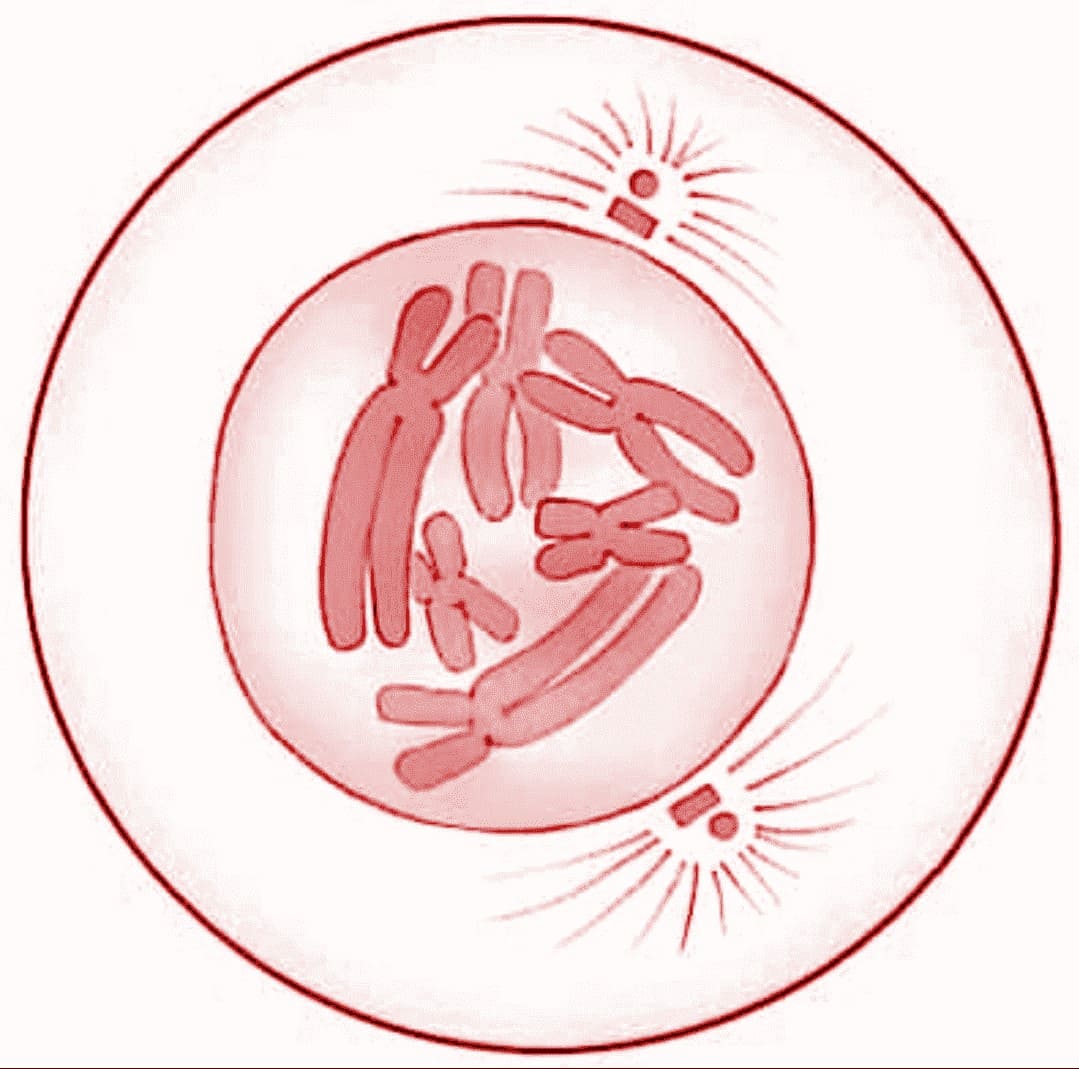
e. Diakinesis: Chiasmata is terminated at this stage. Nucleolus as well as the nuclear membrane disappears.
Q3Written answer

Differentiate between the events of mitosis and meiosis.

Show solutionHide solution
Worked solution

Ans: The following are the differences between mitosis and meiosis:-

Events

Mitosis

Meiosis

Prophase

The prophase lasts for a shorter period of time.

At this point, the chromosomes are not distinguishable.

Two distinct chromatids can be seen on chromosomes. During this stage, there is no crossing over.


The prophase is straightforward and devoid of sub-stages.

Prophase–I is the longer of the two phases, while prophase–II is the shorter of the two.

Chromosomes are distinct from one another. Prophase–I chromosomes do not have distinct chromatids. The chiasmata is formed, and the crossing over occurs.

Metaphase

There is only one metaphasic plate. Chromosomes are self-contained and do not have any connections. The chromosomes' limbs are pointing in different directions. A chromosome's two chromatids are genetically identical.

During metaphase–I, two metaphasic plates form, but during metaphase–II, only one metaphasic plate forms. The chromosomes that are homologous are linked together. The chromosomes' limbs point to the centre. A chromosome's two chromatids are usually genetically distinct.

Anaphase

Two centromeres are formed when a centromere splits along its length.

Single-stranded chromosomes are found in all living organisms. Chromosomes that are similar move to opposite poles.

Centromeres do not divide during anaphase–I; however, centromere division occurs during anaphase–II. In anaphase–I, double-stranded chromosomes are present, but single-stranded chromosomes are present in anaphase–II.

Dissimilar chromosomes move in opposite directions.


Telophase

Telophase lasts a little longer. It causes interphase nuclei to form.

Telophase–I is the shortest phase.

Cytokinesis

Every mitosis is followed by cytokinesis. At the end, two daughter cells are formed.

After meiosis–I, cytokinesis takes place, but not before meiosis–II. At the end of meiosis–II, there are four daughter cells.


Q4Written answer

Write brief note on the following

a. Synaptonemal complex:

b. Metaphase plate:

Show solutionHide solution
Worked solution

Ans: Protein makes up the synaptonemal complex. During meiosis, it is formed between two homologous chromosomes. Pairing, synapsis, and recombination all take place here. The homologous chromosomes are paired through the synaptonemal complex during prophase–I of meiosis. This complex facilitates the exchange of genes. Synaptonemal complexes play a role in the recombination of genetic characters.


Ans: Metaphase plate is an imaginary line which is equidistant from the two centrosome poles. During metaphase, the chromosomes assemble at the metaphase plate. The even alignment of chromosomes is due to the opposing kinetochore microtubules.


Q5Written answer

Write briefly the significance of mitosis and meiosis in multicellular organisms.

Show solutionHide solution
Worked solution

Ans: 

Significance of Mitosis:

1. Mitosis facilitates development of single-cell zygote into a full-grown organism

2. It facilitates the repair of worn out or damaged tissues.

3. It facilitates the vegetative propagation in flowering plants. 

4. It facilitates regeneration in some animals; like Planaria.


Significance of Meiosis:

1. Meiosis ensures that the number of chromosomes becomes diploid in gametes. This helps in ensuring conservation of specific chromosomal numbers in each species.

2. Meiosis facilitates genetic variability in populations & This is because of crossing over events that occur during prophase–I.


Q6Written answer

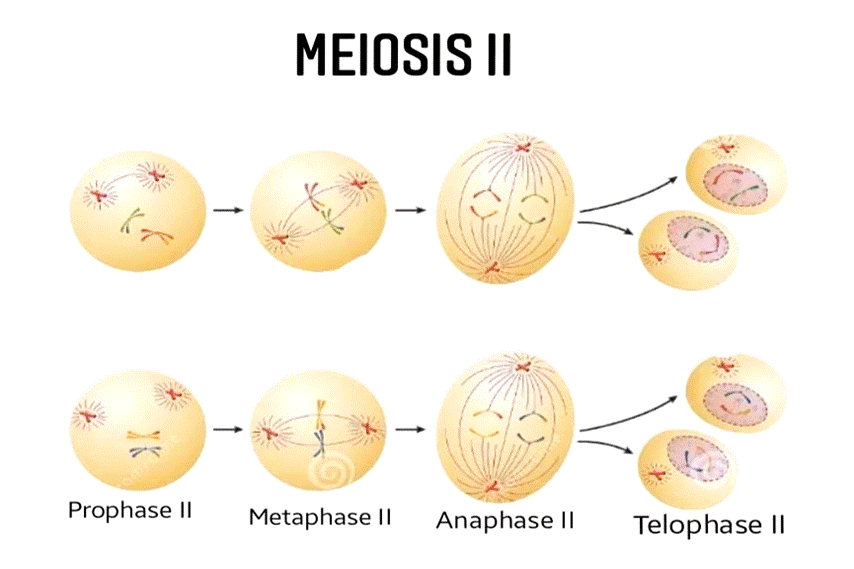
An organism has two pairs of chromosomes (i.e., chromosome number = 4). Diagrammatically represent the chromosomal arrangement during different phases of meiosis-II.

Show solutionHide solution
Worked solution

Ans: The following diagram shows different phases of meiosis—II of an organism which has two pairs of chromosomes.


seo images