My Cart
Your Cart 0

    Your cart is empty.

  • Total (Amount) ₹0.00
NCERT Exemplar · Class 11 · Biology

Chapter 10: Cell Cycle and Cell Division

Practice each question, then open the answer or worked solution.

Short Answer Questions

13 questions
Q1Written answer

State the role of centrioles other than spindle formation.

Show solutionHide solution
Worked solution

Ans: The role of centrioles other than spindle formation are-: 

1. Formation of basal body of cilia and flagella. 

2. Formation of microtubules.

3. Formation of sperm tail.


Q2Written answer

Mitochondria and plastids have their own DNA (genetic material). What is known about their fate during nuclear division like mitosis?

Show solutionHide solution
Worked solution

Ans: Extra-genomic DNA is found in mitochondria and plastids. It has nothing to do with the division of the nucleus during mitosis. As a result, extra-genomic DNAs are unaffected by karyokinesis during cell division.


Q3Written answer

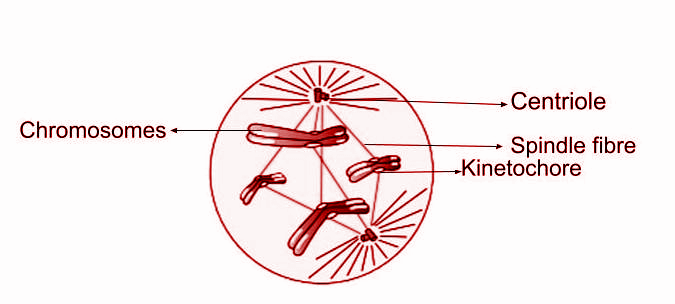
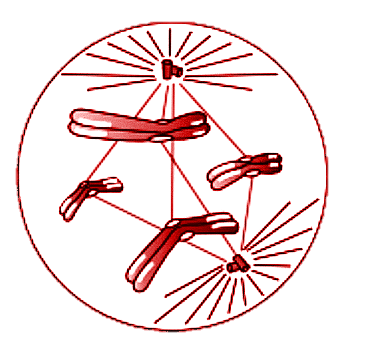
Label the diagram and also determine the stage at which this structure is visible.


seo images
Show solutionHide solution
Worked solution

Ans: This figure shows the transition from prophase to metaphase during mitosis.


seo images
Q4Written answer

A cell has 32 chromosomes. It undergoes mitotic division. What will be the chromosome number (N) during metaphase? What would be the DNA content (C) during anaphase?

Show solutionHide solution
Worked solution

Ans: We know that DNA replication takes place during S phase and hence, the DNA content becomes double just after the S phase; and will remain so during the whole event of mitosis.


Q5Written answer

While examining the mitotic stage in a tissue, one finds some cells with 16 chromosomes and some with 32 chromosomes. What possible reasons could you assign to this difference in chromosome number? Do you think cells with 16 chromosomes could have arisen from cells with 32 chromosomes or vice versa?

Show solutionHide solution
Worked solution

Ans: Because of mosaicism, this can happen. Mosaicism refers to the coexistence of two populations of cells with different genotypes in a single person. Mosaicism can occur due to a variety of factors, including nondisjunction, anaphase lag, and endoreplication.


Mosaicism appears to be caused primarily by anaphase lag. The cells with 16 chromosomes must have developed from those with 32 chromosomes in this case.


Q6Written answer

The following events occur during the various phases of the cell cycle, Name the phase against each of the events.

a. Disintegration of nuclear membrane

b. Appearance of nucleolus

c. Division of centromere

d. Replication of DNA 

Show solutionHide solution
Worked solution

Ans: 

a.  Disintegration of nuclear membrane occurs in prophase.

b.  Appearance of nucleolus occurs in telophase.

c.  Division of centromere occurs in anaphase.

d.  Replication of DNA occurs in S-phase.


Q7Written answer

Mitosis results in producing two cells which are similar to each other. What would be the consequence if each of the following irregularities occur during mitosis?

a. Nuclear membrane fails to disintegrate

b. Duplication of DNA does not occur

c. Centromeres do not divide

d. Cytokinesis does not occur.

Show solutionHide solution
Worked solution

Ans: If the nuclear membrane fails to disintegrate, then the spindle fibres would not be able to reach chromosomes. Due to that, the chromosomes would not be able to reach the opposite poles of the cell.


Ans: If DNA duplication does not take place, then the cell may not be able to reach the M phase. This will result in cessation of the cell cycle.


Ans: If division of centromeres does not take place, then one of the daughter cells will get a complete pair of chromosomes and another daughter cell will get none. This may result in trisomy. Trisomy is a type of abnormal number of chromosomes, i.e. aneuploidy.


Ans: If cytokinesis does not occur, then a cell with a multinucleate condition would be formed.

Q8Written answer

Both unicellular and multicellular organisms undergo mitosis. What are the differences, if any, observed in the process between the two?

Show solutionHide solution
Worked solution

Ans: The differences are: 

Mitosis in unicellular organisms

Mitosis in multicellular organisms

1. The cell is directly divided into two parts. This type of cell division is known as amitosis

1. Karyokinesis (division of nucleus) takes place before the division of cytoplasm (cytokinesis)

2. Duplication of DNA content takes place simultaneously with the division of nucleus

2. Duplication of DNA occurs in separate phase i.e. S phase.


Q9Written answer

Name the pathological condition when uncontrolled cell division occurs.

Show solutionHide solution
Worked solution

Ans: The pathological condition that occurs due to uncontrolled cell division is called malignancy. The disease which happens because of malignancy is called cancer.


Q10Written answer

Two key events take place, during S phase in animal cells, DNA replication and duplication of centriole. In which parts of the cell do events occur?

Show solutionHide solution
Worked solution

Ans: DNA replication takes place in the nucleus. Duplication of centriole takes place in the cytoplasm.