My Cart
Your Cart 0

    Your cart is empty.

  • Total (Amount) ₹0.00
NCERT Exemplar · Class 10 · Science

Chapter 5: Periodic Classification of Elements

Practice each question, then open the answer or worked solution.

Down

7 questions
Q46Written answer

(a) In this ladder (Figure 5.2) symbols of elements are jumbled up. Rearrange these symbols of elements in the increasing order of their atomic number in the Periodic Table.

(b) Arrange them in the order of their group also.

Show solutionHide solution
Worked solution
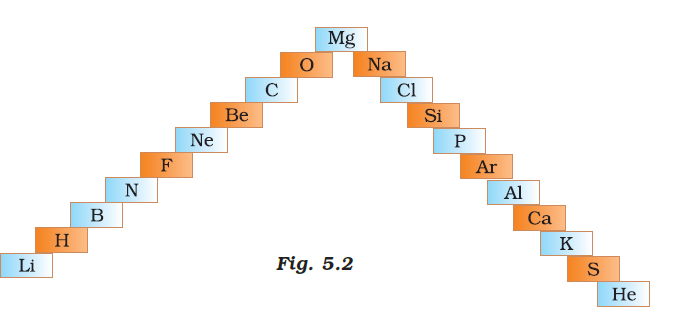
arrange in increasing order

a) H, He, Li, Be, B, C, N, O, F, Ne, Mg, Al Si, P, S, Cl, Ar, K, Ca

b)

Group 1:H, Li, Na, K

Group 2: Be, Mg, Ca

Group 13: B. Al

Group 14: C, Si

Group 15: N. P

Group 16: 0, S

Group 17: F. U

Group 18: He, Ne, Ar
Q47Multiple choice

Mendeleev ′ predicted the existence of certain elements not known at that time and named two of them as Eka-silicon and Eka-aluminium.

Show answerHide answer
Correct option: A
Show solutionHide solution
Worked solution

a) Eka-Silicon was replaced by germanium, Eka-aluminium was replaced by Gallium

b) Germanium-Group 14 Period 4

Gallium-Group 13 Period 4

c) Germanium is a metalloid and Gallium is a metal.

d) Germanium has 4 electrons, Gallium has 3 valence electrons

Q48Written answer

(a) Electropositive nature of the element(s) increases down the group and decreases across the period

(b) Electronegativity of the element decreases down the group and increases across the period

(c) Atomic size increases down the group and decreases across a period (left to right)

(d) Metallic character increases down the group and decreases across a period.

Based on the above trends of the Periodic Table, answer the following about the elements with atomic numbers 3 to 9.

(a) Name the most electropositive element among them

(b) Name the most electronegative element

(c) Name the element with the smallest atomic size

(d) Name the element which is a metalloid

(e) Name the element which shows maximum valency.

Show solutionHide solution
Worked solution

(a)Electropositive nature of the element(s) increases down the group and decreases across the period.

(b) Electronegativity of the element decreases down the group and increases across the period

(c) Atomic size increases down the group and decreases across a period (left to right)

(d) Metallic character increases down the group and decreases across a period.

a) Lithium is the most electropositive element.

b) Fluorine is the most electronegative element

c) ) Fluorine is the element with smallest atomic size among the given elements

c) Boron

d) Carbon is the element which shows maximum valency.

Q49Multiple choice

An element X which is a yellow solid at room temperature shows catenation and allotropy. X forms two oxides which are also formed during the thermal decomposition of ferrous sulphate crystals and are the major air pollutants.

(e) Locate the position of the element in the Modern Periodic Table

Show solutionHide solution
Worked solution
  1. Element X is Sulphur
  2. 2,8,6
  3. 2FeSO4 Fe2O3+SO2+SO3
  4. Sulphur oxides are acidic in nature
  5. Group 16 Period 3
Q50Written answer

An element X of group 15 exists as a diatomic molecule and combines with hydrogen at 773 K in presence of the catalyst to form a compound, ammonia which has a characteristic pungent smell.

(a) Identify the element X. How many valence electrons does it have?

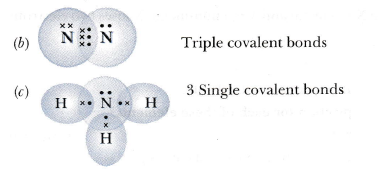
(b) Draw the electron dot structure of the diatomic molecule of X. What type of bond is formed in it?

(c) Draw the electron dot structure for ammonia and what type of bond is formed in it?

Show solutionHide solution
Worked solution
  1. Answer is Nitrogen and it has 5 electrons in its outermost shell.

triple covalent bond

  1. Ammonia forms covalent bonding

Q51Written answer

Which group of elements could be placed in Mendeleev’s ′ Periodic Table without disturbing the original order? Give reason.

Show solutionHide solution
Worked solution

Inert gases could be placed in Mendeleev’s Periodic Table without disturbing the original order.

Before Mendeleev Noble gases; like Helium. Neon and Argon had been mentioned by various scientists. But these gases could be grouped as noble gases much later than Mendeleev’s discovery.

Mendeleev used 63 elements till his periodic table because these were the only known elements till his time. However, he was bold enough to leave gaps in his periodic table. He had predicted that more elements would be discovered in times to come.

Mendeleev’s Periodic Table was the first comprehensive attempt to classify elements based on their chemical properties. This is the main reason that new elements could be easily placed in Mendeleev’s Periodic Table without disturbing the original order.

Q52Written answer

Give an account of the process adopted by Mendeleev ′ for the classification of elements. How did he arrive at “Periodic Law”?

Show solutionHide solution
Worked solution

During Mendeleev’s time, only 63 elements were known. Mendeleev examined the correlation between chemical properties and Atomic manes of elements. For this, he concentrated on compounds which were formed by the elements with hydrogen and oxygen. He selected hydrogen and oxygen, because these elements make a compound with most of the other elements.

Mendeleev made 63 cards and wrote the name of an element on each card: along with the chemical properties of a particular element. Then, he pinned those cards on a wall. He could observe that most of the elements could be arranged in the periodic table in increasing order of their atomic masses. That is how Mendeleev arrived at “Periodic law”. Mendeleev’s Periodic Law states that properties of elements are periodic function of their atomic masses.