Identify and name the metals out of the following elements whose electronic configurations are given below.
(a) 2, 8, 2
(b) 2, 8, 1
(c) 2, 8, 7
(d) 2, 1
Show solutionHide solution
- Magnesium
- Sodium
- Chlorine
- Lithium
Your cart is empty.
Practice each question, then open the answer or worked solution.
Identify and name the metals out of the following elements whose electronic configurations are given below.
(a) 2, 8, 2
(b) 2, 8, 1
(c) 2, 8, 7
(d) 2, 1
Write the formula of the product formed when the element A (atomic number 19) combines with the element B (atomic number 17). Draw its electronic dot structure. What is the nature of the bond formed?
Element A is K (Potassium).
The electronic configuration of element A (atomic number 19) would be 2, 8, 8, 1. As it has only one valence electron therefore it must be a metal. Thus it is potassium.
Element B is Cl (Chlorine).
The electronic configuration of element B (atomic number 17) would be 2, 8, 7. As it has 7 valence electrons therefore it must be a non-metal. Thus it is chlorine.
A metal and a non-metal usually combine with an ionic bond. Metals tend to lose electrons and form cations whereas non-metals can accept electrons to form anions.
Dot structure:
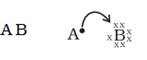
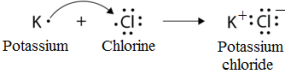
Potassium and chlorine will combine with an ionic bond to form potassium chloride (KCl).
The electron dot structure of KCl is as given below:
Arrange the following elements in the increasing order of their metallic character Mg, Ca, K, Ge, Ga
Identify the elements with the following property and arrange them in increasing order of their reactivity
(a) An element which is a soft and reactive metal
(b) The metal which is an important constituent of limestone
(c) The metal which exists in a liquid state at room temperature
Properties of the elements are given below. Where would you locate the following elements in the periodic table?
(a) A soft metal stored under kerosene
(b) An element with variable (more than one) valency stored underwater.
(c) An element which is tetravalent and forms the basis of organic chemistry
(d) An element which is an inert gas with atomic number 2
(e) An element whose thin oxide layer is used to make other elements corrosion-resistant by the process of “ anodising”