My Cart
Your Cart 0

    Your cart is empty.

  • Total (Amount) ₹0.00
NCERT Exemplar · Class 10 · Science

Chapter 4: Carbon and Its Compounds

Practice each question, then open the answer or worked solution.

so compound S is Ester or Ethyl ethanoate and compound A is Ethanol

5 questions
Q53Written answer

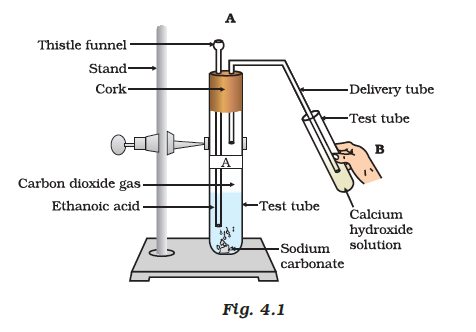
Look at Figure 4.1 and answer the following questions

(a) What change would you observe in the calcium hydroxide solution taken in tube B?

(b) Write the reaction involved in test tubes A and B respectively.

(c) If ethanol is given instead of ethanoic acid, would you expect the same change?

(d) How can a solution of lime water be prepared in the laboratory?
chemical reaction

Show solutionHide solution
Worked solution
  1. Calcium Hydroxide solution would become milky
  2. Reaction in Tube A

CH3COOH+NAHCO3 →CH3COONA+CO2+ H2O

Reaction in tube B

Ca(OH)2+CO2 CaCO3+H2O

  1. Ethanol will not react with Sodium Hydrogen carbonate. Hence same change will not be observed.
  2. In a beaker take distilled water and mix Calcium carbonate powder and mix thoroughly. Allow the solution to settle and decant the clear solution to obtain the lime water.
Q54Written answer

How would you bring about the following conversions? Name the process and write the reaction involved.

(a) ethanol to ethene.

b) propanol to propanoic acid. Write the reactions.

Show solutionHide solution
Worked solution
  1. Ethene is formed when ethanol is heated at 443 K with an excess of concentrated sulphuric acid.

CH3CH2OH Con H2SO4 CH2=CH+H2O

  1. Propanol is treated with alkaline Potassium permanganate or acidified Potassium-di-chromate to obtain propanoic acid.

CH3CH2CH2OH Alk KMnO4/ acidified K2Cr2O7 CH3CH2COOH

Q55Written answer

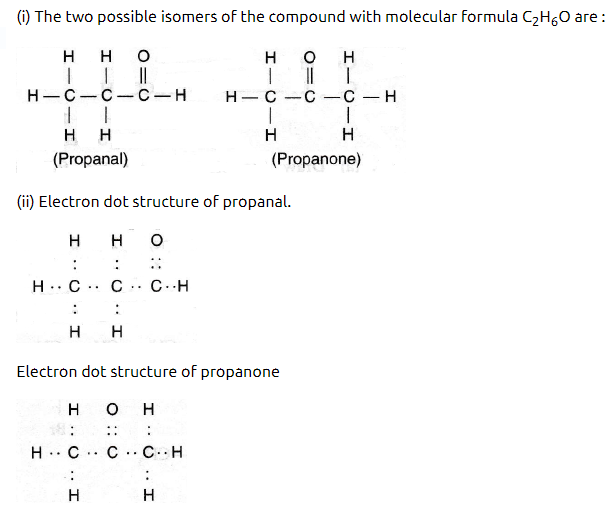
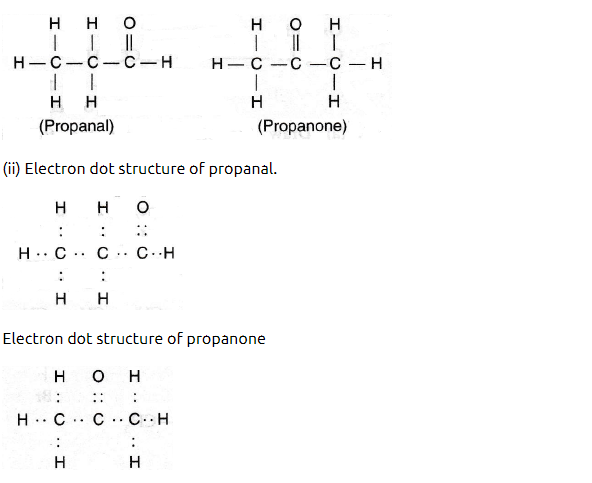
Draw the possible isomers of the compound with molecular formula C3H6O and also give their electron dot structures.

Show solutionHide solution
Worked solution

isomers of C3H6O

isomers of C3H6O

Q56Written answer

Explain the given reactions with the examples

(a) Hydrogenation reaction

(b) Oxidation reaction

(c) Substitution reaction

(d) Saponification reaction

(e) Combustion reaction

Show solutionHide solution
Worked solution

(a) Hydrogenation reaction can be defined as an addition reaction between the hydrogen and other compounds in the presence of a catalyst.

CH2 = CH2 → CH3CH3

(b) An oxidation reaction is a reaction in which oxygen combines with an element or a compound. In other words, it can also be defined as a molecule loses its electrons.

2Mg + O2→ 2MgO

(c) Substitution reaction can be defined as the reaction in which a more reactive element displaces a less reactive element from its aqueous salt solution.

Zn + CuSO4 → ZnSO4 + Cu

(d) Saponification reaction is the reaction in which the hydrolysis of an ester takes place with NaOH or KOH to give alcohol and sodium or potassium salt of the acid.

CH3COOC2H5 + NaOH → C2H5OH + CH3COONa

(e) Combustion reaction is the reaction in which oxygen combines with a compound to form carbon dioxide and water. These reactions are exothermic, meaning they give off heat.

CH4 + 2O2 → 2H2O + CO2


Q57Written answer

An organic compound A on heating with concentrated H2 SO4 forms a compound B which on addition of one mole of hydrogen in presence of Ni forms a compound C. One mole of compound C on combustion forms two moles of CO2 and 3 moles of H2O. Identify the compounds A, B and C and write the chemical equations of the reactions involved.

Show solutionHide solution
Worked solution

Compound A is Ethanol

Compound A = CH3CH2OH

CH3CH2OH (in the presence of conc. H2SO4) → CH2-CH2+ H2O

Compound B is Ethene

Compound B is CH2= CH2

CH2=CH2 (in the presence of Ni)  →C2H6

Compound C = CH3 — CH3

2C2H6+7O2 4CO2 +6H2O