My Cart
Your Cart 0

    Your cart is empty.

  • Total (Amount) ₹0.00
NCERT Exemplar · Class 10 · Science

Chapter 4: Carbon and Its Compounds

Practice each question, then open the answer or worked solution.

Short Answer Questions

23 questions
Q40Written answer

Carbon, Group (14) element in the Periodic Table, is known to form compounds with many elements. Write an example of a compound formed with

(a) chlorine (Group 17 of Periodic Table)

(b) oxygen (Group 16 of Periodic Table)

Show solutionHide solution
Worked solution

a)CCl4– Carbon Tetrachloride

b) Carbon-di-oxide- CO2
Q41Written answer

In electron dot structure, the valence shell electrons are represented by crosses or dots.

(a) The atomic number of chlorine is 17. Write its electronic configuration

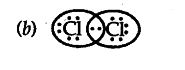
(b) Draw the electron dot structure of chlorine molecule

Show solutionHide solution
Worked solution
  1. KLM- 2,8,7

electron dot structure of chlorine molecule

Q42Written answer

Catenation is the ability of an atom to form bonds with other atoms of the same element. It is exhibited by both carbon and silicon. Compare the ability of catenation of the two elements. Give reasons.

Show solutionHide solution
Worked solution

Catenation is shown by both Silicon and Carbon. Silicon bonds are less stable and reactive whereas bonds formed by Carbon bonds are very strong hence carbon shows better catenation than Silicon.

Q43Written answer

Unsaturated hydrocarbons contain multiple bonds between the two C-atoms and show addition reactions. Give the test to distinguish ethane from ethene.

Show solutionHide solution
Worked solution

Saturated Hydrocarbons burns with a clean flame and produce no soot whereas non-saturated Hydrocarbons burns with a yellow flame and produces a lot of soot. Ethane is saturated hydrocarbon and it burns with clean flame with no soot. Ethene is unsaturated hence it burns with yellow flame producing a lot of soot.

Q44Written answer

Match the reactions given in Column (A) with the names given in column (B).

Column A Column B
(a) CH3OH + CH3COOH CH3COOCH3 + H2O (i) Addition reaction
(b) CH2 = CH2 + H2 CH3 — CH3 (ii) Substitution reaction
(c) CH4 + Cl2 Sunlight CH3Cl + HCl (iii) Neutralisation reaction
(d) CH3COOH+NaOH CH3COONa+H2O (iv) Esterification reaction
Show solutionHide solution
Worked solution
Column A Column B
(a) CH3OH + CH3COOH CH3COOCH3 + H2O (iv) Esterification reaction
(b) CH2 = CH2 + H2 CH3 — CH3 (i) Addition reaction
(c) CH4 + Cl2 Sunlight CH3Cl + HCl (ii) Substitution reaction
(d) CH3COOH+NaOH CH3COONa+H2O (iii) Neutralisation reaction
Q45Written answer

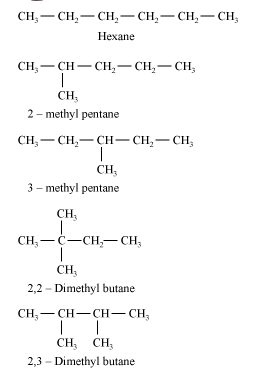
Write the structural formulae of all the isomers of hexane.

Show solutionHide solution
Worked solution

structural formulae of all the isomers of hexane

Q46Written answer

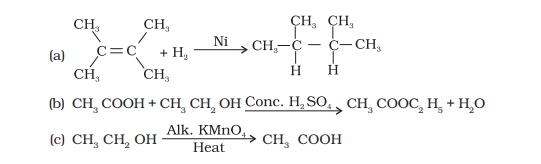
What is the role of metal or reagents written on arrows in the given chemical reactions?

Show solutionHide solution
Worked solution

chemcial reactions

Q47Written answer

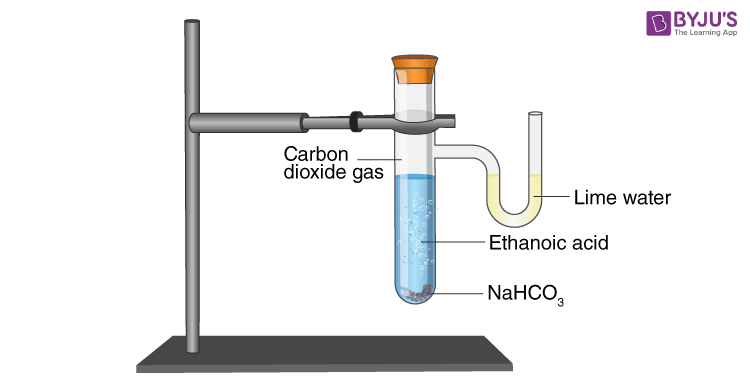
A salt X is formed and a gas is evolved when ethanoic acid reacts with sodium hydrogen carbonate. Name the salt X and the gas evolved. Describe an activity and draw the diagram of the apparatus to prove that the evolved gas is the one which you have named. Also, write a chemical equation of the reaction involved.

Show solutionHide solution
Worked solution

When ethanoic acid reacts with Sodium Hydrogen Carbonate with production of Sodium Ethanoate and producing Carbon-di-oxide gas.

CH3COOH+NaHCO3 → CH3COONA+H2O+CO2

Here salt X is Sodium Ethanoate and gas evolved is Carbon-di-oxide.

ethanoic acid reacts with Sodium Hydrogen Carbonate

Activity

  • Set up the experiment as shown in figure.
  • Take a spoon full of Sodium Hydrogen Carbonate in a test-tube and add 2ml of dilute ethanoic acid.
  • Brisk effervescence occur in testtube.
  • Pass the produced gas into lime water
  • Lime water turns milky confirming the evolution of CO2
Q48Written answer

(a) What are hydrocarbons? Give examples.

(b) Give the structural differences between saturated and unsaturated hydrocarbons with two examples each. (c) What is a functional group? Give examples of four different functional groups.

Show solutionHide solution
Worked solution
  1. Compounds of Carbon and hydrogen are called as Hydrocarbons. Ex: Ethane, Methane
  2. All the bond in saturated Hydrocarbons are single bonds whereas bonds in the unsaturated Hydrocarbons are either double or triple bonds.

Saturated Hydrocarbon Ex: Ethane, Methane

Unsaturated Hydrocarbons-Ethyne, Ethene

  1. Functional groups are a set of atoms joined in a specific manner which is responsible for the characteristic chemical property of the compound. Ex: CHO-Aldehyde, OH-Hydroxyl, COOH- Carboxylic acid.
Q49Written answer

Name the reaction which is commonly used in the conversion of vegetable oils to fats. Explain the reaction involved in detail.

Show solutionHide solution
Worked solution

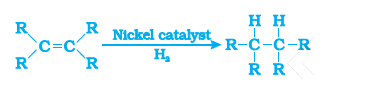
Addition reaction is involved in the conversion of oils into fats. This process is known as Hydrogenation. Here Unsaturated vegetable are converted to saturated fats which have saturated carbons.

Nickel is used as a catalyst in the hydrogenation process and the reaction is given below

Hydrogenation