My Cart
Your Cart 0

    Your cart is empty.

  • Total (Amount) ₹0.00
NCERT Exemplar · Class 10 · Maths

Chapter 3: Pair of Linear Equations in Two Variables

Practice each question, then open the answer or worked solution.

Exercise 3.4

6 questions
Q1Written answer

Graphically, solve the following pair of equations:

2x + y = 6

2x – y + 2 = 0

Find the ratio of the areas of the two triangles formed by the lines representing these equations with the x-axis and the lines with the y-axis.

Show solutionHide solution
Worked solution

Given equations are 2x + y = 6 and 2x – y + 2 = 0

Table for equation 2x + y – 6 = 0, for x = 0, y = 6, for y = 0, x = 3.

x 0 3
y 6 0

Table for equation 2x – y + 2 = 0, for x = 0, y = 2, for y = 0,x = – 1

x 0 -1
y 2 0

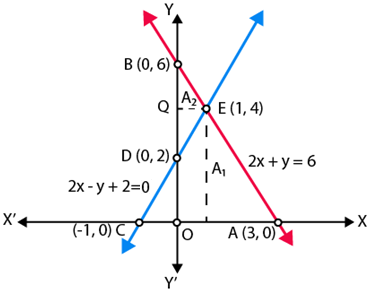
Let A1 and A2 represent the areas of triangles ACE and BDE, respectively.

NCERT Exemplar Class 10 Maths Chapter 3 Ex. 3.4 Question 1

Let the area of triangle formed with x-axis = T1

T1 = Area of △ACE = ½ × AC × PE

T1 = ½ × 4 × 4 = 8

And area of triangle formed with y-axis = T2

T1 = Area of △BDE = ½ × BD × QE

T1 = ½ × 4 × 1 = 2

T1:T2 = 8:2 = 4:1

Hence, the pair of equations intersect graphically at point E(1,4)

i.e., x = 1 and y = 4.

Q2Written answer

Determine, graphically, the vertices of the triangle formed by the lines

y = x, 3y = x, x + y = 8

Show solutionHide solution
Worked solution

Given linear equations are

y = x …(i)

3y = x …(ii)

and x + y = 8 …(iii)

Table for line y = x,

x 0 1 2
y 0 1 2


Table for line x = 3y,

x 0 3 6
y 0 1 2


Table for line x + y = 8

x 0 4 8
y 8 4 0


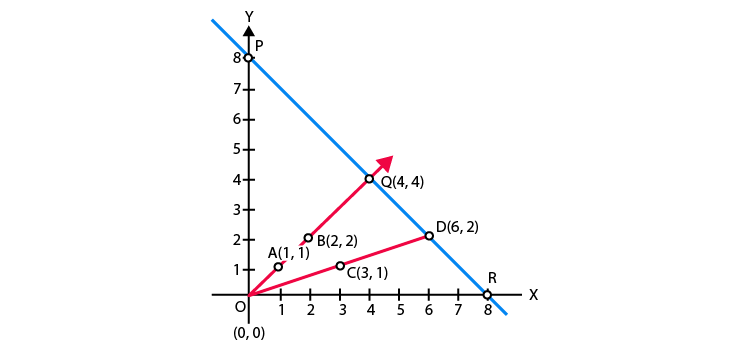
Plotting the points A (1, 1), B(2,2), C (3, 1), D (6, 2), we get the straight lines AB and CD.

Similarly, plotting the points P (0, 8), Q(4, 4) and R(8, 0), we get the straight line PQR.

AB and CD intersect the line PR on Q and D, respectively.
NCERT Exemplar Class 10 Maths Chapter 3 Ex. 3.4 Question 2

So, △OQD is formed by these lines. Hence, the vertices of the △OQD formed by the given lines are O(0, 0), Q(4, 4) and D(6,2).

Q3Written answer

Draw the graphs of the equations x = 3, x = 5 and 2x – y – 4 = 0. Also, find the area of the quadrilateral formed by the lines and the x–axis.

Show solutionHide solution
Worked solution

Given equation of lines x = 3, x = 5 and 2x-y-4 = 0.

Table for line 2x – y – 4 = 0

x 0 2
y -4 0

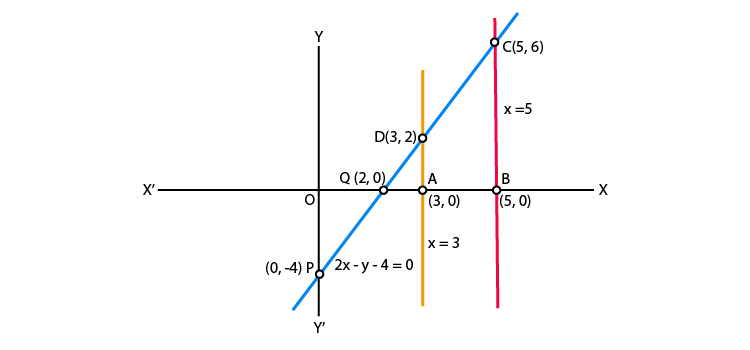
Plotting the graph, we get,

NCERT Exemplar Class 10 Maths Chapter 3 Ex. 3.4 Question 3

From the graph, we get,

AB = OB-OA = 5-3 = 2

AD = 2

BC = 6

Thus, quadrilateral ABCD is a trapezium, then,

Area of quadrilateral ABCD = ½ × (distance between parallel lines) = ½ × (AB) × (AD + BC)

= 8 sq units

Q4Written answer

The cost of 4 pens and 4 pencil boxes is Rs. 100. Three times the cost of a pen is Rs. 15 more than the cost of a pencil box. Form the pair of linear equations for the above situation. Find the cost of a pen and a pencil box.

Show solutionHide solution
Worked solution

Let the cost of a pen and a pencil box be Rs x and Rs y, respectively.

According to the question,

4x + 4y = 100

Or x + y = 25 …(i)

3x = y + 15

Or 3x-y = 15 …(ii)

On adding Equation (i) and (ii), we get,

4x = 40

So, x = 10

Substituting x = 10, in Eq. (i), we get

y = 25-10 = 15

Hence, the cost of a pen = Rs. 10

The cost of a pencil box = Rs. 15

Q5Written answer

Determine, algebraically, the vertices of the triangle formed by the lines

3x – y = 3

2x – 3y = 2

x + 2y = 8

Show solutionHide solution
Worked solution

3x – y = 2 …(i)

2x -3y = 2 …(ii)

x + 2y = 8 …(iii)

Let the equations of the line (i), (ii) and (iii) represent the side of a ∆ABC.

On solving (i) and (ii),

We get,

(9x-3y)-(2x-3y) = 9-2

7x = 7

x = 1

Substituting x=1 in Eq. (i), we get

3×1-y = 3

y = 0

So, the coordinate of point B is (1, 0)

On solving lines (ii) and (iii),

We get,

(2x + 4y)-(2x-3y) = 16-2

7y = 14

y = 2

Substituting y=2 in Eq. (iii), we get

x + 2 × 2 = 8

x + 4 = 8

x = 4

Hence, the coordinate of point C is (4, 2).

On solving lines (iii) and (i),

We get,

(6x-2y) + (x + 2y) = 6 + 8

7x = 14

x = 2

Substituting x=2 in Eq. (i), we get

3 × 2 – y = 3

y = 3

So, the coordinate of point A is (2, 3).

Hence, the vertices of the ∆ABC formed by the given lines are as follows,

A (2, 3), B (1, 0) and C (4, 2).

Q6Written answer

Ankita travels 14 km to her home partly by rickshaw and partly by bus. She takes half an hour if she travels 2 km by rickshaw and the remaining distance by bus. On the other hand, if she travels 4 km by rickshaw and the remaining distance by bus, she takes 9 minutes longer. Find the speed of the rickshaw and of the bus.

Show solutionHide solution
Worked solution

Let the speed of the rickshaw and the bus be x and y km/h, respectively.

Now, she has taken time to travel 2 km by rickshaw, t1 = (2/x) hr

Speed = distance/ time

She has taken time to travel the remaining distance i.e., (14 – 2) = 12km

By bus t2 = (12/y) hr

By the first condition,

t1 + t2 = ½ = (2/x) + (12/y) … (i)

Now, she has taken time to travel 4 km by rickshaw, t3 = (4/x) hr

and she has taken time to travel the remaining distance i.e., (14 – 4) = 10km, by bus = t4 = (10/y) hr

By the second condition,

t3 + t4 = ½ + 9/60 = ½ + 3/20

(4/x) + (10/y) = (13/20) …(ii)

Let (1/x) = u and (1/y) = v

Then equations (i) and (ii) become

2u + 12v = ½ …(iii)

4u + 10v = 13/20…(iv)

(4u + 24v) – (4u + 10v) = 1–13/20

14v = 7/20

v = 1/40

Substituting the value of v in Eq. (iii),

2u + 12(1/40) = ½

2u = 2/10

u = 1/10

x = 1/u = 10km/hr

y = 1/v = 40km/hr

Hence, the speed of rickshaw = 10 km/h

And the speed of the bus = 40 km/h.

Also, BYJU’S provides Class 10 Maths NCERT Solutions, notes, exemplar books, question papers and some preparation tips and tricks so that students can score good marks in Maths subject. They are also suggested to solve sample papers and previous years’ question papers to get a clear idea of the question pattern and marking scheme for the chapter, Pair of Linear Equations in Two Variables.

The exemplar comes with detailed explanations to help students grasp the core concepts and get the right insight into how the problems should be handled. With the exemplar solutions, students will be able to study smartly, develop better Maths skills and ultimately be prepared to solve any type of question that may be asked in the board exams. Get updated study materials to study well, and also download BYJU’S – The Learning App to experience a new method of learning with the help of educational videos clearing the concepts of Maths topics in a visual way.