My Cart
Your Cart 0

    Your cart is empty.

  • Total (Amount) ₹0.00
NCERT Exemplar · Class 10 · Maths

Chapter 13: Statistics and Probability

Practice each question, then open the answer or worked solution.

Exercise 13.1

13 questions
Q1Written answer

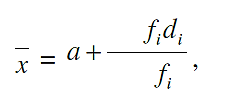
In the formula
NCERT Exemplar Class 10 Maths Chapter 13 Ex. 13.1 Question 1

For finding the mean of grouped data di’s are deviations from a of

(A) Lower limits of the classes

(B) Upper limits of the classes

(C) Mid points of the classes

(D) Frequencies of the class marks

Show solutionHide solution
Worked solution

(C) Mid points of the classes

Explanation:

We know,

di = xi – a

Where,

xi are data and ‘a’ is the assumed mean

So, di are the deviations from of mid – points of the classes.

Hence, the option (C) is correct

Q2Written answer

While computing mean of grouped data, we assume that the frequencies are

(A) Evenly distributed over all the classes

(B) Centred at the class marks of the classes

(C) Centred at the upper limits of the classes

(D) Centred at the lower limits of the classes

Show solutionHide solution
Worked solution

(B) Centered at the class marks of the classes

Explanation:

In computing the mean of grouped data, the frequencies are centered at the class marks of the classes.

Hence, the option (B) is correct

Q3Written answer

If xi’s are the mid points of the class intervals of grouped data, fi’s are the corresponding frequencies and x is the mean, then (fixi –

\(\begin{array}{l}\overline{x}\end{array} \)
) is equal to

(A)0 (B) –1 (C) 1 (D) 2

Show solutionHide solution
Worked solution

(A) 0

Explanation:

Mean (x) = Sum of all the observations/ Number of observations

x = (f1x1 + f2x2 + …..+ fnxn) / f1 + f2 +……+ fn

x = Σfixi / Σfi, Σfi = n

x = Σfixi / n

n x = Σfixi …………… (1)

Σ (fixi – x) = (f1x1 – x) + (f2x2 – x)+ …..+ (fnxn – x)

Σ (fixi – x) = (f1x1 + f2x2 + …..+ fnxn) – (x +x +….n times)

Σ (fixi – x) = Σfixi –nx

Σ(fixi – x) = nx – nx ( From eq1)

Σ(fixi – x) = 0

Hence, option (A) is correct

Q4Written answer

In the formula x = a + h(fiui/fi), for finding the mean of grouped frequency distribution, ui =

(A) (xi+a)/h

(B) h (xi – a)

(C) (xi –a)/h

(D) (a – xi)/h

Show solutionHide solution
Worked solution

(C) (xi –a)/h

Explanation:

According to the question,

x = a + h(fiui/fi),

Above formula is a step deviation formula.

In the above formula,

xi is data values,

a is assumed mean,

h is class size,

When class size is same we simplify the calculations of the mean by computing the coded mean of u1,u2,u3…..,

Where ui = (xi – a)/h

Hence, option (C) is correct

Q5Written answer

The abscissa of the point of intersection of the less than type and of the more than type cumulative frequency curves of a grouped data gives its

(A) mean (B) median

(C) mode (D) all the three above

Show solutionHide solution
Worked solution

(B) Median

Explanation:

Since, the intersection point of less than ogive and more than ogive gives the median on the abscissa, the abscissa of the point of intersection of the less than type and of the more than type cumulative frequency curves of a grouped data gives its

Hence, option (B) is correct

Q6Written answer

For the following distribution :

Class 0-05 5-10 10-15 15-20 20-25

Frequency 10 15 12 20 9

the sum of lower limits of the median class and modal class is

(A)15 (B) 25 (C) 30 (D) 35

Show solutionHide solution
Worked solution

(B) 25

Explanation:

Class Frequency Cumulative Frequency
0-5 10 10
5-10 15 25
10-15 12 37
15-20 20 57
20-25 9 66

From the table, N/2 = 66/2 = 33, which lies in the interval 10 – 15.

Hence, lower limit of the median class is 10.

The highest frequency is 20, which lies in between the interval 15 – 20.

Hence, lower limit of modal class is 15.

Therefore, required sum is 10 + 15 = 25.

Hence, option (B) is correct

Q7Written answer

Consider the following frequency distribution:

Class 0-05 6-11 12-17 18-23 24-29

Frequency 13 10 15 8 11

The upper limit of the median class is

(A)17 (B) 17.5 (C) 18 (D) 18.5

Show solutionHide solution
Worked solution

(B) 17.5

Explanation:

According to the question,

Classes are not continuous, hence, we make the data continuous by subtracting 0.5 from lower limit and adding 0.5 to upper limit of each class.

Class Frequency Cumulative Frequency
0.5-5.5 13 13
6.5-11.5 10 23
11.5-17.5 15 38
17.5-23.5 8 46
23.5-29.5 11 57

According to the question,

N/2 = 57/2 = 28.5

28.5 lies in between the interval 11.5 – 17.5.

Therefore, the upper limit is 17.5.

Hence, option (B) is correct

Q8Written answer

For the following distribution:

Marks Number of students

Below 10 3

Below 20 12

Below 30 27

Below 40 57

Below 50 75

Below 60 80

The modal class is

(A)10-20 (B) 20-30 (C) 30-40 (D) 50-60

Show solutionHide solution
Worked solution

(C) 30-40

Explanation:

Marks Number of students Cumulative Frequency
Below 10 3=3 3
10-20 (12 – 3) = 9 12
20-30 (27 – 12) = 15 27
30-40 (57 – 27) = 30 57
40-50 (75 – 57) = 18 75
50-60 (80 – 75) = 5 80

Here, we see that the highest frequency is 30, which lies in the interval 30 – 40.

Hence, option (C) is correct

Q9Written answer

Consider the data :

Class 65-85 85-105 105-125 125-145 145-165 165-185 185-205
Frequency 4 5 13 20 14 7 4

The difference of the upper limit of the median class and the lower limit of the modal class is

A0 (B) 19 (C) 20 (D) 38

Show solutionHide solution
Worked solution

(C) 20

Explanation:

Class Frequency Cumulative Frequency
65-85 4 4
85-105 5 9
105-125 13 22
125-145 20 42
145-165 14 56
165-185 7 63
185-205 4 67

Here, N/2 = 67/2 = 33.5 which lies in the interval 125 – 145.

Hence, upper limit of median class is 145.

Here, we see that the highest frequency is 20 which lies in 125 – 145.

Hence, the lower limit of modal class is 125.

∴ Required difference = Upper limit of median class – Lower limit of modal class

= 145 – 125 = 20

Hence, option (C) is correct

Q10Written answer

The times, in seconds, taken by 150 athletes to run a 110 m hurdle race are tabulated below

Class 13.8-14 14-14.2 14.2-14.4 14.4-14.6 14.6-14.8 14.8-15
Frequency 2 4 5 71 48 20

The number of athletes who completed the race in less than 14.6 seconds is :

A11 (B) 71 (C) 82 (D) 130

Show solutionHide solution
Worked solution

(C) 82

Explanation:

The number of athletes who completed the race in less than 14.6 second= 2 + 4 + 5 + 71 = 82

Hence, option (C) is correct