My Cart
Your Cart 0

    Your cart is empty.

  • Total (Amount) ₹0.00
NCERT Exemplar · Class 10 · Maths

Chapter 13: Statistics and Probability

Practice each question, then open the answer or worked solution.

Exercise 13.2

7 questions
Q1Written answer

The median of an ungrouped data and the median calculated when the same data is grouped are always the same. Do you think that this is a correct statement? Give reason.

Show solutionHide solution
Worked solution

In order to calculate the median of a grouped data, the formula used is based on the assumption that the observations in the classes are uniformly distributed or equally spaced. Hence, we cannot say that the statement “the median of an ungrouped data and the median calculated when the same data is grouped are always the same” is always correct.
Q2Written answer

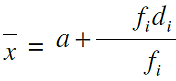
In calculating the mean of grouped data, grouped in classes of equal width, we may use the formula

NCERT Exemplar Class 10 Maths Chapter 13 Ex. 13.2 Question 2

where a is the assumed mean. a must be one of the mid-points of the classes. Is the last statement correct? Justify your answer.

Show solutionHide solution
Worked solution

No, the statement is not correct. It is not necessary that assumed mean should be the mid – point of the class interval. a can be considered as any value which is easy to simplify it.

Q3Written answer

Is it true to say that the mean, mode and median of grouped data will always be different? Justify your answer.

Show solutionHide solution
Worked solution

No, the values of mean, mode and median of grouped data can be the same as well, it depends on the type of data given.

Q4Written answer

Will the median class and modal class of grouped data always be different? Justify your answer.

Show solutionHide solution
Worked solution

The median class and modal class of grouped data is not always different, it depends on the data given.


Q5Written answer

In a family having three children, there may be no girl, one girl, two girls or three girls. So, the probability of each is ¼. Is this correct? Justify your answer.

Show solutionHide solution
Worked solution

No it is not correct that in a family having three children, there may be no girl, one girl, two girls or three girls, the probability of each is ¼. .

Let boys be B and girls be G

Outcomes can be BBB , GGG , BBG , BGB , GBB, GGB, GBG , BGG

Then Probability of 3 girls = 1/8

Probability of 0 girls = 1/8

Probability of 2 girls = 3/8

Probability of 1 girl = 3/8

Q6Written answer

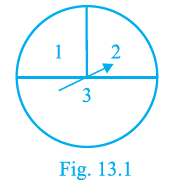
A game consists of spinning an arrow which comes to rest pointing at one of the regions (1, 2 or 3) (Fig. 13.1). Are the outcomes 1, 2 and 3 equally likely to occur? Give reasons.

Show solutionHide solution
Worked solution

NCERT Exemplar Class 10 Maths Chapter 13 Ex. 13.2 Question 6

Total no. of outcome = 360

p(1)= 90/360 =1/4

p(2) = 90/ 360 = 1/4

p(3) = 180/360 =1/2

Hence, it is clear that the outcome are not equal

Q7Written answer

Apoorv throws two dice once and computes the product of the numbers appearing on the dice. Peehu throws one die and squares the number that appears on it. Who has the better chance of getting the number 36? Why?

Show solutionHide solution
Worked solution

Apoorv throw two dice at once.

Hence, the total number of outcomes = 36

Number of outcomes for getting product 36 = 1(6×6)

∴ Probability for Apoorv = 1/36

Peehu throws one die,

Hence, the total number of outcomes = 6

Number of outcomes for getting square = 36

∴ Probability for Peehu = 6/36 = 1/6

Therefore, Peehu has a better chance of getting the number 36.