My Cart
Your Cart 0

    Your cart is empty.

  • Total (Amount) ₹0.00
NCERT · Class 9 · Science

Chapter 8: Force and Laws of Motion

Practice each question, then open the answer or worked solution.

Exercises · Page 128,129

Textbook page 128,129 · 18 questions
Q1Written answer

An object experiences a net zero external unbalanced force. Is it possible for the object to be travelling with a non-zero velocity? If yes, state the conditions that must be placed on the magnitude and direction of the velocity. If no, provide a reason.

Show solutionHide solution
Worked solution

Yes, it is possible. An object moving in some direction with constant velocity will continue in its state of motion as long as there are no external unbalanced forces acting on it. In order to change the motion of the object, some external unbalanced force must act upon it.
Q2Written answer

When a carpet is beaten with a stick, dust comes out of it. Explain.

Show solutionHide solution
Worked solution

When the carpet is beaten with a stick, the stick exerts a force on the carpet which sets it in motion. The inertia of the dust particles residing on the carpet resists the change in the motion of the carpet. Therefore, the forward motion of the carpet exerts a backward force on the dust particles, setting them in motion in the opposite direction. This is why the dust comes out of the carpet when beaten.

Q3Written answer

Why is it advised to tie any luggage kept on the roof of a bus with a rope?

Show solutionHide solution
Worked solution

When some luggage is placed on the roof of a bus which is initially at rest, the acceleration of the bus in the forward direction will exert a force (in the backward direction) on the luggage. In a similar manner, when a bus which is initially in a state of motion suddenly comes to rest due to the application of brakes, a force (in the forward direction) is exerted on the luggage.

Depending on the mass of the luggage and the magnitude of the force, the luggage may fall off the bus due to inertia. Tying up the luggage will secure its position and prevent it from falling off the bus.

Q4Written answer

A batsman hits a cricket ball which then rolls on a level ground. After covering a short distance, the ball comes to rest. The ball slows to a stop because (a) the batsman did not hit the ball hard enough. (b) velocity is proportional to the force exerted on the ball. (c) there is a force on the ball opposing the motion. (d) there is no unbalanced force on the ball, so the ball would want to come to rest.

Show solutionHide solution
Worked solution

When the ball rolls on the flat surface of the ground, its motion is opposed by the force of friction (the friction arises between the ground and the ball). This frictional force eventually stops the ball. Therefore, the correct answer is (c).

If the surface of the level ground is lubricated (with oil or some other lubricant), the friction that arises between the ball and the ground will reduce, which will enable the ball to roll for a longer distance.

Q5Written answer

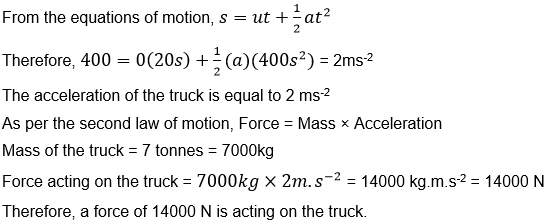
A truck starts from rest and rolls down a hill with a constant acceleration. It travels a distance of 400 m in 20 s. Find its acceleration. Find the force acting on it if it’s mass is 7 tonnes (Hint: 1 tonne = 1000 kg.)

Show solutionHide solution
Worked solution

Given, distance covered by the truck (s) = 400 meters

Time taken to cover the distance (t) = 20 seconds

The initial velocity of the truck (u) = 0 (since it starts from a state of rest)

NCERT Solutions For Class 9 Science Chapter 9 Image 3

Q6Written answer

A stone of 1 kg is thrown with a velocity of 20 ms-1 across the frozen surface of a lake and comes to rest after travelling a distance of 50 m. What is the force of friction between the stone and the ice?

Show solutionHide solution
Worked solution

Given, Mass of the stone (m) = 1kg

Initial velocity (u) = 20m/s

Terminal velocity (v) = 0 m/s (the stone reaches a position of rest)

Distance travelled by the stone (s) = 50 m

As per the third equation of motion

v² = u² + 2as

Substituting the values in the above equation we get,

0² = (20)² + 2(a)(50)

-400 = 100a

a = -400/100  =  -4m/s² (retardation)

We know that

F = m×a

Substituting above obtained value of a = -4 in F = m x a

We get,

F = 1 × (-4) = -4N

Here the negative sign indicates the opposing force which is Friction


Q7Written answer

An 8000 kg engine pulls a train of 5 wagons, each of 2000 kg, along a horizontal track. If the engine exerts a force of 40000 N and the track offers a friction force of 5000 N, then calculate: (a) the net accelerating force and (b) the acceleration of the train

Show solutionHide solution
Worked solution

(a) Given, the force exerted by the train (F) = 40,000 N

Force of friction = -5000 N (the negative sign indicates that the force is applied in the opposite direction)

Therefore, the net accelerating force = sum of all forces = 40,000 N + (-5000 N) = 35,000 N

(b) Total mass of the train = mass of engine + mass of each wagon = 8000kg + 5 × 2000kg

The total mass of the train is 18000 kg.

As per the second law of motion, F = ma (or: a = F/m)

Therefore, acceleration of the train = (net accelerating force) / (total mass of the train)

= 35,000/18,000 = 1.94 ms-2

The acceleration of the train is 1.94 m.s-2.

Q8Written answer

An automobile vehicle has a mass of 1500 kg. What must be the force between the vehicle and road if the vehicle is to be stopped with a negative acceleration of 1.7 ms-2?

Show solutionHide solution
Worked solution

Given, mass of the vehicle (m) = 1500 kg

Acceleration (a) = -1.7 ms-2

As per the second law of motion, F = ma

F = 1500kg × (-1.7 ms-2) = -2550 N

Hence, the force between the automobile and the road is -2550 N, in the opposite direction of the automobile’s motion.

Q9Written answer

What is the momentum of an object of mass m, moving with a velocity v?

(a) (mv)2 (b) mv2 (c) ½ mv2 (d) mv

Show solutionHide solution
Worked solution

The momentum of an object is defined as the product of its mass m and velocity v

Momentum = mass x velocity

Hence, the correct answer is mv i.e option (d)

Q10Written answer

Using a horizontal force of 200 N, we intend to move a wooden cabinet across a floor at a constant velocity. What is the friction force that will be exerted on the cabinet?

Show solutionHide solution
Worked solution

Since the velocity of the cabinet is constant, its acceleration must be zero. Therefore, the effective force acting on it is also zero. This implies that the magnitude of opposing frictional force is equal to the force exerted on the cabinet, which is 200 N. Therefore, the total friction force is -200 N.