My Cart
Your Cart 0

    Your cart is empty.

  • Total (Amount) ₹0.00
NCERT · Class 9 · Science

Chapter 8: Force and Laws of Motion

Practice each question, then open the answer or worked solution.

Intext Questions – 2

Textbook page 126,127 · 4 questions
Q1Written answer

If action is always equal to the reaction, explain how a horse can pull a cart.

Show solutionHide solution
Worked solution

When the horse walks forward (with the cart attached to it), it exerts a force in the backward direction on the Earth. An equal force in the opposite direction (forward direction) is applied on the horse by the Earth. This force moves the horse and the cart forward. As a result, the cart moves forward.
Q2Written answer

Explain, why is it difficult for a fireman to hold a hose, which ejects large amounts of water at a high velocity.

Show solutionHide solution
Worked solution

When a fireman holds a hose, which is ejecting large amounts of water at a high velocity, then a reaction force is exerted on him by the ejecting water in the backward direction. This is because of Newton’s third law of motion. As a result of the backward force, the stability of the fireman decreases. Hence, it is difficult for him to remain stable while holding the hose.

Q3Written answer

From a rifle of mass 4 kg, a bullet of mass 50 g is fired with an initial velocity of 35 m s–1. Calculate the initial recoil velocity of the rifle.

Show solutionHide solution
Worked solution

Given, the Bullet’s mass (m1) = 50 g

The rifle’s mass (m2) = 4kg = 4000g

Initial velocity of the fired bullet (v1) = 35 m/s

Let the recoil velocity be v2.

Since the rifle was initially at rest, the initial momentum of the rifle = 0

The total momentum of the rifle and bullet after firing = m1v1 + m2v2

As per the law of conservation of momentum, the total momentum of the rifle and the bullet after firing = 0 (same as initial momentum)

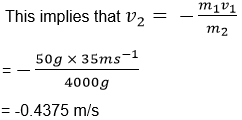
Therefore, m1v1 + m2v2 = 0

NCERT Solutions For Class 9 Science Chapter 9 Image 1

The negative sign indicates that recoil velocity is opposite to the bullet’s motion.

Q4Written answer

Two objects of masses 100 g and 200 g are moving along the same line and direction with velocities of 2 ms–1 and 1 ms–1, respectively. They collide and after the collision, the first object moves at a velocity of 1.67 ms–1. Determine the velocity of the second object.

Show solutionHide solution
Worked solution

Assuming that the first object is object A and the second one is object B, it is given that:

Mass of A (m1) = 100g

Mass of B (m2) = 200g

Initial velocity of A (u1) = 2 m/s

Initial velocity of B (u2) = 1 m/s

Final velocity of A (v1) = 1.67 m/s

Final velocity of B (v2) =?

Total initial momentum = Initial momentum of A + initial momentum of B

= m1u1 + m2u2

= (100g) × (2m/s) + (200g) × (1m/s) = 400 g.m.sec-1

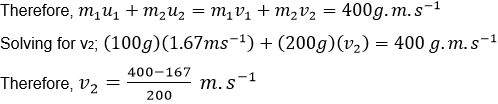
As per the law of conservation of momentum, the total momentum before collision must be equal to the total momentum post collision.

NCERT Solutions For Class 9 Science Chapter 9 Image 2

v2 = 1.165 m/s

Therefore, the velocity of object B after the collision is 1.165 meters per second.