My Cart
Your Cart 0

    Your cart is empty.

  • Total (Amount) ₹0.00
NCERT · Class 9 · Science

Chapter 2: Is Matter Around Us Pure?

Practice each question, then open the answer or worked solution.

Exercise-2.3

Textbook page 24 · 3 questions
Q1Written answer

How will you separate a mixture containing kerosene and petrol (the difference in their boiling points is more than 25°C), which are miscible with each other?

Show solutionHide solution
Worked solution

image name

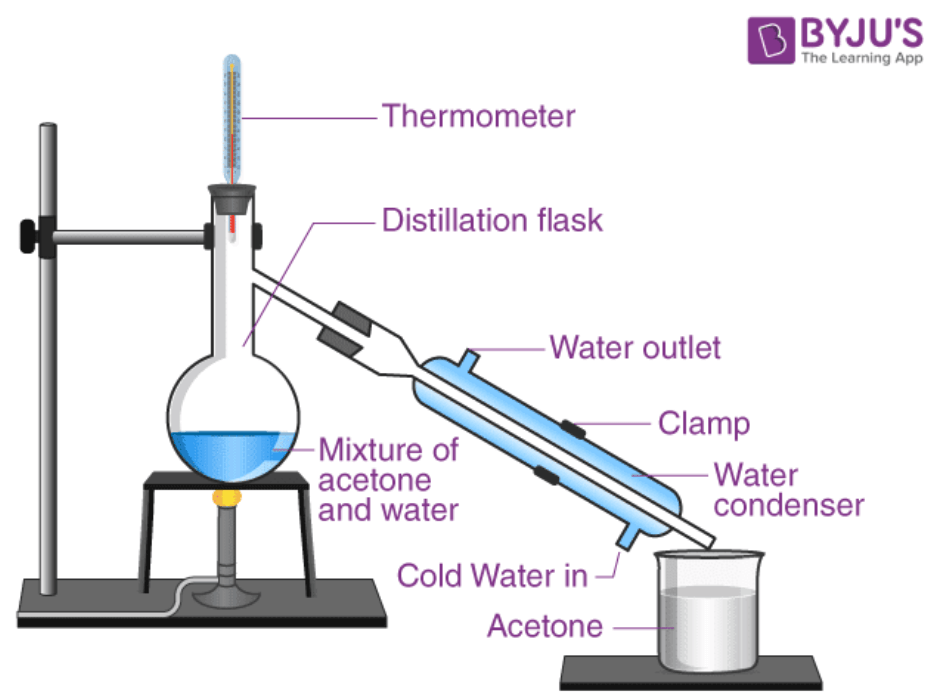
According to the question, kerosene and petrol are miscible, and their boiling points differ by more than 25 degrees Celsius, which is a significant difference. Therefore they can be separated using a simple distillation procedure.

Distillation can separate kerosene and petrol since their boiling points differ by more than 25 degrees Celsius. The kerosene and petrol combination will be poured into a hot distillation flask. Because petrol has a lower boiling point, it will evaporate and create vapours first as the temperature of the mixture rises. A condenser condenses the vapours of gasoline and collects them through the condenser output. In the distillation flask, kerosene with a higher boiling point will be left behind.

Because their vapours will develop within the same temperature range if the difference in boiling points of two liquids is not great, a simple distillation procedure cannot be utilised to separate them. Fractional distillation separates these liquids by passing the vapours through a fractionating column before condensation.

Q2Written answer

Name the techniques used to separate the following:

(a) Butter from curd

(b) Salt from seawater

(c) Camphor from salt

Show solutionHide solution
Worked solution

a) A process known as centrifugation is used to separate butter from curd. The process is governed by the principle of density.

b) We can use the simple evaporation technique to separate salt from seawater. Distillation causes water to evaporate, leaving solid salt behind, hence the production of salt.

c) Sublimation can be used to separate camphor from salt, as during the phase change, camphor does not undergo a liquid phase.

Q3Written answer

What types of mixtures are separated by the technique of crystallisation?

Show solutionHide solution
Worked solution

The technique of crystallisation is used to separate solids from a liquid solution. It is linked to precipitation, but in this technique, the precipitate is achieved in a crystal form which exhibits extremely high levels of purity. The principle of crystallisation can be applied to purify impure substances.