My Cart
Your Cart 0

    Your cart is empty.

  • Total (Amount) ₹0.00
NCERT · Class 9 · Maths

Chapter 9: Circles

Practice each question, then open the answer or worked solution.

Exercise: 10.6 (

10 questions
Q1Written answer

Prove that the line of centres of two intersecting circles subtends equal angles at the two points of intersection.

Show solutionHide solution
Worked solution

Consider the following diagram.
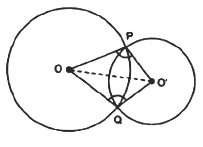
Ncert solutions class 9 chapter 10-29

In ΔPOO’ and ΔQOO’

OP = OQ          (Radius of circle 1)

O’P = O’Q        (Radius of circle 2)

OO’ = OO’        (Common arm)

So, by SSS congruency, ΔPOO’ ≅ ΔQOO’

Thus, ∠OPO’ = ∠OQO’ (proved).
Q2Written answer

Two chords AB and CD of lengths 5 cm and 11 cm, respectively, of a circle, are parallel to each other and are on opposite sides of its centre. If the distance between AB and CD is 6, find the radius of the circle.

Show solutionHide solution
Worked solution

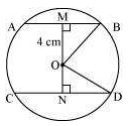
Ncert solutions class 9 chapter 10-30

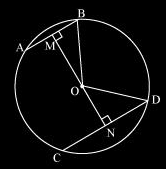
Here, OM ⊥ AB and ON ⊥ CD are drawn, and OB and OD are joined.

We know that AB bisects BM as the perpendicular from the centre bisects the chord.

Since AB = 5 so,

BM = AB/2 = 5/2

Similarly, ND = CD/2 = 11/2

Now, let ON be x.

So, OM = 6−x.

Consider ΔMOB,

OB2 = OM2+MB2

Or,

Ncert solutions class 9 chapter 10-31

Consider ΔNOD,

OD2 = ON2 + ND2

Or

Ncert solutions class 9 chapter 10-32

We know, OB = OD (radii)

From equation 1 and equation 2, we get

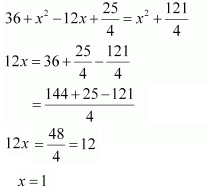
Ncert solutions class 9 chapter 10-33

Now, from equation (2), we have,

OD2= 12 +(121/4)

Or OD = (5/2)×√5 cm

Q3Written answer

The lengths of two parallel chords of a circle are 6 cm and 8 cm. If the smaller chord is at a distance 4 cm from the centre, what is the distance of the other chord from the centre?

Show solutionHide solution
Worked solution

Consider the following diagram.

Ncert solutions class 9 chapter 10-34

Here, AB and CD are 2 parallel chords. Now, join OB and OD.

Distance of smaller chord AB from the centre of the circle = 4 cm

So, OM = 4 cm

MB = AB/2 = 3 cm

Consider ΔOMB.

OB2 = OM2+MB2

Or, OB = 5cm

Now, consider ΔOND.

OB = OD = 5 (Since they are the radii.)

ND = CD/2 = 4 cm

Now, OD2= ON2+ND2

Or, ON = 3 cm

Q4Written answer

Let the vertex of an angle ABC be located outside a circle, and let the sides of the angle intersect equal chords AD and CE with the circle. Prove that ∠ABC is equal to half the difference of the angles subtended by the chords AC and DE at the centre.

Show solutionHide solution
Worked solution

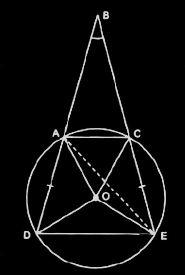
Consider the diagram.

Ncert solutions class 9 chapter 10-35

Here AD = CE

We know any exterior angle of a triangle is equal to the sum of interior opposite angles.

So,

∠DAE = ∠ABC+∠AEC (in ΔBAE) ——————-(i)

DE subtends ∠DOE at the centre and ∠DAE in the remaining part of the circle.

So,

∠DAE = (½)∠DOE ——————-(ii)

Similarly, ∠AEC = (½)∠AOC  ——————-(iii)

Now, from equations (i), (ii), and (iii), we get

(½)∠DOE = ∠ABC+(½)∠AOC

Or, ∠ABC = (½)[∠DOE-∠AOC]  (Hence, proved)

Q5Written answer

Prove that the circle drawn with any side of a rhombus as diameter passes through the point of intersection of its diagonals.

Show solutionHide solution
Worked solution

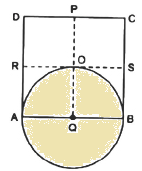
Ncert solutions class 9 chapter 10-36

To prove: A circle drawn with Q as the centre will pass through A, B and O (i.e., QA = QB = QO).

Since all sides of a rhombus are equal,

AB = DC

Now, multiply (½) on both sides.

(½)AB = (½)DC

So, AQ = DP

BQ = DP

Since Q is the midpoint of AB,

AQ= BQ

Similarly,

RA = SB

Again, as PQ is drawn parallel to AD,

RA = QO

Now, as AQ = BQ and RA = QO, we get

QA = QB = QO (Hence, proved)

Q6Written answer

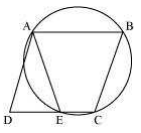
ABCD is a parallelogram. The circle through A, B and C intersect CD (produced if necessary) at E. Prove that AE = AD.

Show solutionHide solution
Worked solution

Ncert solutions class 9 chapter 10-37

Here, ABCE is a cyclic quadrilateral. In a cyclic quadrilateral, the sum of the opposite angles is 180°.

So, ∠AEC+∠CBA = 180°

As ∠AEC and ∠AED are linear pairs,

∠AEC+∠AED = 180°

Or, ∠AED = ∠CBA … (1)

We know in a parallelogram, opposite angles are equal.

So, ∠ADE = ∠CBA … (2)

Now, from equations (1) and (2), we get

∠AED = ∠ADE

Now, AD and AE are angles opposite to equal sides of a triangle.

∴ AD = AE (proved)

Q7Written answer

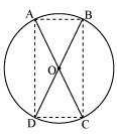
AC and BD are chords of a circle which bisect each other. Prove that (i) AC and BD are diameters; (ii) ABCD is a rectangle.

Show solutionHide solution
Worked solution

Ncert solutions class 9 chapter 10-38

Here, chords AB and CD intersect each other at O.

Consider ΔAOB and ΔCOD.

∠AOB = ∠COD (They are vertically opposite angles.)

OB = OD (Given in the question.)

OA = OC (Given in the question.)

So, by SAS congruency, ΔAOB ≅ ΔCOD

Also, AB = CD (By CPCT)

Similarly, ΔAOD ≅ ΔCOB

Or, AD = CB (By CPCT)

In quadrilateral ACBD, opposite sides are equal.

So, ACBD is a parallelogram.

We know that opposite angles of a parallelogram are equal.

So, ∠A = ∠C

Also, as ABCD is a cyclic quadrilateral,

∠A+∠C = 180°

⇒∠A+∠A = 180°

Or, ∠A = 90°

As ACBD is a parallelogram and one of its interior angles is 90°, so, it is a rectangle.

∠A is the angle subtended by chord BD. And as ∠A = 90°, therefore, BD should be the diameter of the circle. Similarly, AC is the diameter of the circle.

Q8Written answer

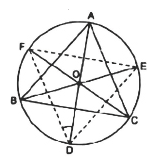
Bisectors of angles A, B and C of a triangle ABC intersect its circumcircle at D, E and F, respectively. Prove that the angles of the triangle DEF are 90°–(½)A, 90°–(½)B and 90°–(½)C.

Show solutionHide solution
Worked solution

Consider the following diagram.

Ncert solutions class 9 chapter 10-39

Here, ABC is inscribed in a circle with centre O, and the bisectors of ∠A, ∠B and ∠C intersect the circumcircle at D, E and F, respectively.

Now, join DE, EF and FD.

As angles in the same segment are equal, so,

∠EDA = ∠FCA ————-(i)

∠FDA = ∠EBA ————-(i)

By adding equations (i) and (ii), we get

∠FDA+∠EDA = ∠FCA+∠EBA

Or, ∠FDE = ∠FCA+∠EBA = (½)∠C+(½)∠B

We know, ∠A +∠B+∠C = 180°

So, ∠FDE = (½)[∠C+∠B] = (½)[180°-∠A]

∠FDE = [90-(∠A/2)]

In a similar way,

∠FED = [90° -(∠B/2)] °

And,

∠EFD = [90° -(∠C/2)] °

Q9Written answer

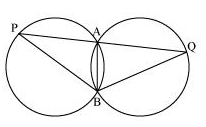
Two congruent circles intersect each other at points A and B. Through A, any line segment PAQ is drawn so that P, Q lie on the two circles. Prove that BP = BQ.

Show solutionHide solution
Worked solution

The diagram will be

Ncert solutions class 9 chapter 10-40

Here, ∠APB = ∠AQB (as AB is the common chord in both the congruent circles.)

Now, consider ΔBPQ.

∠APB = ∠AQB

So, the angles are opposite to equal sides of a triangle.

∴ BQ = BP

Q10Written answer

In any triangle ABC, if the angle bisector of ∠A and perpendicular bisector of BC intersect, prove that they intersect on the circumcircle of the triangle ABC.

Show solutionHide solution
Worked solution

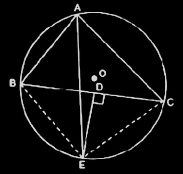
Consider this diagram.

Ncert solutions class 9 chapter 10-41

Here, join BE and CE.

Now, since AE is the bisector of ∠BAC,

∠BAE = ∠CAE

Also,

∴arc BE = arc EC

This implies chord BE = chord EC

Now, consider triangles ΔBDE and ΔCDE.

DE = DE     (It is the common side)

BD = CD     (It is given in the question)

BE = CE      (Already proved)

So, by SSS congruency, ΔBDE ≅ ΔCDE.

Thus, ∴∠BDE = ∠CDE

We know, ∠BDE = ∠CDE = 180°

Or, ∠BDE = ∠CDE = 90°

∴ DE ⊥ BC (Hence, proved).