My Cart
Your Cart 0

    Your cart is empty.

  • Total (Amount) ₹0.00
NCERT · Class 9 · Maths

Chapter 11: Surface Areas and Volumes

Practice each question, then open the answer or worked solution.

Exercise 13.6

8 questions
Q1Written answer

The circumference of the base of the cylindrical vessel is 132cm, and its height is 25cm.

How many litres of water can it hold? (1000 cm3= 1L) (Assume π = 22/7)

Show solutionHide solution
Worked solution

Circumference of the base of cylindrical vessel = 132 cm

Height of vessel, h = 25 cm

Let r be the radius of the cylindrical vessel.

Step 1: Find the radius of the vessel.

We know that the circumference of the base = 2πr, so

2πr = 132 (given)

r = (132/(2 π))

r = 66×7/22 = 21

The radius is 21 cm.

Step 2: Find the volume of the vessel.

Formula: Volume of cylindrical vessel = πr2h

= (22/7)×212×25

= 34650

Therefore, the volume is 34650 cm3

Since 1000 cm3 = 1L

So, Volume = 34650/1000 L= 34.65L

Therefore, the vessel can hold 34.65 litres of water.
Q2Written answer

The inner diameter of a cylindrical wooden pipe is 24cm, and its outer diameter is 28 cm. The length of the pipe is 35cm. Find the mass of the pipe, if 1cm3 of wood has a mass of 0.6g. (Assume π = 22/7)

Show solutionHide solution
Worked solution

Inner radius of cylindrical pipe, say r1 = diameter1/ 2 = 24/2 cm = 12cm

Outer radius of cylindrical pipe, say r2 = diameter2/ 2 = 28/2 cm = 14 cm

Height of pipe, h = Length of pipe = 35cm

Now, the Volume of pipe = π(r22-r12)h cm3

Substitute the values.

Volume of pipe = 110×52 cm3 = 5720 cm3

Since Mass of 1 cm3 wood = 0.6 g

Mass of 5720 cm3 wood = (5720×0.6) g = 3432 g or 3.432 kg.

Q3Written answer

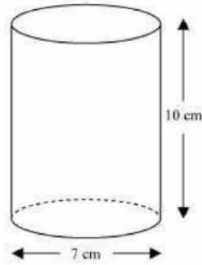
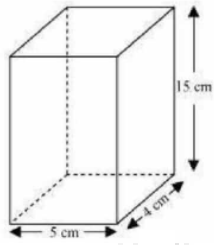
A soft drink is available in two packs – (i) a tin can with a rectangular base of length 5cm and width 4cm, having a height of 15 cm and (ii) a plastic cylinder with a circular base of diameter 7cm and height 10cm. Which container has greater capacity, and by how much? (Assume π=22/7)

Show solutionHide solution
Worked solution

(i) Tin can will be cuboidal in shape.

Ncert solutions class 9 chapter 13-8

Dimensions of the tin can are

Length, l = 5 cm

Breadth, b = 4 cm

Height, h = 15 cm

Capacity of tin can = l×b×h= (5×4×15) cm3 = 300 cm3

(ii) Plastic cylinder will be cylindrical in shape.

Ncert solutions class 9 chapter 13-9

Dimensions of the plastic can are

Radius of the circular end of plastic cylinder, r = 3.5cm

Height , H = 10 cm

Capacity of the plastic cylinder = πr2H

Capacity of the plastic cylinder = (22/7)×(3.5)2×10 = 385

Capacity of the plastic cylinder is 385 cm3

From the results of (i) and (ii), the plastic cylinder has more capacity.

Difference in capacity = (385-300) cm3 = 85cm3

Q4Written answer

If the lateral surface of a cylinder is 94.2cm2 and its height is 5cm, then find

(i) radius of its base (ii) its volume.[Use π= 3.14]

Show solutionHide solution
Worked solution

CSA of cylinder = 94.2 cm2

Height of cylinder, h = 5cm

(i) Let the radius of the cylinder be r.

Using the CSA of the cylinder, we get

2πrh = 94.2

2×3.14×r×5 = 94.2

r = 3

The radius is 3 cm.

(ii) Volume of cylinder

The formula for the volume of the cylinder = πr2h

Now, πr2h = (3.14×(3)2×5) (using the value of r from (i))

= 141.3

Volume is 141.3 cm3

Q5Written answer

It costs Rs 2200 to paint the inner curved surface of a cylindrical vessel 10m deep. If the cost of painting is at the rate of Rs 20 per m2, find

(i) inner curved surface area of the vessel

(ii) radius of the base

(iii) capacity of the vessel

(Assume π = 22/7)

Show solutionHide solution
Worked solution

(i) Rs 20 is the cost of painting 1 m2 area.

Rs 1 is the cost to paint 1/20 m2 area.

So, Rs 2200 is the cost of painting = (1/20×2200) m2

= 110 m2 area

The inner surface area of the vessel is 110m2.

(ii) Radius of the base of the vessel, let us say r.

Height (h) = 10 m and

Surface area formula = 2πrh

Using the result of (i),

2πrh = 110 m2

2×22/7×r×10 = 110

r = 1.75

The radius is 1.75 m.

(iii) Volume of vessel formula = πr2h

Here r = 1.75 and h = 10

Volume = (22/7)×(1.75)2×10 = 96.25

The volume of vessel is 96.25 m3

Therefore, the capacity of the vessel is 96.25 m3 or 96250 litres.

Q6Written answer

The capacity of a closed cylindrical vessel of height 1m is 15.4 litres. How many square metres of the metal sheet would be needed to make it? (Assume π = 22/7)

Show solutionHide solution
Worked solution

Height of cylindrical vessel, h = 1 m

Capacity of cylindrical vessel = 15.4 litres = 0.0154 m3

Let r be the radius of the circular end.

Now,

Capacity of cylindrical vessel = (22/7)×r2×1 = 0.0154

After simplifying, we get r = 0.07 m

Again, the total surface area of the vessel = 2πr(r+h)

= 2×22/7×0.07(0.07+1)

= 0.44×1.07

= 0.4708

Total surface area of the vessel is 0.4708 m2

Therefore, 0.4708 m2 of the metal sheet would be required to make the cylindrical vessel.

Q7Written answer

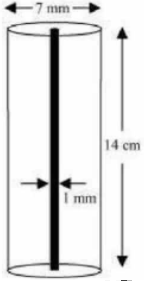
A lead pencil consists of a cylinder of wood with a solid cylinder of graphite filled in the interior. The diameter of the pencil is 7 mm, and the diameter of the graphite is 1 mm. If the length of the pencil is 14 cm, find the volume of the wood and that of the graphite. (Assume π = 22/7)

Show solutionHide solution
Worked solution

Ncert solutions class 9 chapter 13-10

Radius of pencil, r1 = 7/2 mm = 0.7/2 cm = 0.35 cm

Radius of graphite, r2 = 1/2 mm = 0.1/2 cm = 0.05 cm

Height of pencil, h = 14 cm

Formula to find the volume of wood in pencil = (r12-r22)h cubic units

Substituting values, we have,

= [(22/7)×(0.352-0.052)×14]

= 44×0.12

= 5.28

This implies that the volume of wood in pencil = 5.28 cm3

Again,

Volume of graphite = r22h cubic units

Substituting the values, we have,

= (22/7)×0.052×14

= 44×0.0025

= 0.11

So, the volume of graphite is 0.11 cm3.

Q8Written answer

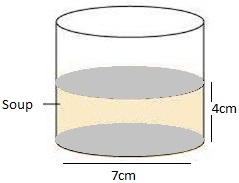
A patient in a hospital is given soup daily in a cylindrical bowl of diameter 7cm. If the bowl is filled with soup to a height of 4cm, how much soup the hospital has to prepare daily to serve 250 patients? (Assume π = 22/7)

Show solutionHide solution
Worked solution

Diameter of the cylindrical bowl = 7 cm

Radius of the cylindrical bowl, r = 7/2 cm = 3.5 cm

Bowl is filled with soup to a height of4cm, so h = 4 cm

Ncert solutions class 9 chapter 13-11

Volume of the soup in one bowl= πr2h

(22/7)×3.52×4 = 154

Volume of the soup in one bowl is 154 cm3

Therefore,

Volume of the soup given to 250 patients = (250×154) cm3= 38500 cm3

= 38.5litres.