My Cart
Your Cart 0

    Your cart is empty.

  • Total (Amount) ₹0.00
NCERT · Class 9 · Maths

Chapter 11: Surface Areas and Volumes

Practice each question, then open the answer or worked solution.

Exercise 13.2

11 questions
Q1Written answer

The curved surface area of a right circular cylinder of height 14 cm is 88 cm2. Find the diameter of the base of the cylinder (Assume π =22/7 ).

Show solutionHide solution
Worked solution

Height of cylinder, h = 14cm

Let the diameter of the cylinder be d.

The curved surface area of cylinder = 88 cm2

We know that the formula to find the Curved surface area of the cylinder is 2πrh.

So 2πrh =88 cm2 (r is the radius of the base of the cylinder)

2×(22/7)×r×14 = 88 cm2

2r = 2 cm

d =2 cm

Therefore, the diameter of the base of the cylinder is 2 cm.
Q2Written answer

It is required to make a closed cylindrical tank of height 1m and base diameter 140cm from a metal sheet. How many square metres of the sheet are required for the same? Assume π = 22/7

Show solutionHide solution
Worked solution

Let h be the height and r be the radius of a cylindrical tank.

Height of cylindrical tank, h = 1m

Radius = half of diameter = (140/2) cm = 70cm = 0.7m

Area of sheet required = Total surface area of tank = 2πr(r+h) unit square

= [2×(22/7)×0.7(0.7+1)]

= 7.48 square metres

Therefore, 7.48 square metres of the sheet are required.

Q3Written answer

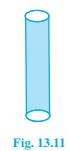
A metal pipe is 77 cm long. The inner diameter of a cross-section is 4 cm, the outer diameter being 4.4cm (see fig. 13.11). Find its

Ncert solutions class 9 chapter 13-3

(i) inner curved surface area

(ii) outer curved surface area

(iii) total surface area

(Assume π=22/7)

Show solutionHide solution
Worked solution

Let r1 and r2 inner and outer radii of the cylindrical pipe.

r1 = 4/2 cm = 2 cm

r2 = 4.4/2 cm = 2.2 cm

Height of cylindrical pipe, h = length of cylindrical pipe = 77 cm

(i) Curved surface area of the outer surface of pipe = 2πr1h

= 2×(22/7)×2×77 cm2

= 968 cm2

(ii) Curved surface area of the outer surface of pipe = 2πr2h

= 2×(22/7)×2.2×77 cm2

= (22×22×2.2) cm2

= 1064.8 cm2

(iii) Total surface area of pipe = inner curved surface area+ outer curved surface area+ area of both circular ends of pipe

= 2r1h+2r2h+2π(r12-r22)

= 9668+1064.8+2×(22/7)×(2.22-22)

= 2031.8+5.28

= 2038.08 cm2

Therefore, the total surface area of the cylindrical pipe is 2038.08 cm2.

Q4Written answer

The diameter of a roller is 84 cm, and its length is 120 cm. It takes 500 complete revolutions to

move once over to level a playground. Find the area of the playground in m2 (Assume π = 22/7).

Show solutionHide solution
Worked solution

A roller is shaped like a cylinder.

Let h be the height of the roller and r be the radius.

h = Length of roller = 120 cm

Radius of the circular end of roller = r = (84/2) cm = 42 cm

Now, CSA of roller = 2πrh

= 2×(22/7)×42×120

= 31680 cm2

Area of field = 500×CSA of roller

= (500×31680) cm2

= 15840000 cm2

= 1584 m2.

Therefore, the area of the playground is 1584 m2.

Q5Written answer

A cylindrical pillar is 50 cm in diameter and 3.5 m in height. Find the cost of painting the curved surface of the pillar at the rate of Rs. 12.50 per m2.

(Assume π = 22/7)

Show solutionHide solution
Worked solution

Let h be the height of a cylindrical pillar and r be the radius.

Given:

Height cylindrical pillar = h = 3.5 m

Radius of the circular end of pillar = r = diameter/2 = 50/2 = 25cm = 0.25m

CSA of pillar = 2πrh

= 2×(22/7)×0.25×3.5

= 5.5 m2

Cost of painting 1 m2 area = Rs. 12.50

Cost of painting 5.5 m2 area = Rs (5.5×12.50)

= Rs.68.75

Therefore, the cost of painting the curved surface of the pillar at the rate of Rs. 12.50 per m2 is Rs 68.75.

Q6Written answer

Curved surface area of a right circular cylinder is 4.4 m2. If the radius of the base of the cylinder is 0.7 m, find its height. (Assume π = 22/7)

Show solutionHide solution
Worked solution

Let h be the height of the circular cylinder and r be the radius.

The radius of the base of the cylinder, r = 0.7m

CSA of cylinder = 2πrh

CSA of cylinder = 4.4m2

Equating both equations, we have

2×(22/7)×0.7×h = 4.4

Or h = 1

Therefore, the height of the cylinder is 1 m.

Q7Written answer

The inner diameter of a circular well is 3.5m. It is 10m deep. Find

(i) its inner curved surface area.

(ii) the cost of plastering this curved surface at the rate of Rs. 40 per m2.

(Assume π = 22/7)

Show solutionHide solution
Worked solution

Inner radius of circular well, r = 3.5/2m = 1.75m

Depth of circular well, say h = 10m

(i) Inner curved surface area = 2πrh

= (2×(22/7 )×1.75×10)

= 110 m2

Therefore, the inner curved surface area of the circular well is 110 m2.

(ii) Cost of plastering 1 m2 area = Rs.40

Cost of plastering 110 m2 area = Rs (110×40)

= Rs.4400

Therefore, the cost of plastering the curved surface of the well is Rs. 4,400.

Q8Written answer

In a hot water heating system, there is a cylindrical pipe of length 28 m and diameter 5 cm. Find the total radiating surface in the system. (Assume π = 22/7)

Show solutionHide solution
Worked solution

Height of cylindrical pipe = Length of cylindrical pipe = 28m

Radius of circular end of pipe = diameter/ 2 = 5/2 cm = 2.5cm = 0.025m

Now, CSA of cylindrical pipe = 2πrh, where r = radius and h = height of the cylinder

= 2×(22/7)×0.025×28 m2

= 4.4m2

The area of the radiating surface of the system is 4.4m2.

Q9Written answer

Find

(i) the lateral or curved surface area of a closed cylindrical petrol storage tank that is 4.2 m in diameter and 4.5m high.

(ii) How much steel was actually used, if 1/12 of the steel actually used was wasted in making the tank? (Assume π = 22/7)

Show solutionHide solution
Worked solution

Height of cylindrical tank, h = 4.5m

Radius of the circular end , r = (4.2/2)m = 2.1m

(i) The lateral or curved surface area of the cylindrical tank is 2πrh.

= 2×(22/7)×2.1×4.5 m2

= (44×0.3×4.5) m2

= 59.4 m2

Therefore, the CSA of the tank is 59.4 m2.

(ii) Total surface area of tank = 2πr(r+h)

= 2×(22/7)×2.1×(2.1+4.5)

= 44×0.3×6.6

= 87.12 m2

Now, Let S m2 steel sheet be actually used in making the tank.

S(1 -1/12) = 87.12 m2

This implies, S = 95.04 m2

Therefore, 95.04m2 steel was used in actuality while making such a tank.

Q10Written answer

In fig. 13.12, you see the frame of a lampshade. It is to be covered with a decorative cloth.

The frame has a base diameter of 20 cm and a height of 30 cm. A margin of 2.5 cm is to be given for folding it over the top and bottom of the frame. Find how much cloth is required to cover the lampshade. (Assume π = 22/7)

Ncert solutions class 9 chapter 13-4

Show solutionHide solution
Worked solution

Say h = height of the frame of the lampshade, which looks like a cylindrical shape.

r = radius

Total height is h = (2.5+30+2.5) cm = 35cm and

r = (20/2) cm = 10cm

Use the curved surface area formula to find the cloth required for covering the lampshade, which is 2πrh.

= (2×(22/7)×10×35) cm2

= 2200 cm2

Hence, 2200 cm2 cloth is required to cover the lampshade.