Write the following in decimal form and say what kind of decimal expansion each has :
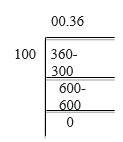
(i) 36/100
Show solutionHide solution

= 0.36 (Terminating)
(ii)1/11
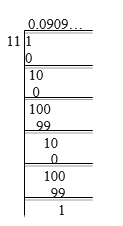


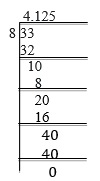
= 4.125 (Terminating)
(iv) 3/13
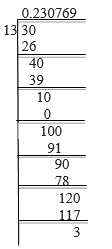

(v) 2/11


(vi) 329/400

= 0.8225 (Terminating)
Your cart is empty.
Practice each question, then open the answer or worked solution.
Write the following in decimal form and say what kind of decimal expansion each has :
(i) 36/100

= 0.36 (Terminating)
(ii)1/11


= 4.125 (Terminating)
(iv) 3/13


(v) 2/11
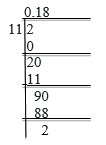

(vi) 329/400
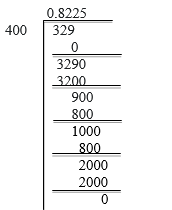
= 0.8225 (Terminating)
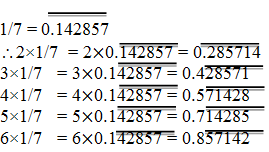
You know that 1/7 = 0.142857. Can you predict what the decimal expansions of 2/7, 3/7, 4/7, 5/7, 6/7 are, without actually doing the long division? If so, how?
[Hint: Study the remainders while finding the value of 1/7 carefully.]

Express the following in the form p/q, where p and q are integers and q 0.
(i) 

Assume that x = 0.666…
Then,10x = 6.666…
10x = 6 + x
9x = 6
x = 2/3
(ii)
= (4/10)+(0.777/10)
Assume that x = 0.777…
Then, 10x = 7.777…
10x = 7 + x
x = 7/9
(4/10)+(0.777../10) = (4/10)+(7/90) ( x = 7/9 and x = 0.777…0.777…/10 = 7/(9×10) = 7/90 )
= (36/90)+(7/90) = 43/90


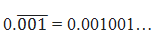
Assume that x = 0.001001…
Then, 1000x = 1.001001…
1000x = 1 + x
999x = 1
x = 1/999
Express 0.99999…. in the form p/q . Are you surprised by your answer? With your teacher and classmates discuss why the answer makes sense.
Assume that x = 0.9999…..Eq (a)
Multiplying both sides by 10,
10x = 9.9999…. Eq. (b)
Eq.(b) – Eq.(a), we get
10x = 9.9999
–x = -0.9999…
_____________
9x = 9
x = 1
The difference between 1 and 0.999999 is 0.000001 which is negligible.
Hence, we can conclude that, 0.999 is too much near 1, therefore, 1 as the answer can be justified.
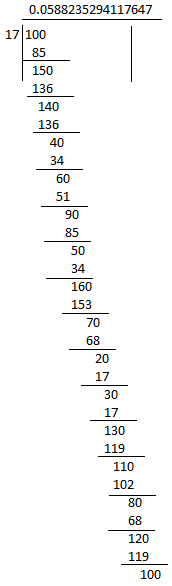
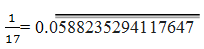
What can the maximum number of digits be in the repeating block of digits in the decimal expansion of 1/17 ? Perform the division to check your answer.
1/17
Dividing 1 by 17:


There are 16 digits in the repeating block of the decimal expansion of 1/17.
Look at several examples of rational numbers in the form p/q (q ≠ 0), where p and q are integers with no common factors other than 1 and having terminating decimal representations (expansions). Can you guess what property q must satisfy?
We observe that when q is 2, 4, 5, 8, 10… Then the decimal expansion is terminating. For example:
1/2 = 0. 5, denominator q = 21
7/8 = 0. 875, denominator q =23
4/5 = 0. 8, denominator q = 51
We can observe that the terminating decimal may be obtained in the situation where prime factorization of the denominator of the given fractions has the power of only 2 or only 5 or both.
Write three numbers whose decimal expansions are non-terminating non-recurring.
We know that all irrational numbers are non-terminating non-recurring. three numbers with decimal expansions that are non-terminating non-recurring are:
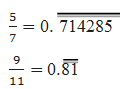
Find three different irrational numbers between the rational numbers 5/7 and 9/11.

Three different irrational numbers are:
Classify the following numbers as rational or irrational according to their type:
(i)√23
√23 = 4.79583152331…
Since the number is non-terminating and non-recurring therefore, it is an irrational number.
(ii)√225
√225 = 15 = 15/1
Since the number can be represented in p/q form, it is a rational number.
(iii) 0.3796
Since the number,0.3796, is terminating, it is a rational number.
(iv) 7.478478
The number,7.478478, is non-terminating but recurring, it is a rational number.
(v) 1.101001000100001…
Since the number,1.101001000100001…, is non-terminating non-repeating (non-recurring), it is an irrational number.