Screw the lid tightly onto the top of the bottle and (shake/shape) well before using the contents.
Show solutionHide solution
1. The site of the accident was ghastly.
2. Our college principal is very strict.
3. I studied continuously for eight hours.
4. The fog had an adverse effect on the traffic.
5. Cezanne, the famous French painter, was a brilliant artist.
6. The book that you gave me yesterday is an extraordinary collage of science fiction and mystery.
7. Our school will host an exhibition on cruelty to animals and wildlife conservation.
8. Screw the lid tightly onto the top of the bottle and shake well before using the contents.
II. Irony is when we say one thing but mean another, usually the opposite of what we say. When someone makes a mistake and you say, “Oh! that was clever!”, that is irony. You’re saying ‘clever‘ to mean ‘not clever’.
Expressions we often use in an ironic fashion are:
• Oh, wasn’t that clever!/Oh that was clever!
• You have been a great help, I must say!
• You’ve got yourself into a lovely mess, haven’t you?
• Oh, very funny!/ How funny!
We use a slightly different tone of voice when we use these words ironically.
Read the play carefully and find the words and expressions Gerrard uses in an ironic way. Then say what these expressions really mean. Two examples have been given below. Write down three more such expressions along with what they really mean.
| What the author says | What he means |
| Why, this is a surprise, Mr—er— | He pretends that the intruder is a social visitor whom he is welcoming.
In this way he hides his fear. |
| At last a sympathetic audience! | He pretends that the intruder wants to listen to him, whereas actually the intruder wants to find out information for his own use. |
| What the author says | What he means |
| You have been so modest. | Gerrard says this to express how immodest the intruder has been by not talking about himself at all. |
| At last a sympathetic audience! | Gerrard says this sarcastically as the intruder is asking about Gerrard while holding a gun. |
| You won’t kill me for a very good reason. | Gerrard says this as if he has some ‘very good reason’ to be spared by the intruder. He says this so as to create a doubt in the intruder about killing him. |
Dictionary Use
A word can mean different things in different contexts. Look at these three sentences:
• The students are taught to respect different cultures.
• The school is organising a cultural show.
• His voice is cultured.
In the first sentence, ‘culture’ (noun) means way of life; in the second, ‘cultural’ (adjective) means connected with art, literature and music; and in the third, ‘cultured’ (verb) means sophisticated, well mannered. Usually a dictionary helps you identify the right meaning by giving you signposts.
Look at the dictionary entry on ‘culture’ from Oxford Advanced Learner’s Dictionary, 2005.
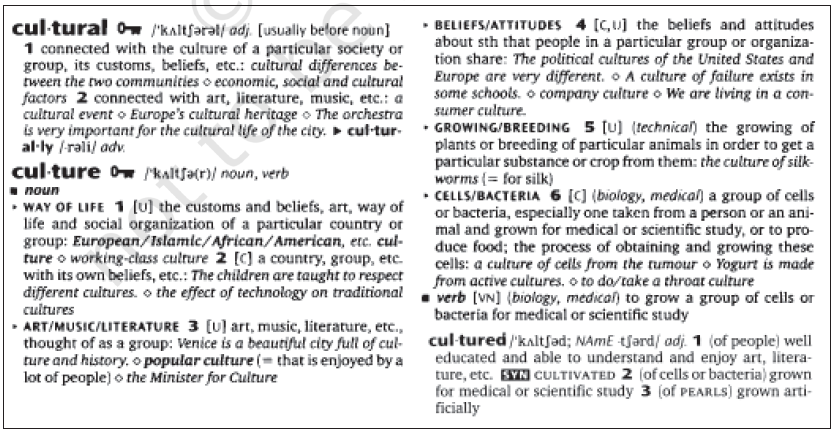
(Noun, verb, adjective, adverb, synonyms, etc. are signposts which help you locate the right meaning and usage, and give information about the part of speech that the word is.)
Look up the dictionary entries for the words sympathy, familiarity, comfort, care, and surprise. Use the information given in the dictionary and complete the table.
| Noun | Adjective | Adverb | Verb | Meaning |
| Sympathy | ||||
| Familiarity | ||||
| Comfort | ||||
| Care | ||||
| Surprise |
| Noun | Adjective | Adverb | Verb | Meaning |
| Sympathy | sympathetic | sympathetically | sympathize | To feel pity for someone |
| Familiarity | familiar | familiarly | familiarize | To know someone/ something |
| Comfort | comfortable | comfortably | comfort | To make someone feel relaxed |
| Care | caring | carefully | care | To be concerned about someone |
| Surprise | surprising | surprisingly | surprise | To amaze someone |